
Ait Ben Haddou, an earthen ksar above the Ounila Valley
Published on 09/19/2026 at 10:04 | Editorial responsibility: Rafael Müller, Editor-in-Chief AD HOC NEWS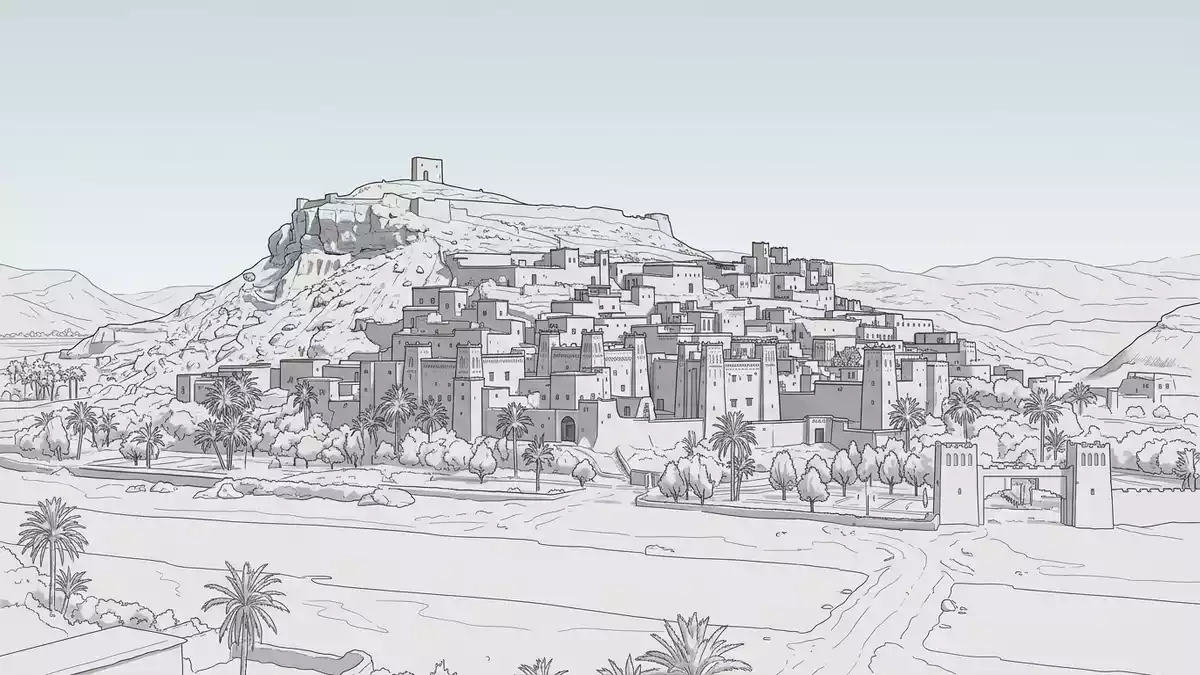
Ait Ben Haddou in southern Morocco is an earthen fortified village that climbs a hillside above the Ounila Valley, with clay houses and towers packed behind defensive walls. Set in Ouarzazate Province on the southern slopes of the High Atlas, it is inscribed as the Ksar of Ait-Ben-Haddou on the UNESCO World Heritage List, recognised for its traditional pre-Saharan earthen architecture and compact urban form since 1987.
An earthen hillside village in the High Atlas foothills
Ait Ben Haddou stands on a low hill beside the Ounila River, a cluster of earthen buildings facing the valley and the distant High Atlas ridges. The ksar is formed from packed earth and clay mixed with local materials, giving its walls and towers a warm, reddish-brown colour that blends with the surrounding slopes.Located in the foothills on the southern slopes of the High Atlas The houses rise in terraces up the hill, with flat roofs and simple openings looking out across the riverbed.
The inhabited area sits within defensive walls reinforced by corner towers, forming what is described as a ksar, a traditional pre-Saharan grouping of clustered dwellings and barns.A fortified village of adobe buildings Narrow lanes weave between the houses, while stepped paths lead towards higher terraces and viewpoints. From the upper levels, the view extends over the Ounila Valley and the road corridor that links this part of Morocco with the larger towns beyond the mountains.
Traditional Maghreb earthen architecture and layout
The architecture of Ait Ben Haddou is part of a wider tradition of earthen construction in the Maghreb, where walls and structural elements are formed from clay and earth shaped into blocks or compacted into formwork.A group of earthen buildings surrounded by high walls Within the walls, dwellings and storage spaces are arranged around internal courtyards, with simple decorative details in the plaster and timber over doorways and parapets.
Many buildings in the ksar take the form of tall earthen structures that resemble towers, giving the hillside a jagged skyline above the valley. Some of these are described as kasbahs within the wider ksar, indicating fortified residences that sit among more modest houses and communal structures.A ksar can contain several kasbahs within its boundaries The use of earth and timber, combined with the compact plan, creates a dense built fabric where shaded passageways and small open spaces alternate as the slope rises.
History, caravan route and World Heritage status
Ait Ben Haddou lies along a former caravan route that linked trading centres south of the Sahara with the imperial city of Marrakesh via the Tizi-n'Telouet pass, and the ksar’s position above the valley reflects this historic role as a stopping place on that corridor.On a former caravan route between the Sahara and Marrakech The settlement is associated with the Ben Haddou tribe, whose name forms part of the toponym, and its architecture reflects the development of southern Moroccan earthen building traditions over several centuries.
The World Heritage Committee inscribed the Ksar of Ait-Ben-Haddou on the UNESCO List in 1987 under cultural criteria that highlight its value as an example of pre-Saharan habitat and southern Moroccan architecture.Inscribed on the World Heritage List in 1987 under cultural criteria (iv) and (v) This recognition emphasises both the form of the ksar, with its earthen walls, corner towers and clustered dwellings, and its relationship to the wider landscape of valleys in the Dra, Todgha, Dadès and Souss regions.
Visiting Ait Ben Haddou: what travellers from Western Europe should know
- Ait Ben Haddou is in Ouarzazate Province in southern Morocco, in the Ounila Valley south of the High Atlas Mountains, reached by road from Ouarzazate and other regional centres.
- The approach to the ksar involves crossing the valley and climbing stepped paths and sloping lanes on the hillside, with uneven earthen surfaces and some narrow passages between buildings.
- The official language is Arabic and the currency is the Moroccan dirham.
- Entry requirements depend on your nationality; UK travellers can check the FCDO travel advice at gov.uk/foreign-travel-advice, Irish travellers the Department of Foreign Affairs at ireland.ie.
Searching for Ait Ben Haddou on social platforms
These links open searches for Ait Ben Haddou on each platform.
Frequently asked questions about Ait Ben Haddou
Where is Ait Ben Haddou located?
Ait Ben Haddou is in Ouarzazate Province in southern Morocco, on the southern slopes of the High Atlas in the Ounila Valley.
What can visitors expect when exploring the ksar?
Visitors encounter a hillside fortified village of earthen houses and towers, accessed by crossing the valley and walking up stepped paths and narrow lanes.
What makes Ait Ben Haddou distinctive among Moroccan sites?
Ait Ben Haddou is distinctive for its compact earthen ksar layout, its position on a historic caravan route and its recognition as a UNESCO World Heritage Site since 1987.


