
Ahramat al-Giza, stone pyramids on the desert edge of Gizeh
Published on 09/14/2026 at 16:29 | Editorial responsibility: Rafael Müller, Editor-in-Chief AD HOC NEWS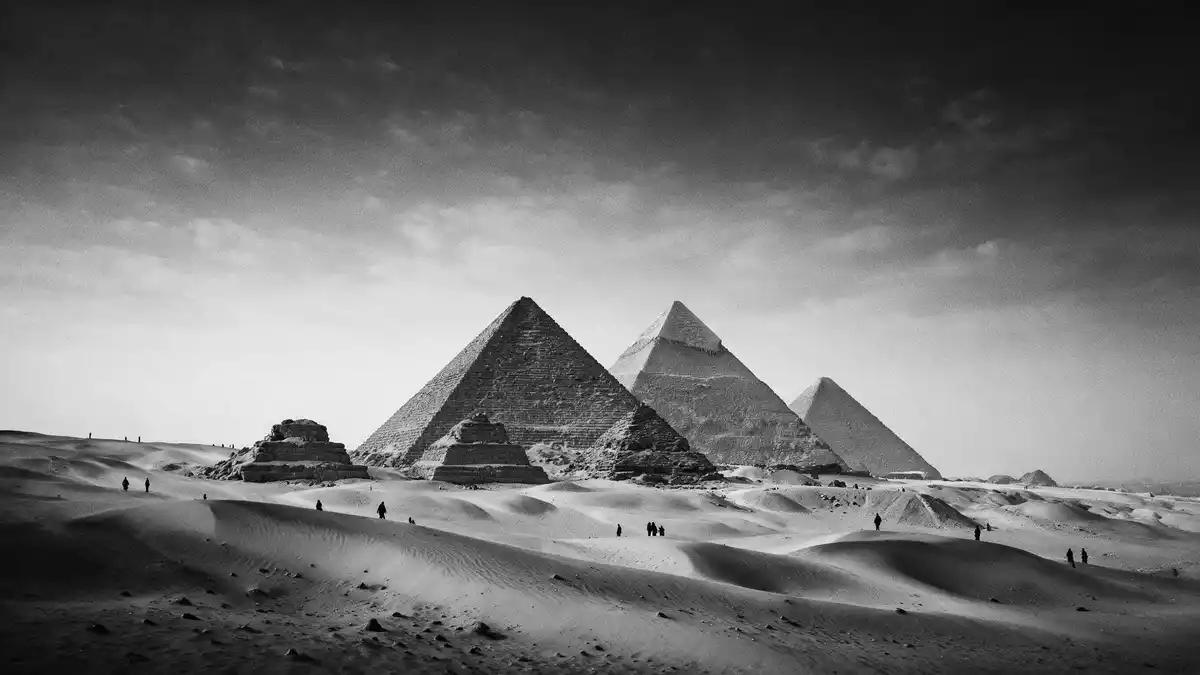
Ahramat al-Giza, known in English as the Pyramids of Giza, forms a concentration of stone pyramids and tombs on the desert plateau west of the Nile at Gizeh in Egypt. On this limestone rise three large royal pyramids from Egypt’s Fourth Dynasty dominate the skyline, with the Great Pyramid of Khufu in particular standing as a landmark of Old Kingdom architecture.
Stone geometry on the Giza Plateau
The core of Ahramat al-Giza is a group of three major pyramids built for the pharaohs Khufu, Khafre and Menkaure in the third millennium BC, each set within its own funerary complex of temples, causeways and subsidiary tombs on the Giza Plateau.Khufu, Khafre and Menkaure The Great Pyramid, raised for Khufu around the middle of the twenty-sixth century BC, originally rose to about 146 m (479 ft), with a square base measuring over 230 m (755 ft) on each side.rises to a height of 146 metres
South-west of Khufu’s monument stands the pyramid of Khafre, slightly smaller in height yet visually prominent because its core sits on higher bedrock and retains a stretch of casing stones near its summit, while farther south the more modest pyramid of Menkaure forms the third large volume on the ridge.the pyramids of Khufu, Khafre and Menkaure Together these structures rise out of the pale plateau rock at the edge of the Nile valley, with their faces aligned to the cardinal directions, giving the site its distinctive profile against the desert.
A necropolis of the Fourth Dynasty
The pyramids at Ahramat al-Giza belong to Egypt’s Fourth Dynasty, an era of royal building traditionally dated to the twenty-sixth century BC, when Old Kingdom rulers invested heavily in monumental tombs along the west bank of the Nile.three 4th-dynasty pyramids The Giza necropolis developed over roughly three generations: Khufu initiated the plateau complex, his son Khafre added his own pyramid and the Great Sphinx nearby, and his grandson Menkaure completed the trio with a smaller pyramid and its associated temples.built over roughly three generations
Ahramat al-Giza forms part of a wider archaeological zone recognised as “Memphis and its Necropolis – the Pyramid Fields from Giza to Dahshur”, inscribed as a UNESCO World Heritage Site in 1979.part of the UNESCO World Heritage Site Within this expanse, the Giza Plateau carries royal pyramids, mastaba tombs for officials, cemeteries and traces of a workers’ village, giving a compact picture of pharaonic funerary practice and the settlement that supported such construction.Giza pyramid complex
Approaching the pyramids and the surrounding desert
Geographically, Ahramat al-Giza stands on the Giza Plateau on the west bank of the Nile opposite the Greater Cairo urban area, with the plateau forming a clear edge where cultivation gives way to desert.a limestone plateau in Giza, Egypt The pyramids and the Great Sphinx occupy the eastern side of this plateau, while open desert stretches to the west, allowing wide views across the pyramid group and back towards the river valley.Giza Plateau - Discover Egypt's Monuments
The site connects with the road network of Greater Cairo, including routes that run out from the city towards the plateau, which mark a transition from dense streets to the more open ground around the pyramids.rise from the desert plateau west of the Nile Within the plateau itself, tracks and paved sections bring visitors close to the bases of the pyramids and towards vantage points in the surrounding desert, where the geometry of Khufu, Khafre and Menkaure aligns in different perspectives.
Visiting Ahramat al-Giza: what travellers from Western Europe should know
- Ahramat al-Giza stands on the Giza Plateau on the west bank of the Nile near Gizeh, reached over the river from central Cairo by road towards the desert edge.
- The ground at the pyramids includes uneven stone, sand and short climbs on foot around the bases, with longer walks required to reach viewpoints in the open desert.
- In Egypt the official language is Arabic and the currency is the Egyptian pound.
- Entry requirements depend on your nationality; UK travellers can check the FCDO travel advice at gov.uk/foreign-travel-advice, Irish travellers the Department of Foreign Affairs at ireland.ie.
Searching for Ahramat al-Giza on social platforms
These links open searches for Ahramat al-Giza on each platform.
Frequently asked questions about Ahramat al-Giza
Where is Ahramat al-Giza located?
Ahramat al-Giza lies on the Giza Plateau on the west bank of the Nile near Gizeh, forming part of the Greater Cairo region in Egypt.
What should visitors expect on a visit?
Visitors encounter large stone pyramids, the Great Sphinx and extensive tomb areas on uneven plateau ground, with walks between monuments and viewpoints in the surrounding desert.
What makes Ahramat al-Giza distinctive among ancient sites?
The concentration of three major Fourth Dynasty pyramids for Khufu, Khafre and Menkaure, together with the Great Sphinx and the wider necropolis, gives Ahramat al-Giza its distinctive character.


