
Ahramat al-Giza: stone geometry on the edge of the Nile
Published on 09/17/2026 at 11:45 | Editorial responsibility: Rafael Müller, Editor-in-Chief AD HOC NEWS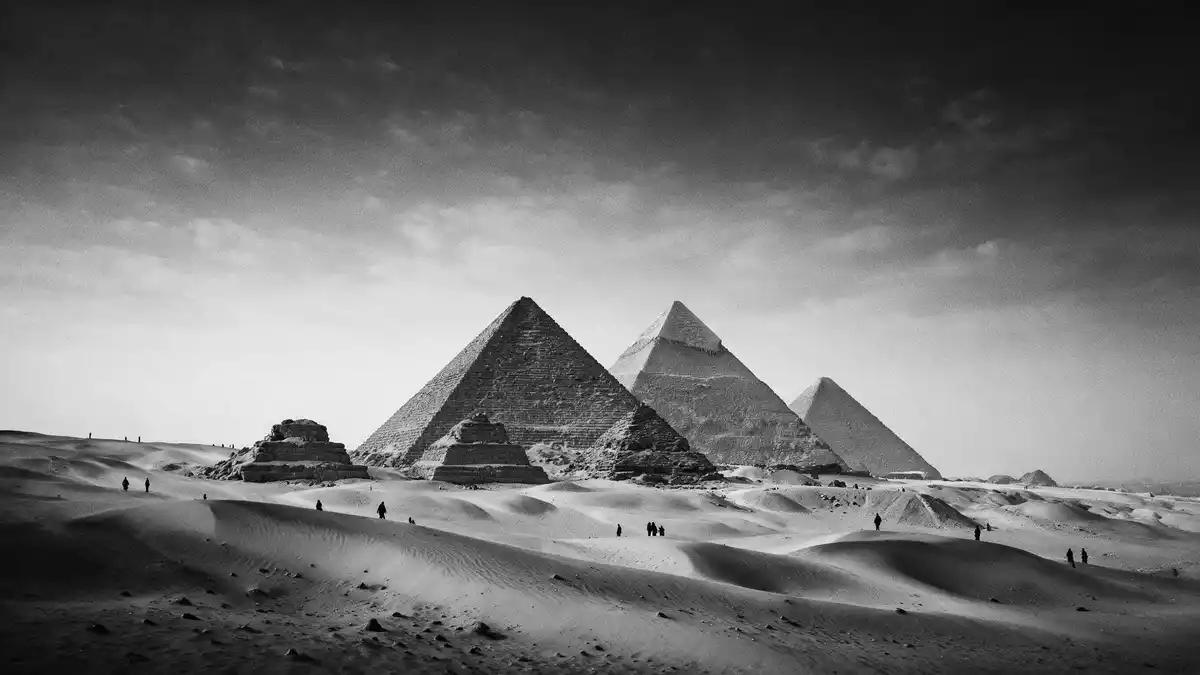
Ahramat al-Giza, better known internationally as the Pyramids of Giza, form a band of monumental stone geometry on the desert plateau west of the Nile at Gizeh. The three main pyramids were built during Egypt’s Fourth Dynasty in the Old Kingdom, creating a funerary landscape that has defined this edge of northern Egypt for more than four millennia.
Stone mountains for Khufu, Khafre and Menkaure
The core of Ahramat al-Giza consists of three royal pyramids for the pharaohs Khufu, Khafre and Menkaure, arranged along the ridge of the Giza Plateau above the river valley. Each of these pyramids belongs to a single generation of rulers in the Fourth Dynasty, with Khufu’s Great Pyramid traditionally dated to the middle of the third millennium BC.Fourth Dynasty pharaohs
The Great Pyramid of Khufu is the largest of the three, originally standing about 147 m (482 ft) tall with a square base clad in polished limestone, and still rising well over 130 m (426 ft) above the plateau.height of the Great Pyramid A short distance to the south-west, the Pyramid of Khafre sits on slightly higher ground, its upper courses retaining traces of casing stone, while Menkaure’s pyramid is markedly smaller but completes the triad of major royal tombs.Khafre and Menkaure pyramids
A desert necropolis at the edge of the Western Desert
The Giza Plateau itself is a limestone rise at the boundary between irrigated Nile land and the Western Desert, giving Ahramat al-Giza a clear horizon above the river plain. The pyramid field forms the northernmost part of a wider necropolis that runs south towards Saqqara and Dahshur, all linked historically to the ancient capital Memphis.Memphis necropolis
The wider Giza pyramid complex covers a protected area of over 16,000 ha, incorporating temples, subsidiary pyramids, mastaba cemeteries and the remains of a workers’ settlement around the base of the plateau.extent of the Giza complex The whole ensemble forms part of the “Memphis and its Necropolis” UNESCO World Heritage Site, inscribed in 1979 for its concentration of Old Kingdom royal tombs and associated monuments.UNESCO inscription
Mortuary architecture and the Great Sphinx
Each of the three principal pyramids at Ahramat al-Giza belongs to a larger mortuary complex with a temple at its base and a stone causeway leading down towards the former floodplain of the Nile. These causeways, some nearly a kilometre long, once connected the plateau to valley temples nearer the cultivated land, tying the desert tombs to the river that sustained the civilisation.causeways and valley temples
Alongside the pyramids stands the Great Sphinx of Giza, carved directly from the bedrock of the plateau near Khafre’s pyramid and forming a colossal guardian figure at the eastern edge of the complex.Great Sphinx location Around the main monuments, smaller queens’ pyramids, boat pits and burial fields in stone and mudbrick record layers of elite and workers’ burials, turning Ahramat al-Giza into a dense archaeological landscape rather than a single set of free-standing structures.satellite pyramids and cemeteries
Visiting Ahramat al-Giza: what travellers from Western Europe should know
- Ahramat al-Giza stand on the Giza Plateau, roughly south-southwest of central Cairo on the west bank of the Nile, reached from the city by road.
- The pyramid field lies on a rocky desert plateau above the green river plain, and walking between monuments involves uneven ground and stretches on foot without shade.
- The interiors of the three main pyramids are accessed through narrow passages and confined chambers, with steep sections that demand sure footing.
- The official language is Arabic and the currency is the Egyptian pound.
- Entry requirements depend on your nationality; UK travellers can check the FCDO travel advice at gov.uk/foreign-travel-advice, Irish travellers the Department of Foreign Affairs at ireland.ie.
Searching for Ahramat al-Giza on social platforms
These links open searches for Ahramat al-Giza on each platform.
Frequently asked questions about Ahramat al-Giza
Where are Ahramat al-Giza located in Egypt?
Ahramat al-Giza stand on the Giza Plateau in Gizeh, on the west bank of the Nile in northern Egypt, southwest of central Cairo.location of Giza
What should visitors expect on a first visit?
Visitors encounter a wide desert plateau dotted with pyramids, the Great Sphinx, temples and burial fields, with approaches on foot over uneven, often sandy ground.layout of the complex
What makes Ahramat al-Giza distinctive among Egyptian sites?
Ahramat al-Giza combine three major Fourth Dynasty royal pyramids, the Great Sphinx and an extensive necropolis within a single plateau, forming the most concentrated Old Kingdom funerary landscape in Egypt.Pyramids of Giza ensemble


