
Ahramat al-Giza: stone geometry on the edge of the Nile
Published on 08/30/2026 at 11:22 | Editorial responsibility: Rafael Müller, Editor-in-Chief AD HOC NEWS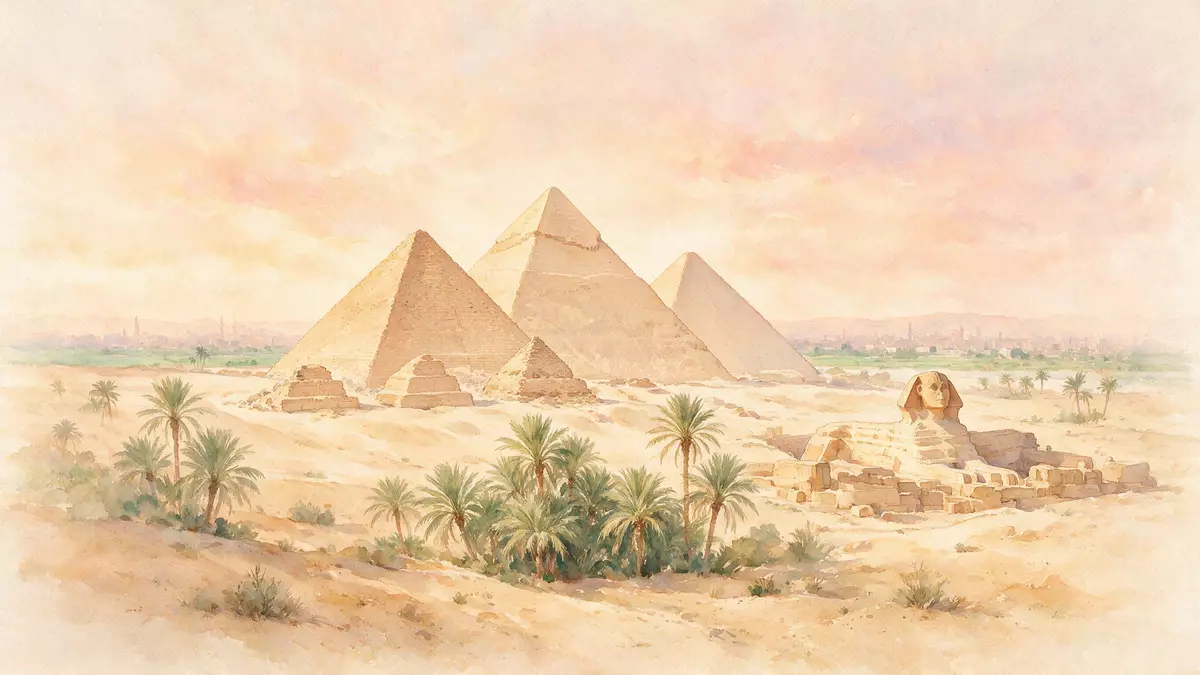
Ahramat al-Giza, known in English as the Pyramids of Giza, form a concentration of ancient stone monuments on the desert plateau west of Gizeh and Cairo. Here the great royal pyramids of the Fourth Dynasty stand above a grid of tombs and temples, a funerary landscape shaped more than four thousand years ago.
The plateau of pyramids and the desert edge
The Giza plateau lies at the boundary between irrigated Nile land and the dry Western Desert, lifted slightly above the river plain but close to the urban fabric of Gizeh and Greater Cairo. The ancient builders chose this limestone rise on the west bank of the Nile, a location that places the pyramids between cultivated fields and open desert, with the river lying to the east.Giza pyramid complex
Across this plateau three major pyramids define the site: the pyramid of Khufu, the pyramid of Khafre and the pyramid of Menkaure, each accompanied by temples and subsidiary structures. Around them stretches a necropolis of mastaba tombs and smaller pyramids for queens and members of the court, laid out in regular lines that give the cemetery a planned grid character.necropolis of the royal family
Khufu’s Great Pyramid and its stone geometry
The Great Pyramid of Khufu dominates Ahramat al-Giza by scale, a colossal stone volume that was completed in the early twenty-fifth century BC for the second king of Egypt’s Fourth Dynasty.built by Khufu When finished, the pyramid rose to a height of about 146 m (around 480 ft), with a square base a little over 230 m (about 750 ft) on each side.height of 146 metres
Each side of the base varies only slightly in length, and the pyramid’s faces align closely to the cardinal directions, giving the structure a precise geometric presence despite its massive bulk.sides and orientation The core of the pyramid consists of rough-hewn local limestone blocks, while the original outer casing was made of carefully cut stones laid in horizontal courses, once forming smooth faces that caught the Egyptian sun.inner core stones and casing
The wider necropolis and the Great Sphinx
Ahramat al-Giza is more than three pyramids: it is a broad funerary landscape with stone causeways, valley temples near the former river edge and subsidiary pyramids aligned with the main monuments.associated pyramid complexes The complex includes the Great Sphinx, carved from the natural limestone bedrock as a monumental figure with a human head and a lion’s body, facing towards the Nile valley.
Beyond the royal tombs, the plateau carries tombs of nobles and officials, cut as mastabas and shafts into the bedrock and built as low rectangular structures above ground. Together these elements form part of the wider World Heritage Site Memphis and its Necropolis, recognised since 1979 for its outstanding testimony to ancient Egyptian civilisation.Memphis and its Necropolis
Visiting Ahramat al-Giza: what travellers from Western Europe should know
- Ahramat al-Giza stand on the Giza plateau south-west of central Cairo, reached from the city by road through Gizeh on the west bank of the Nile.
- The main monuments rise on open desert ground, and approaches involve walking over rough limestone and sand with gentle gradients but little shade.
- The area around the pyramids includes stone steps and uneven surfaces inside historic structures, and access routes can require climbing enclosed passages.
- The official language is Arabic and the currency is the Egyptian pound.
- Entry requirements depend on your nationality; UK travellers can check the FCDO travel advice at gov.uk/foreign-travel-advice, Irish travellers the Department of Foreign Affairs at ireland.ie.
Searching for Ahramat al-Giza on social platforms
These links open searches for Ahramat al-Giza on each platform.Frequently asked questions about Ahramat al-Giza
Where are Ahramat al-Giza located?
Ahramat al-Giza stand on the Giza plateau west of the Nile, within the province of Gizeh on the outskirts of Greater Cairo in Egypt.
What should visitors expect on a visit?
Visitors encounter large stone pyramids, the Great Sphinx, ancient temples and tombs spread across open desert terrain with archaeological remains visible above and below ground.
What makes Ahramat al-Giza distinctive?
The site combines Khufu’s vast pyramid, other royal tombs of the Fourth Dynasty and a planned necropolis, forming part of the Memphis and its Necropolis World Heritage landscape.


