
Ahramat al-Giza: stone geometry on the edge of the desert
Published on 09/19/2026 at 06:14 | Editorial responsibility: Rafael Müller, Editor-in-Chief AD HOC NEWS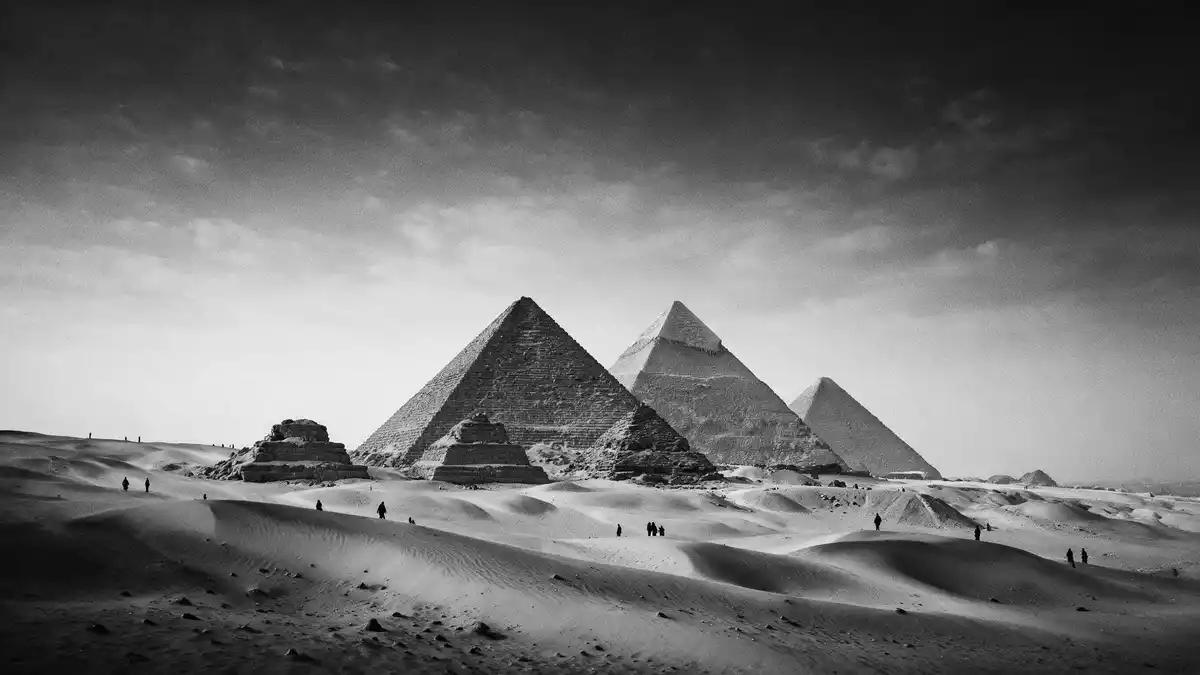
Ahramat al-Giza, known in English as the Pyramids of Giza, forms a vast ancient cemetery west of the Nile where monumental pyramids rise from a limestone plateau above Gizeh. Set within the Pyramid Fields of Memphis and its Necropolis, the complex developed during the fourth dynasty of Egypt’s Old Kingdom and turned this stretch of desert into a landscape of stone geometry aligned with royal power.
The fourth-dynasty pyramid field on the Giza Plateau
The core of Ahramat al-Giza is the Giza pyramid complex, a group of large pyramids, smaller satellite structures and tombs laid out on the Giza Plateau on the outskirts of Cairo. The plateau itself is a natural limestone shelf overlooking the Nile valley, its rocky surface cut and levelled in places to carry massive stone structures that anchor the cemetery to the bedrock.Giza Plateau Here the ancient builders arranged the pyramids of Khufu, Khafre and Menkaure along a roughly north–south line, flanked by causeways, valley temples and subsidiary burials that together form a planned funerary landscape.Giza pyramid complex
The pyramids belong to the Old Kingdom’s fourth dynasty, when kings such as Khufu, Khafre and Menkaure chose this plateau for their royal tombs during the third millennium BC. In that period Egypt’s rulers developed large-scale stone construction on an unprecedented scale, and the necropolis at Gizeh became one of several major burial fields around Memphis, alongside Saqqarah and Dahshur, that were later inscribed together as a UNESCO World Heritage Site under the title “Memphis and its Necropolis”.Memphis and its Necropolis The Arabic name Ahr?m?t al-J?zah reflects this identity: the pyramids of Gizeh on the western bank of the Nile.Arabic name Ahr?m?t al-J?zah
Khufu, Khafre and Menkaure: three great pyramids in stone
The largest pyramid at Ahramat al-Giza is the Great Pyramid of Khufu, built for the second king of Egypt’s fourth dynasty and completed in the early twenty-fifth century BC.Great Pyramid of Khufu At construction the Great Pyramid rose to about 146 m (around 480 ft), with a square base roughly 230 m (about 754 ft) on each side, making it the tallest man-made structure known for many centuries.height and base of the Great Pyramid Erosion and the loss of most of its fine limestone casing have reduced its height, but the stepped mass of core blocks still dominates the northern end of the plateau.
South of Khufu’s pyramid stands the pyramid of Khafre, slightly smaller in absolute height but raised on higher ground and preserving a cap of smooth casing stones at its summit, and further south the more modest pyramid of Menkaure completes the line of three main royal tombs.pyramids of Khafre and Menkaure Each of these pyramids forms part of a larger complex with a mortuary temple at its base, a causeway linking the pyramid to a valley temple nearer the Nile, and subsidiary pyramids and mastaba tombs around it for members of the royal household and high officials.associated pyramid complexes The combined effect is a dense field of stone structures where colossal pyramids rise above a grid of lower, rectangular tombs cut into the plateau.
The wider necropolis: sphinx, temples and workers’ traces
Beneath the pyramids and towards the eastern edge of the plateau, Ahramat al-Giza includes the Great Sphinx of Giza, carved directly from the bedrock near Khafre’s valley temple. The Sphinx, with a lion’s body and a human head, forms part of the same fourth-dynasty setting and watches over a group of temples that frame the entrance from the ancient riverbank into the cemetery.Great Sphinx and valley temples Nearby, pits once holding large wooden boats associated with Khufu’s funerary rituals and long rows of mastaba tombs extend the necropolis beyond the three main pyramids.Khufu ship and mastabas
Archaeological work on the plateau has revealed the remains of a workers’ village and industrial installations, showing how labourers and artisans lived close to the construction site while shaping and placing millions of limestone and granite blocks. The wider Pyramid Fields of Memphis, including sites at Saqqarah, Dahshur, Abu Rawash and Abu Sir, frame Ahramat al-Giza within a long belt of royal cemeteries on the desert edge south of Cairo.Pyramid Fields of Memphis From the plateau the view runs across the city to the Nile, underlining the way this ancient necropolis stands between cultivated river land and open Sahara.
Visiting Ahramat al-Giza: what travellers from Western Europe should know
- Ahramat al-Giza stands on the Giza Plateau on the western side of the Nile opposite central Cairo, reached by road from Gizeh and Greater Cairo.
- The terrain on the plateau is uneven desert ground with stone surfaces and slopes around the pyramids, and movement between monuments involves walking on sandy and rocky paths.
- The necropolis lies in Egypt, where the official language is Arabic and the currency is the Egyptian pound.
- Entry requirements depend on your nationality; UK travellers can check the FCDO travel advice at gov.uk/foreign-travel-advice, Irish travellers the Department of Foreign Affairs at ireland.ie.
Searching for Ahramat al-Giza on social platforms
These links open searches for Ahramat al-Giza on each platform.
Frequently asked questions about Ahramat al-Giza
Where is Ahramat al-Giza located?
Ahramat al-Giza stands on the Giza Plateau west of the Nile in Gizeh, forming part of Greater Cairo in northern Egypt.
What can visitors expect on a visit to Ahramat al-Giza?
Visitors encounter three major pyramids, the Great Sphinx, temples, rock-cut tombs and expansive desert views over the Nile valley and the city.
What makes Ahramat al-Giza distinctive among Egypt’s ancient sites?
The combination of gigantic fourth-dynasty pyramids, associated temples and a wide necropolis on a single plateau gives Ahramat al-Giza a concentration of royal monuments that is rare even within Egypt’s long line of desert cemeteries.


