
Ahramat al-Giza and its three stone pyramids
Published on 09/23/2026 at 21:28 | Editorial responsibility: Rafael Müller, Editor-in-Chief AD HOC NEWS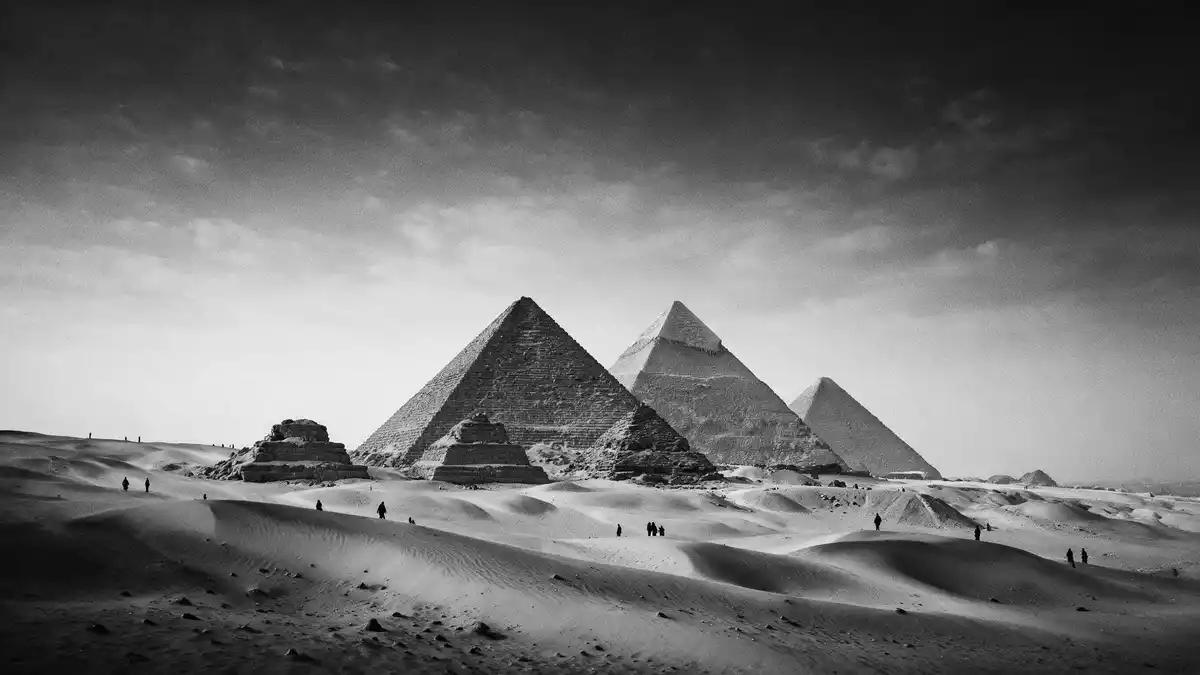
Ahramat al-Giza is a landscape of three royal pyramids on a rocky plateau west of the Nile near Gizeh, Egypt. Their shared geometric form conceals distinct monuments associated with Khufu, Khafre and Menkaure, rulers of the Fourth Dynasty.
Three pyramids, three royal names
The northernmost pyramid belongs to Khufu, also known by the Greek name Cheops. It is the largest and oldest of the three principal pyramids, with a square base whose sides measure about 230 metres (755 ft). Its original height reached about 147 metres (481 ft), although the monument no longer retains its complete outer casing.
The central pyramid was built for Khafre, Khufu’s son and a Fourth-Dynasty king. It originally stood about 143 metres (471 ft) high, and remnants of its smooth limestone casing remain near the summit. Menkaure’s pyramid forms the southern part of the group. It is smaller, with an original height of about 66 metres (218 ft), and includes granite in its lower construction.
The three monuments date from the Old Kingdom, broadly within the twenty-sixth century BC. They were royal tombs within larger funerary complexes, not isolated stone monuments. Each complex included temples, a causeway and subsidiary burial structures connected with royal ritual.
Limestone surfaces and granite chambers
Most of the stone came from the Giza plateau. Fine limestone from Tura formed much of the outer casing, while granite from Aswan appears in selected chambers and architectural elements. Menkaure’s lower courses preserve the clearest association between the smallest pyramid and granite.
The Great Pyramid contains a descending corridor, an ascending passage, the Queen’s Chamber, the Grand Gallery and the King’s Chamber. The burial room is lined with granite. The interior is largely a massive stone core crossed by passages and chambers.
The pyramid’s original casing created smooth, pale outer surfaces. Much of that material disappeared through ancient and medieval stone removal, leaving the stepped courses of the underlying masonry visible across the monument.
Close to Khafre’s valley temple stands the Great Sphinx, carved from limestone bedrock. It has a human face and the body of a reclining lion, measuring about 73 metres (240 ft) from end to end. Its association with Khafre forms part of the wider funerary landscape.
A necropolis beside the Nile valley
Ahramat al-Giza occupies the northern part of the wider Memphis and its Necropolis property. The UNESCO World Heritage designation dates from 1979 and includes ancient sites extending from Giza towards Saqqara and Dahshur.
The plateau places the pyramids above the cultivated Nile valley. Their stone masses, temples, causeways, mastabas and boat pits form a connected archaeological landscape rather than a group of three isolated buildings.
Mastabas surround the principal pyramids in organised fields. These flat-topped tombs served relatives and officials connected with the royal court. Excavations have also revealed work areas, bakeries, storage spaces and modest burials associated with the people who supported the building programme.
The Great Pyramid was the only surviving monument among the traditional Seven Wonders of the Ancient World. Its scale remains legible through the base, the exposed masonry and the internal passages, even though the original summit and casing are gone. The three royal tombs therefore present both preserved form and visible loss.
The name Ahramat al-Giza is the Arabic name associated with the Pyramids of Giza. The complex belongs to ancient Egypt’s Fourth Dynasty, while its formal heritage status places it within a much larger archaeological zone. Its identity rests on the relationship between royal tombs, limestone plateau and Nile-valley setting.
Visiting Ahramat al-Giza: what travellers from Western Europe should know
- Ahramat al-Giza lies west of the Nile beside Gizeh, on the Giza Plateau. Roads from Cairo and Gizeh lead towards the pyramid area.
- The site is rocky and exposed, with uneven ground around the monuments. Interior routes include narrow passages, low sections and steeply inclined corridors.
- The official language is Arabic and the currency is the Egyptian pound.
- Entry requirements depend on your nationality; UK travellers can check the FCDO travel advice at gov.uk/foreign-travel-advice, Irish travellers the Department of Foreign Affairs at ireland.ie.
Searching for Ahramat al-Giza on social platforms
These links open searches for Ahramat al-Giza on each platform.
Frequently asked questions about Ahramat al-Giza
Where is Ahramat al-Giza?
Ahramat al-Giza lies on the west bank of the Nile near Gizeh in northern Egypt. The pyramids occupy the Giza Plateau within the wider Memphis and its Necropolis heritage property.
What can visitors expect at the site?
The landscape includes three principal pyramids, temples, causeways, mastabas and the Great Sphinx. Rocky ground and narrow interior passages form part of the physical character of the visit.
What distinguishes the three pyramids?
Khufu’s pyramid is the largest, Khafre’s retains casing near its summit, and Menkaure’s lower courses include granite. Their different scales and materials make the royal group visually distinct.


