
Addo Elephant National Park’s thicket, coast and elephants
Published on 09/14/2026 at 12:51 | Editorial responsibility: Rafael Müller, Editor-in-Chief AD HOC NEWS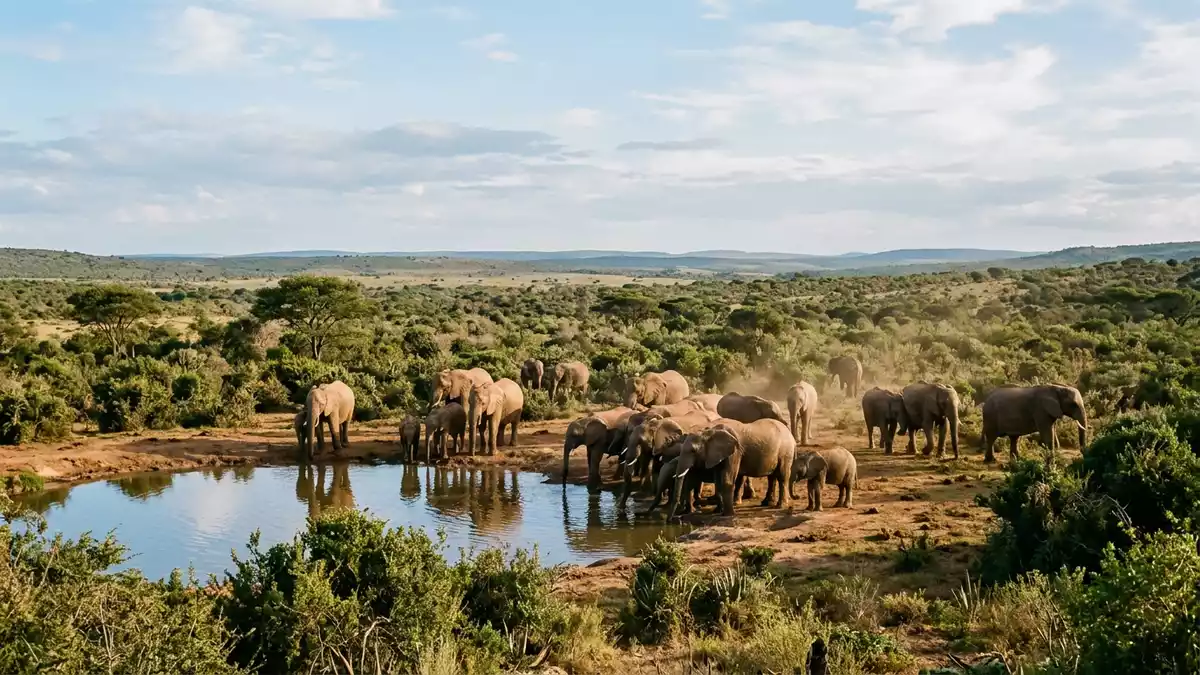
Addo Elephant National Park in South Africa’s Eastern Cape brings elephants, dense thicket, rolling mountains and a long stretch of coast into one protected landscape. Established as a national park in 1931 to safeguard the last surviving elephants in the Sundays River valley, it has grown over the decades into a diverse reserve that reaches from inland Karoo terrain down to Algoa Bay off the Indian Ocean.
From spekboom thicket to a vast protected area
Addo Elephant National Park lies north of Gqeberha, formerly Port Elizabeth, in the Eastern Cape province, with its original core in the Sundays River valley south of the Suurberg range.Eastern Cape location Early accounts describe dense evergreen scrub known locally as Addo bush or spekboom thicket covering the valley floors, a habitat that supported large elephant herds before organised hunting campaigns began in the early twentieth century.Addo’s natural and cultural history
The park was formally proclaimed on 1 August 1931, at first enclosing a relatively small area of a little over 2,000 hectares to protect just eleven surviving elephants that remained in the region.proclaimed in 1931 with eleven elephants Over time its boundaries were extended repeatedly. Figures in official and conservation sources now place the terrestrial park around 1,640 km² (630 sq mi), making it one of South Africa’s larger national parks by area.current park area and designation
Elephants and a wider conservation story
The story that gives Addo Elephant National Park its name is the survival of the elephants of the Eastern Cape. Hunting and conflict with farmers reduced the regional population drastically during the nineteenth and early twentieth centuries, culminating in government-sanctioned culling between 1919 and 1920. By the time the park was proclaimed in 1931, only eleven elephants were left in the valley.remnant elephant population These animals became the founders of a recovering herd that stayed within the fenced reserve.
In the mid-1950s Addo’s manager Graham Armstrong oversaw the construction of an elephant-proof fence using durable materials such as tram rails and lift cables, enclosing an area of about 2,270 hectares and helping to reduce conflict with neighbouring farms.Armstrong fence and early expansion Conservation efforts and habitat protection over subsequent decades allowed the elephant population to grow substantially. The park now holds a large herd viewed as a conservation success, alongside other mammals, birds and reptiles that occupy its thicket, grassland, fynbos and coastal environments.large modern reserve with diverse wildlife
Coast, islands and the Greater Addo landscape
Beyond its original inland core, Addo Elephant National Park has expanded into a broader “Greater Addo” conservation area that links mountains, plains, dunes and sea. The park’s terrestrial sections reach from the Karoo around Darlington Dam through the Zuurberg mountains and down to the coast near the Sundays River Mouth and Woody Cape.extent from Karoo to coast Off shore, a marine protected area in Algoa Bay includes island groups such as St Croix and Bird Island, for which Addo assumes conservation responsibility.marine protected area and island groups
This wider configuration means a visit to Addo Elephant National Park can bring very different landscapes into view on the same trip. Inland, vehicles move through spekboom thicket where elephants, buffalo and antelope browse among shrubs and low trees. Higher up, ridges of the Zuurberg range give long views over the Eastern Cape countryside. Towards the coast, dunes and shoreline habitats form part of the protected area, while offshore islands in Algoa Bay serve as breeding sites for seabirds and marine life that are now managed under the park’s remit.varied biomes from thicket to shoreline
Visiting Addo Elephant National Park: what travellers from Western Europe should know
- Addo Elephant National Park lies north-east of Gqeberha (Port Elizabeth) in South Africa’s Eastern Cape, with main access by road from Addo village and regional highways.
- The terrain in the core game-viewing areas consists of undulating ground and sections of thick thicket; several viewpoints and rest camps are linked by surfaced and unsurfaced roads.
- Beyond the thicket, the Greater Addo area includes mountain sections in the Zuurberg range and coastal dunes near the Sundays River Mouth, so conditions vary between inland heat and exposed coastal wind.
- The official language is Afrikaans and English is widely used; the national currency is the South African rand.
- Entry requirements depend on your nationality; UK travellers can check the FCDO travel advice at gov.uk/foreign-travel-advice, Irish travellers the Department of Foreign Affairs at ireland.ie.
Searching for Addo Elephant National Park on social platforms
These links open searches for Addo Elephant National Park on each platform.
Frequently asked questions about Addo Elephant National Park
Where is Addo Elephant National Park?
Addo Elephant National Park is in South Africa’s Eastern Cape province, north of Gqeberha (Port Elizabeth), with its original core in the Sundays River valley.
What can visitors expect on a visit?
Visitors encounter elephant herds, other wildlife and varied landscapes, from dense spekboom thicket and rolling hills to sections of mountain and protected coastline.
What makes Addo Elephant National Park distinctive?
Addo combines a conservation history rooted in saving eleven elephants in 1931 with a present-day protected area that links inland Karoo, thicket, Zuurberg mountains and marine islands in Algoa Bay.


