
Addo Elephant National Park’s Big Seven wildlife and coastal bushveld
Published on 08/31/2026 at 17:30 | Editorial responsibility: Rafael Müller, Editor-in-Chief AD HOC NEWS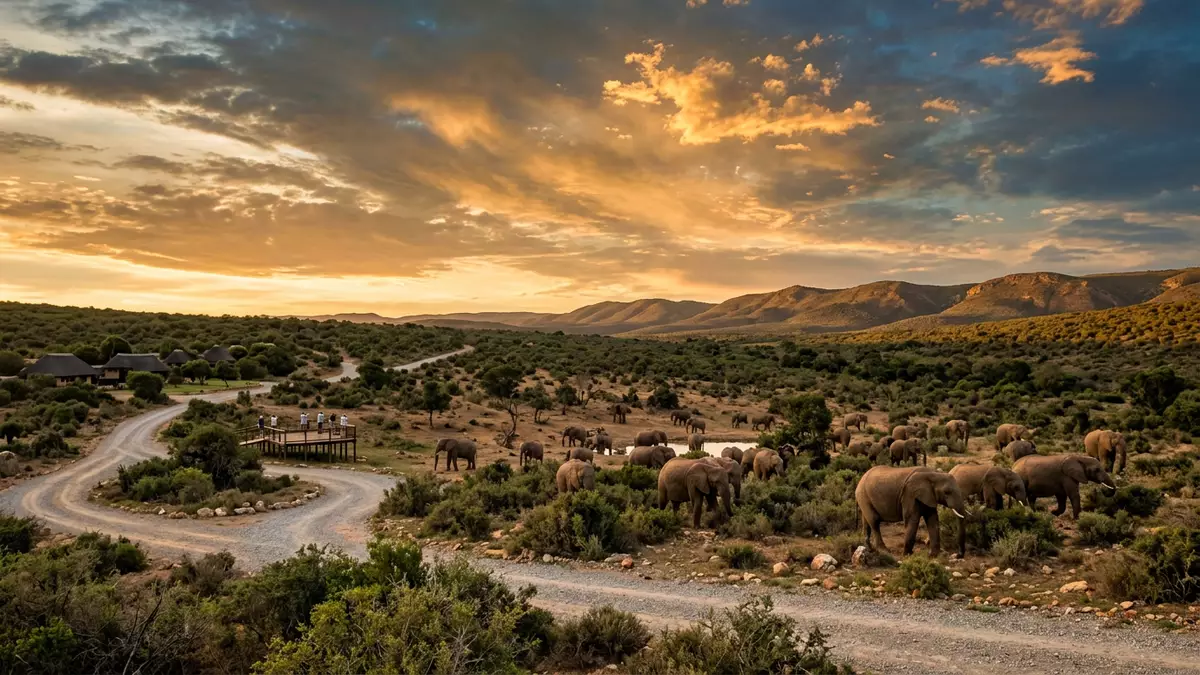
Addo Elephant National Park in South Africa’s Eastern Cape links the dense bushveld around Addo with the islands and waters of Algoa Bay, creating a single protected landscape for elephants, antelope and marine life. Established as a national park in 1931 to safeguard the last surviving Addo elephants, it has grown from a compact sanctuary into an extensive conservation area that reaches from inland valleys to the Indian Ocean.
From embattled elephants to a protected landscape
The story of Addo Elephant National Park begins with conflict between farmers and elephants in the Sundays River valley during the late nineteenth and early twentieth centuries. Hunting and culling campaigns reduced a once extensive elephant population to a remnant group that roamed the dense thicket near Addo.The park was proclaimed in 1931 to protect the remaining elephants, which numbered only 11 at the time.
The original Addo Elephant National Park covered just over 2,000 hectares of scrubby bush, enclosed later in the 1950s by a specially designed elephant-proof fence that used sturdy rails and cables to keep the animals within its boundaries.Conservation thinking at Addo evolved from protecting a single species towards a broader focus on biodiversity, as planners recognised the importance of the wider ecosystem of bush, grassland and coast.
Eastern Cape bush and Algoa Bay islands
Addo Elephant National Park lies north-east of Gqeberha, the city formerly known as Port Elizabeth, in a landscape of rolling hills, valleys and thicket where evergreen shrubs form a low, tangled canopy.The southern section of the park occupies the Sundays River valley south of the Suurberg Range, creating a corridor of protected land between uplands and riverine plains. Over time, additional sections have been added, connected by corridors that extend the habitat available to elephants and other species.
Beyond the inland thicket, the park’s jurisdiction reaches to the Indian Ocean, incorporating islands in Algoa Bay such as St Croix and Bird Islands and the surrounding marine area.The proclamation of the Greater Addo Elephant National Park in 2005 formalised this expansion, linking terrestrial and marine conservation under one protected area that stretches from the Zuurberg Mountains to coastal dunes.
Wildlife, biomes and the “Big Seven”
Addo Elephant National Park is known for its dense elephant population, descended from the small group that survived the culling campaigns of the early twentieth century. Within the enclosed game area, herds move between thicket, open clearings and waterholes, often sharing space with antelope and buffalo. Lions and leopards also occur within the reserve, making Addo one of South Africa’s Big Five destinations.
The park’s reach into Algoa Bay adds a marine dimension to its wildlife. The offshore islands host seabird colonies, while the surrounding waters are recognised habitat for marine species including great white sharks and southern right whales. This combination of land mammals, predators, sharks and whales gives Addo its reputation as a Big Seven destination, a label used to describe places where visitors can encounter the Big Five alongside marine giants.The park encompasses several of South Africa’s biomes, bringing together thicket, grassland, coastal dune systems and marine environments within one protected area.
Visiting Addo Elephant National Park: what travellers from Western Europe should know
- Addo Elephant National Park lies north-east of Gqeberha in South Africa’s Eastern Cape, with park sections close to the town of Addo and road access from the city.
- The terrain in the main game area is undulating, with stretches of dense thicket, gravel roads and lookout points; some viewpoints are reached by short walks on uneven ground.
- The protected area includes both inland bushveld and marine sections of Algoa Bay, so wildlife viewing can range from elephants and antelope to seabirds around offshore islands.
- The official language is Afrikaans and the currency is the South African rand.
- Entry requirements depend on your nationality; UK travellers can check the FCDO travel advice at gov.uk/foreign-travel-advice, Irish travellers the Department of Foreign Affairs at ireland.ie.
Searching for Addo Elephant National Park on social platforms
These links open searches for Addo Elephant National Park on each platform.
Frequently asked questions about Addo Elephant National Park
Where is Addo Elephant National Park located?
Addo Elephant National Park is in South Africa’s Eastern Cape province, north-east of Gqeberha and close to the town of Addo in the Sundays River valley.
What can visitors expect on a visit to Addo Elephant National Park?
Visitors encounter thicket landscapes, gravel game-viewing roads, waterholes and viewpoints, with opportunities to see elephants, other large mammals and, in the marine section, seabirds and marine life.
What makes Addo Elephant National Park distinctive among African parks?
Addo Elephant National Park combines a dense elephant population with a protected marine area in Algoa Bay, offering Big Five wildlife viewing alongside coastal and island ecosystems.


