
Acueducto de Segovia and the Roman stone spine of Segovia
Published on 08/20/2026 at 17:44 | Editorial responsibility: Rafael Müller, Editor-in-Chief AD HOC NEWS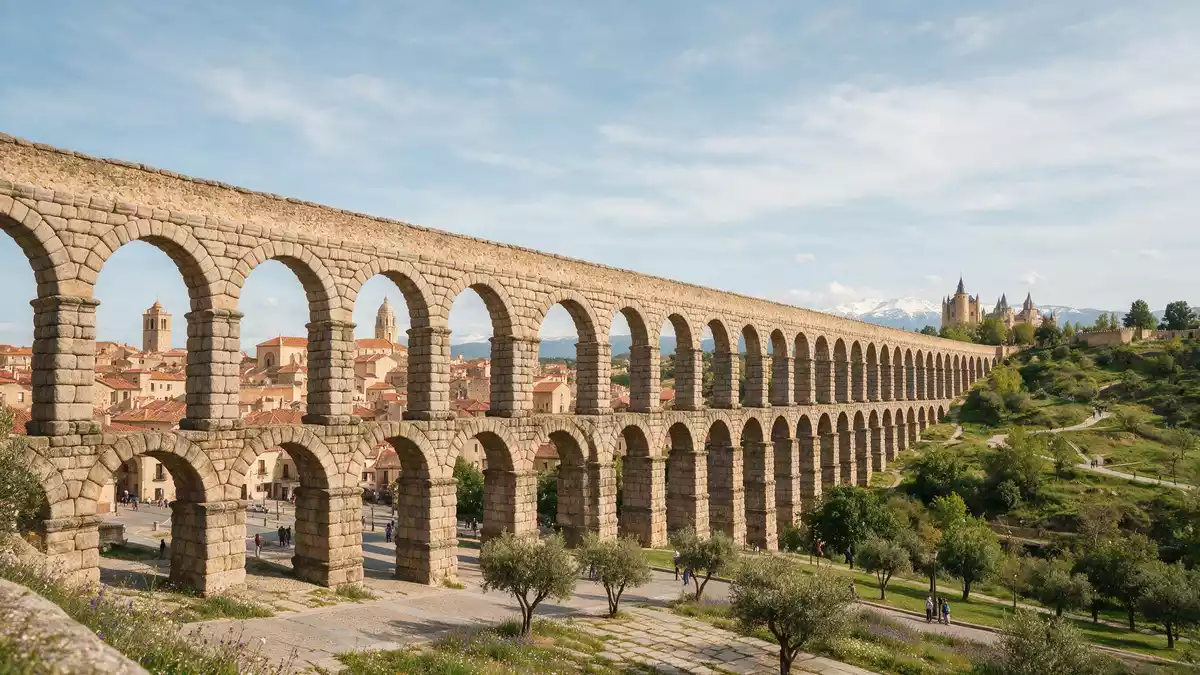
Acueducto de Segovia cuts through the centre of Segovia as a long, stepped line of arches, a Roman waterway turned into the city’s defining stone spine. Built in the early second century AD under the rule of Emperor Trajan, it carried mountain water to Segovia for centuries and still dominates the urban landscape as a monumental piece of masonry.
A Roman structure that became Segovia’s emblem
Acueducto de Segovia is a Roman aqueduct in Spain, constructed to bring water from springs in the Sierra de Guadarrama into the growing settlement of Segovia.Roman aqueduct in Spain The structure dates to the early second century AD and is associated with the reign of Emperor Trajan, whose government oversaw extensive civil engineering works across the empire.early second century AD In Segovia it has taken on a second life as the city’s symbol, appearing on coats of arms and forming the backdrop to everyday streets and squares.
The aqueduct forms part of the Old Town of Segovia and its Aqueduct ensemble inscribed on the UNESCO World Heritage List in 1985, joining the city’s Alcázar and cathedral in a protected group of monuments.Old Town of Segovia and its Aqueduct Long before the UNESCO recognition, it had been declared a national monument in Spain in the nineteenth century, reflecting its status as one of the country’s most important pieces of hydraulic engineering.declared monument in 1884
Stone, arcs and balance: how the aqueduct stands
Architecturally, Acueducto de Segovia is a long masonry construction in granite, set out in straight segments and carried on pillars and arcades.granite and Roman concrete The total hydraulic system runs for more than 16 km (9.9 mi) from the mountains to the city, with the most recognisable urban section forming a high arcade across a valley in Segovia.total length from the mountains Here the structure reaches about 28 m (around 92 ft) above the ground, its blocks locked together without visible mortar in a precise balance of forces.
The visible aqueduct section in the city stretches for more than 800 m (2,625 ft), with a double line of arches borne by over a hundred stone pillars.{1}{2} In this stretch, roughly 160 to 170 arches carry the water channel, creating a repeating rhythm that visitors can trace as it rises from lower single arches to taller, superimposed ones.roughly 167 arches The conduit runs along the top of the structure, enclosed in stonework that protected the water as it crossed streets and open ground before reaching distribution tanks closer to the historic core.
From mountain river to city fountains
The aqueduct’s route begins at the Frío River in the Acebeda valley of the Sierra de Guadarrama, where an intake gathers water and sends it along a gently graded channel towards Segovia.intake on the Frío River Over its full run, the system combines underground sections, bridges and elevated stretches, adjusting to the terrain in order to keep the water flowing. Inside the city it once fed fountains, public baths and private houses, forming a backbone for everyday supply over many generations.fed fountains and baths
The aqueduct carried water into Segovia well into the twentieth century, remaining in service until the 1970s.in use until the mid-twentieth century Over the centuries the intake and parts of the route were altered and repaired as maintenance needs changed, yet the core Roman masonry of the urban arcades stayed remarkably intact.maintenance and later reforms Standing beneath the arches today, visitors see not only an ancient waterworks but also a durable piece of engineering that has been part of Segovia’s infrastructure and identity for roughly two millennia.
Visiting Acueducto de Segovia: what travellers from Western Europe should know
- Acueducto de Segovia stands in central Segovia in Castile and León, north-west of Madrid, with the main arcade crossing Plaza del Azoguejo near the historic core.
- The urban stretch of the aqueduct is approached along paved streets and squares, with level surfaces in some areas and stepped approaches leading to viewpoints beside and above the arches.
- Segovia lies in central Spain, where the official language is Spanish and the currency is the euro (EUR).
Searching for Acueducto de Segovia on social platforms
These links open searches for Acueducto de Segovia on each platform.
Frequently asked questions about Acueducto de Segovia
Where is Acueducto de Segovia located?
Acueducto de Segovia stands in the Spanish city of Segovia in Castile and León, with its main arches crossing a valley near the historic centre.
What can visitors expect when they see the aqueduct?
Visitors encounter a long line of granite arches rising above streets and squares, with vantage points at different levels showing how the structure threads through the city.
What makes Acueducto de Segovia distinctive among Roman works?
Its extended granite arcades, height above the valley and continuous preservation within Segovia’s urban fabric make it a rare example of a Roman aqueduct still standing in a cityscape.


