
Abu Simbel and the mountains reshaped for its temples
Published on 09/19/2026 at 22:43 | Editorial responsibility: Rafael Müller, Editor-in-Chief AD HOC NEWS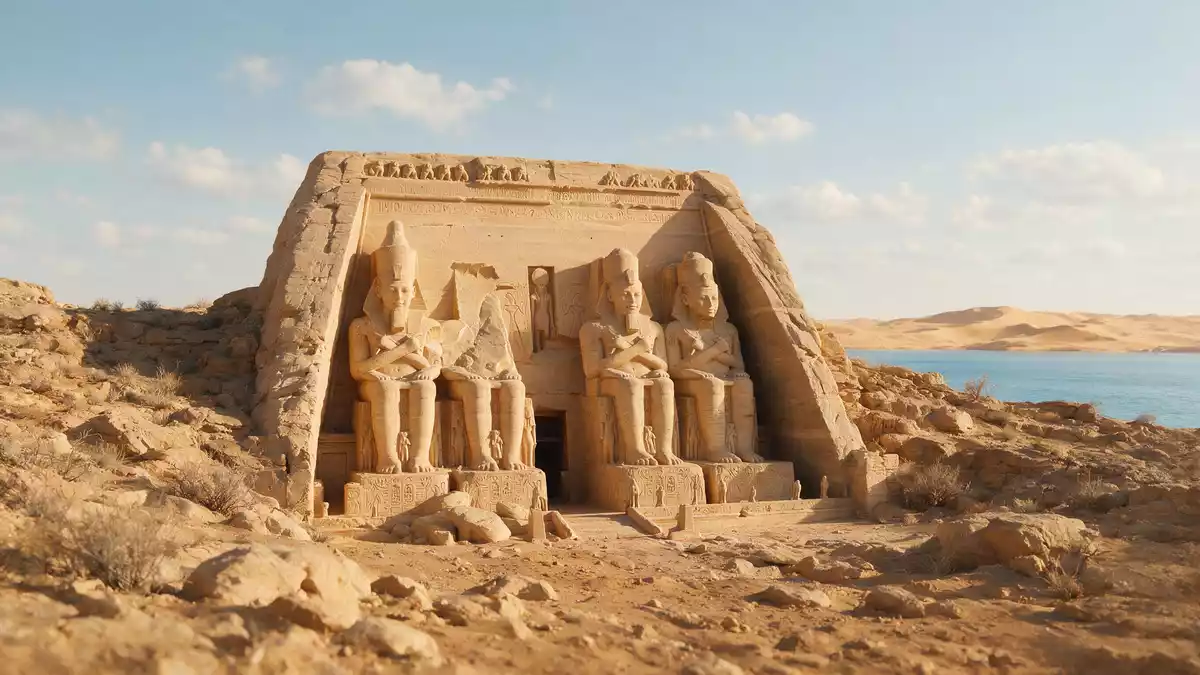
Abu Simbel in southern Egypt is a temple complex where ancient rock-cut sanctuaries of Ramesses II and Nefertari sit inside an artificial mountain shaped in the twentieth century to save them from the Nile. The two temples were carved in the thirteenth century BC during the reign of Ramesses II and later moved piece by piece to higher ground when the Aswan High Dam project threatened to drown their original cliff.
Colossal façades on the shore of Lake Nasser
The setting of Abu Simbel is a stretch of desert in Aswan Governorate close to the border with Sudan, on the western shore of Lake Nasser. At its heart stand two rock-cut temples, the Great Temple of Ramesses II and the smaller temple dedicated to Queen Nefertari, carved from sandstone at the ancient southern frontier of pharaonic Egypt.southern frontier of pharaonic Egypt The façade of the Great Temple presents colossal seated statues of Ramesses II cut directly from the cliff, flanking the entrance and facing out across what is now the reservoir.
These monumental figures rise beside a series of smaller standing statues, carved reliefs and inscriptions that frame the doorway and anchor the temple visually in the rock face. Nearby, the temple of Nefertari has its own façade with standing statues of the queen and the king, giving Abu Simbel a twin-front arrangement of royal imagery in stone.two massive rock-cut temples The desert light and the broad expanse of Lake Nasser set these façades against open sky and water, emphasising their scale.
Interior chambers carved in the thirteenth century BC
Behind the façades, the Great Temple leads into a sequence of halls and chambers that were cut back into the sandstone cliff during the thirteenth century BC, under the rule of Ramesses II of the Nineteenth Dynasty.temples created during the reign of Ramesses II The first hall contains pillars carved in the form of standing figures of the king, with walls covered in reliefs that show military scenes and ritual imagery. Further inside, smaller rooms carry religious scenes, hieroglyphic texts and representations of deities important in New Kingdom Egypt.
The smaller temple of Nefertari is dedicated to the goddess Hathor and to the queen, and its interior repeats the idea of rock-cut halls lined with pillars and carved surfaces. Both sanctuaries were originally cut into a solid sandstone cliff at what was then the second cataract of the Nile, giving the complex a direct relationship with the rivercourse.solid rock cliff at the second cataract Together they form one of the most striking ensembles of royal temple architecture in ancient Nubia.
From cliff to artificial mountain: the relocation story
In the twentieth century, the building of the Aswan High Dam led to the creation of Lake Nasser, a reservoir whose rising waters threatened to submerge Abu Simbel completely.threatened by flooding from Lake Nasser In response, an international rescue campaign coordinated by UNESCO dismantled the temples and reassembled them on nearby higher ground above the future shoreline. Between 1964 and 1968 engineers and workers cut the temples into more than 1,000 numbered blocks, moved them inland and higher in elevation, then rebuilt the interiors under protective concrete structures covered with rock to recreate the form of a cliff.relocated roughly 64 metres higher and 180 metres further inland
These protective structures take the shape of reinforced concrete arches and domes, forming an artificial mountain that conceals the rebuilt temples and gives Abu Simbel its present profile above Lake Nasser. The rescue effort was part of a wider UNESCO Nubia Campaign that safeguarded twenty-two monuments threatened by the reservoir and led to the inclusion of Abu Simbel with Philae and other sites in the World Heritage listing “Nubian Monuments from Abu Simbel to Philae” in 1979.Nubian Monuments from Abu Simbel to Philae Visitors walking around the complex can see the outer slopes of the artificial hill and, beyond them, the broad expanse of the lake that made the relocation necessary.
Visiting Abu Simbel: what travellers from Western Europe should know
- Abu Simbel lies in Aswan Governorate in southern Egypt, close to the border with Sudan, and is reached from the region around Aswan by road or by air via the local airport.
- The site combines a lakeside approach with walking on compact desert surfaces and stairways rising over the artificial hill; access to the interiors involves passages with carved pillars and enclosed chambers.
- The temples stand on the western shore of Lake Nasser, so a visit brings views across the reservoir as well as close encounters with sandstone carvings and monumental façades.
- The official language is Arabic and the currency is the Egyptian pound.
- Entry requirements depend on your nationality; UK travellers can check the FCDO travel advice at gov.uk/foreign-travel-advice, Irish travellers the Department of Foreign Affairs at ireland.ie.
Searching for Abu Simbel on social platforms
These links open searches for Abu Simbel on each platform.
Frequently asked questions about Abu Simbel
Where is Abu Simbel and what kind of place is it?
Abu Simbel is a temple complex in Aswan Governorate in southern Egypt, near the border with Sudan, formed by two rock-cut temples now overlooking Lake Nasser.
What should visitors expect when exploring Abu Simbel?
Visitors encounter monumental sandstone façades with colossal statues, interiors carved with reliefs and hieroglyphs, and an artificial hill that conceals the relocated chambers above the lake shore.
What makes Abu Simbel distinctive among ancient Egyptian sites?
Abu Simbel combines thirteenth-century BC rock-cut temples of Ramesses II and Nefertari with a twentieth-century UNESCO-led relocation that rebuilt them inside an engineered mountain to protect them from inundation.


