
Abu Simbel and the mountains of stone that moved
Published on 09/12/2026 at 19:28 | Editorial responsibility: Rafael Müller, Editor-in-Chief AD HOC NEWS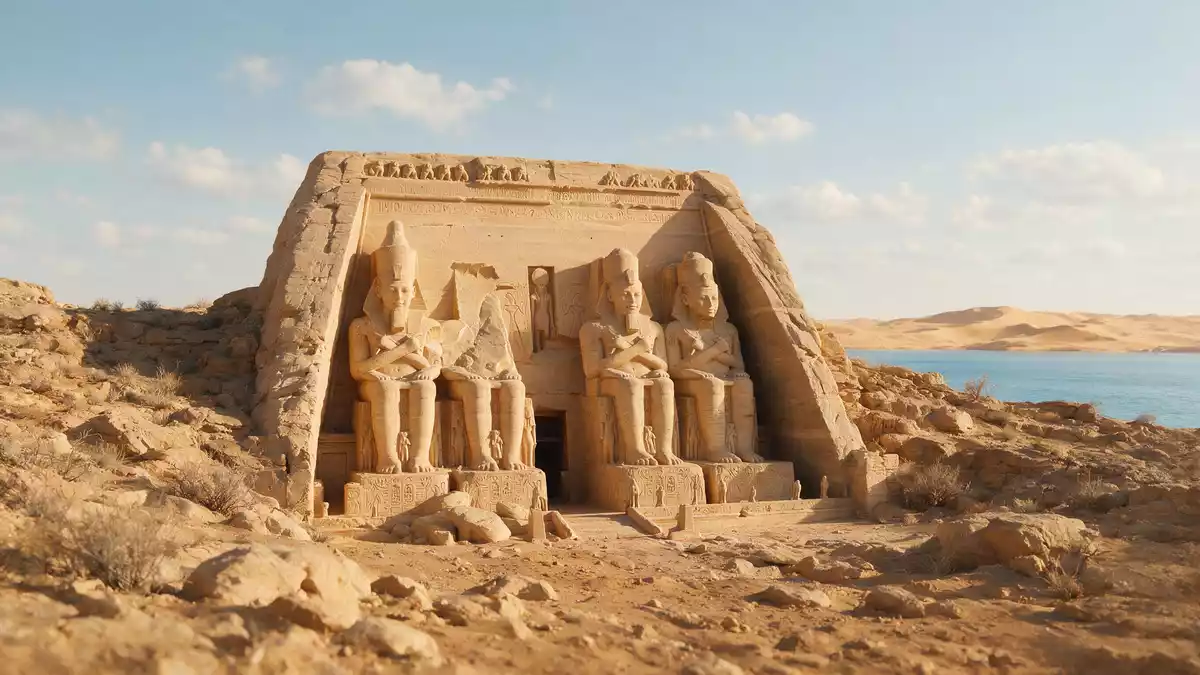
Abu Simbel in southern Egypt is a place where ancient ambition and modern engineering meet in a single sweep of sandstone. On the western shore of Lake Nasser near the Sudanese border, two vast rock-cut temples commissioned by Ramesses II rise from an artificial hill, their façades reassembled block by block after a relocation campaign in the 1960s. The site belongs to the New Kingdom of Egypt and forms part of the UNESCO-listed Nubian Monuments from Abu Simbel to Philae, giving travellers a rare sense of both pharaonic grandeur and international cooperation across millennia.
Ramesses II and his cliff temples in Nubia
Abu Simbel lies in Egypt’s Aswan Governorate in the region historically known as Nubia, facing what was once the southern frontier of pharaonic power.southern Egypt frontier In the thirteenth century BC, during the reign of Ramesses II of the Nineteenth Dynasty, the sandstone cliff above the Nile was carved into two temples: a larger one dedicated to Amun, Ra-Horakhty, Ptah and the deified Ramesses himself, and a smaller one honouring Hathor and his chief wife Nefertari.two massive rock-cut temples The larger “Great Temple” is fronted by four seated colossi of Ramesses II, each around 20 m (66 ft) high, carved directly from the cliff and flanking a single entrance that leads deep into the rock.four colossal statues of Ramesses II
Beneath these colossi stand smaller statues of Nefertari, the king’s mother Mut-Tuy and several of his children, their figures reaching only to the pharaoh’s knees and reinforcing the hierarchy cut into stone.figures around their feet Above, a frieze of baboons raises its arms towards the rising sun, while a niche centred on the façade holds Ra-Horakhty, whose image is combined with hieroglyphs to spell out Ramesses’s throne name. Inside, a hypostyle hall supported by Osirid pillars leads through further chambers to a sanctuary where four seated figures of Ra-Horakhty, Ramesses, Amun Ra and Ptah are carved from the back wall. The smaller “Temple of Hathor and Nefertari”, set nearby, repeats the formula at a different scale: six standing colossi of Ramesses and Nefertari share a façade, an unusual parity in Egyptian art where queens are usually shown much smaller than kings.equal-sized statues of king and queen
Inside the Great Temple: reliefs, alignment and atmosphere
Stepping through the single doorway of the Great Temple leads into a sequence of halls cut deep into the sandstone, extending tens of metres back from the façade.three consecutive halls extending into the cliff The first hypostyle hall is lined with eight Osirid pillars in the form of Ramesses II, their carved bodies attached to the supports and their crowns alternating between symbols of Upper Egypt and the combined realms. The walls carry expansive reliefs of military campaigns, most prominently scenes from the Battle of Kadesh on the Orontes, where chariots, archers and enemy soldiers appear in carefully organised registers.Battle of Kadesh reliefs A second pillared hall, decorated with offering scenes involving sacred boats of Amun and Ra-Horakhty, leads to a transverse vestibule and finally the sanctuary with its four seated gods.
The temple’s long axis carries another layer of design. Twice each year, on dates that fall around 22 February and 22 October, the morning sun reaches into the sanctuary and illuminates three of the four seated figures on the rear wall, leaving Ptah, associated with the realm of the dead, in shadow.sunlight reaching the shrine The effect was noted in the nineteenth century and has become one of the most discussed features of Abu Simbel’s design. The smaller temple echoes the plan of the Great Temple in simplified form: six interior pillars carry Hathoric capitals and reliefs of Nefertari playing the sistrum before Hathor and other deities, while scenes on the walls show Ramesses and his queen offering papyrus plants to the goddess depicted as a cow amid marshes. Together, the two sanctuaries show how theology, royal image and rock-cut architecture were woven into a single composition during the New Kingdom.
Relocating a mountain: the Abu Simbel rescue
The temples that visitors see beside Lake Nasser stand higher and further inland than their original position. In the 1960s, the creation of the Aswan High Dam and its reservoir threatened to submerge the cliff at Abu Simbel under rising water, prompting an international rescue campaign led by UNESCO and Egypt.UNESCO-led relocation Engineers and stonecutters dismantled the Great Temple of Ramesses II and the Small Temple of Hathor and Nefertari, cutting the sandstone into more than a thousand numbered blocks, lifting them away from the original cliff and reassembling them on an artificial plateau. The new site stands roughly 65 m (213 ft) higher than the historic location and more than 200 m (about 660 ft) further inland, protecting the monuments from the waters of Lake Nasser.new site higher and further inland
Above and behind the reassembled façades, reinforced concrete domes support an artificial hill that recreates the impression of temples cut into a natural ridge while ensuring that weight is carried away from the interiors.protective domes and artificial hill The relocation was completed and inaugurated in 1968 and helped prompt the creation of the World Heritage Convention, under which Abu Simbel and other Nubian monuments were formally inscribed on the UNESCO World Heritage List in 1979 as “Nubian Monuments from Abu Simbel to Philae”.World Heritage inscription in 1979 For visitors, the site offers not only pharaonic reliefs and colossal statues, but also a tangible sense of twentieth-century collaboration, where thousands of workers, engineers and archaeologists effectively moved part of a mountain to preserve a pair of temples.
Visiting Abu Simbel: what travellers from Western Europe should know
- Abu Simbel stands in the far south of Egypt near the border with Sudan, on the western shore of Lake Nasser in Aswan Governorate. The nearest major city is Aswan, and Abu Simbel Airport serves the temple area as a domestic hub.
- The terrain around the temples is open desert rock and compacted sand, with broad terraces and several flights of steps linking the lakeside level to the artificial hill in which the temples are set.
- In this part of Egypt the climate is classified as hot desert; temperatures can rise well above 30 °C, and exposed areas around the temples offer little natural shade.
- The official language is Arabic and the currency is the Egyptian pound.
- Entry requirements depend on your nationality; UK travellers can check the FCDO travel advice at gov.uk/foreign-travel-advice, Irish travellers the Department of Foreign Affairs at ireland.ie.
Searching for Abu Simbel on social platforms
These links open searches for Abu Simbel on each platform.
Frequently asked questions about Abu Simbel
Where is Abu Simbel in relation to the Nile and Lake Nasser?
Abu Simbel stands in southern Egypt’s Aswan Governorate on the western shore of Lake Nasser, close to the former course of the Nile and near the Sudanese border.
What should a visitor expect when entering the Great Temple?
Visitors pass four colossal seated statues of Ramesses II before stepping into a sequence of rock-cut halls lined with Osirid pillars and reliefs of royal campaigns leading to a sanctuary of four seated gods.
What makes Abu Simbel distinctive among Egyptian temple sites?
The combination of colossal cliff-cut temples by Ramesses II, the solar alignment in the Great Temple’s sanctuary and the twentieth-century relocation that moved more than a thousand stone blocks to higher ground make Abu Simbel distinctive.


