
Abu Simbel and its rock-cut temples above the Nile
Published on 08/21/2026 at 17:19 | Editorial responsibility: Rafael Müller, Editor-in-Chief AD HOC NEWS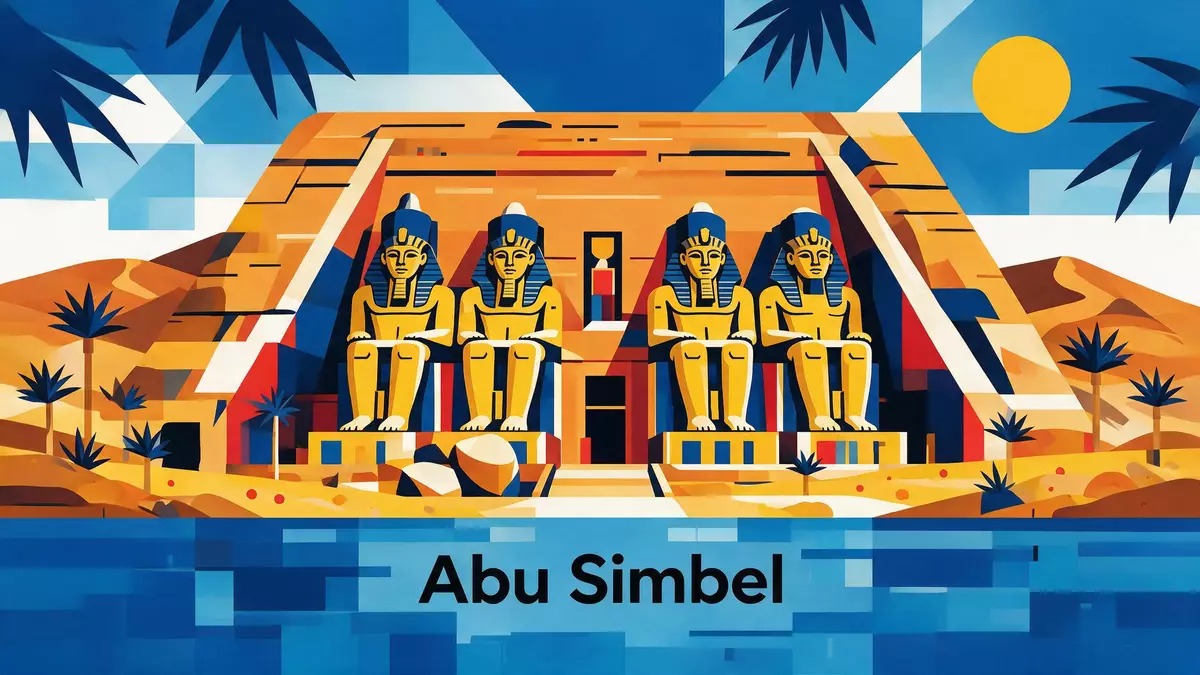
On the western shore of Lake Nasser in southern Egypt, Abu Simbel presents a pair of vast rock-cut temples carved into a sandstone cliff during the reign of Ramesses II in the thirteenth century BC. The complex stands in Nubia within Aswan Governorate, facing the former southern frontier of pharaonic Egypt and the lands of ancient Nubia.
Colossal statues and a cliff turned into architecture
Abu Simbel centres on the Great Temple of Ramesses II, hewn directly from a cliff that once rose above the Nile near the second cataract. Four colossal seated statues of Ramesses II dominate its façade, each rising to around 21 m (69 ft) and flanking the main entrance in pairs.seated colossal statues Their carved crowns, rigid posture and the symmetry of the arrangement turn the cliff face into a monumental gateway that signals the king’s power at the edge of his realm.
The temple interior extends back into the rock as a sequence of halls and side chambers, all cut from the same sandstone mass.ancient temple complex Colossal standing figures of Ramesses II line the main hall, leading towards a sanctuary where four deities sit side by side: Amun Ra, Ra Horakhty, Ptah and a deified Ramesses II himself.sanctuary deities Carved reliefs cover walls and pillars, depicting military campaigns, ritual scenes and offerings, all contained within a space that is still visibly part of the original cliff.
The Small Temple and Queen Nefertari
North of the Great Temple, still cut into the same stretch of sandstone, stands the Small Temple, dedicated to the goddess Hathor and to Ramesses II’s Great Royal Wife, Queen Nefertari.Small Temple for Hathor and Nefertari Its façade carries statues of the king and queen standing together, with the queen shown almost equal in height to the pharaoh, a rare emphasis in ancient Egyptian temple sculpture.
Inside, the Small Temple continues in a more intimate scale, with columns carved in the form of Hathor-headed capitals and walls covered in reliefs showing Nefertari participating in ritual scenes. The dedication of this temple to both Hathor and Nefertari embeds the royal marriage into the sacred landscape of Nubia, pairing divine and human figures in a single rock-cut shrine.Hathor and Nefertari dedication
Dates, dynasties and a relocated cliff
The two temples at Abu Simbel belong to the New Kingdom period and were carved during the nineteenth Dynasty, under Ramesses II, whose reign is generally placed between 1279 and 1213 BC.Ramesses II reign dates Construction of the complex is traditionally dated to the thirteenth century BC, with many sources placing the main phase of building somewhere between 1264 and 1244 BC and estimating around twenty years for the creation of the Great Temple and its companion.twenty-year construction span
The temples stand today not in their original position, but on an artificial hill slightly further inland and higher than the flooded river valley below. Between the 1960s and 1968, the entire cliff-temple complex was carefully cut into large blocks and reassembled above the planned waterline of Lake Nasser, as part of an international campaign connected with the construction of the Aswan High Dam.relocation after Aswan High Dam The relocated site preserves the relation between the two temples and the lake, with the façades still facing towards the broad water surface that now fills the former Nile valley.
Light, alignment and the Nubian Monuments
The orientation of the Great Temple incorporates a striking solar effect. On two days each year, the rising sun sends its light directly along the main axis of the temple into the inner sanctuary, illuminating three of the four seated statues on the back wall while leaving one in shadow.sunlight reaching the sanctuary The alignment links the temple interior with the annual cycle of the sun above the desert horizon.
Abu Simbel forms part of a broader group of monuments recognised as the Nubian Monuments from Abu Simbel to Philae, a serial World Heritage property inscribed by UNESCO in 1979.Nubian Monuments World Heritage Together with the Sanctuary of Isis at Philae and other relocated temples along the former river valley, it illustrates both New Kingdom temple architecture in Nubia and the twentieth-century effort to preserve these sites from inundation by the dam reservoir.
Visiting Abu Simbel: what travellers from Western Europe should know
- Abu Simbel lies in southern Egypt in Aswan Governorate, on the western shore of Lake Nasser near the border with Sudan, reached by road and by air services to the nearby settlement.
- The temples stand on a constructed hill of sandstone and structural material above the former river valley, with approaches that include flights of steps and gently sloping paths over firm ground.
- The wider setting is desert terrain beside the lake, with exposed rock and open views over the water and towards low ridges on the far shore.
- The official language is Arabic and the currency is the Egyptian pound.
- Entry requirements depend on your nationality; UK travellers can check the FCDO travel advice at gov.uk/foreign-travel-advice, Irish travellers the Department of Foreign Affairs at ireland.ie.
Searching for Abu Simbel on social platforms
These links open searches for Abu Simbel on each platform.
Frequently asked questions about Abu Simbel
Where is Abu Simbel and what kind of site is it?
Abu Simbel is an archaeological complex of two rock-cut temples in Nubia in southern Egypt, on the western shore of Lake Nasser within Aswan Governorate.location in Aswan Governorate
What should a visitor expect on a visit to Abu Simbel?
A visit centres on viewing the colossal statues and façades of the Great and Small Temples, then walking through carved halls and chambers cut into the sandstone cliff.
What makes Abu Simbel distinctive among Egyptian temple sites?
Abu Simbel combines two thirteenth-century BC rock-cut temples for Ramesses II and Nefertari, colossal cliff façades, a solar alignment and a complete relocation linked to the Nubian Monuments World Heritage site.Nubian Monuments inscription


