
Abu Simbel and its colossal rock-cut temples
Published on 08/30/2026 at 14:47 | Editorial responsibility: Rafael Müller, Editor-in-Chief AD HOC NEWS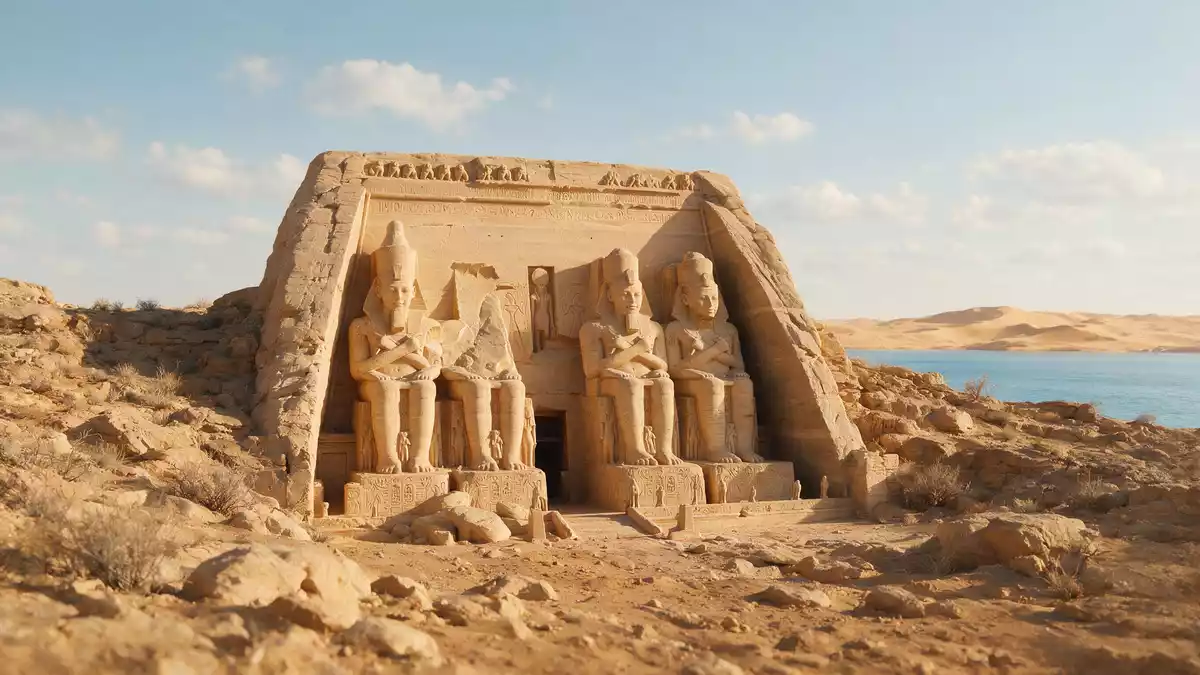
Abu Simbel in southern Egypt is dominated by two colossal rock-cut temples carved into sandstone cliffs above the Nile, presenting a monumental façade of seated figures that emerges directly from the desert rock. The complex belongs to the pharaonic period of the thirteenth century BC and is inseparable from the reign of Ramesses II, whose image and name recur throughout the site.
Colossal façades cut from Nubian sandstone
The historic site at Abu Simbel consists of two temples carved into a sandstone cliff on the western side of the Nile valley in ancient Nubia, close to the present shores of Lake Nasser.sandstone cliff on the west bank The larger sanctuary, widely known as the Great Temple of Ramesses II, is fronted by four colossal statues of the pharaoh seated side by side, their bodies and crowns rising high above visitors approaching the entrance.four colossal statues of Ramesses II
Each of these colossal figures forms part of a single cut rock face, rather than separate masonry blocks, and the façade stretches across the cliff with smaller carved figures, hieroglyphic inscriptions and decorative bands arranged around the main statues.four colossi statues of Ramesses II To one side stands the second sanctuary, often called the temple of Hathor and Nefertari, with a façade of standing statues representing Ramesses II and Queen Nefertari in alternating sequence cut from the same sandstone outcrop.statues of the king and queen Together, the pair of façades form a distinctive ensemble of royal imagery facing the desert and lake.
Ramesses II, Nefertari and the thirteenth century BC
The twin temples of Abu Simbel were carved during the nineteenth Dynasty of Egypt in the thirteenth century BC under Pharaoh Ramesses II, a period often associated with ambitious royal building projects and extensive decoration.thirteenth century BC during the 19th Dynasty The Great Temple is dedicated to a group of state deities of the New Kingdom, including Ra-Horakhty, Amun and Ptah, as well as to Ramesses II himself, whose images appear both as colossal exterior figures and as Osiride statues within the interior halls.dedicated to Ptah Amun-Re and Re-Harakhte
The smaller temple is dedicated to the goddess Hathor, personified by Queen Nefertari, and its façade arranges statues of the king and his chief wife in equal height, an arrangement that highlights her status within the royal household.temple dedicated to Nefertari and Hathor Inside, the halls and chambers are decorated with relief scenes showing rituals, royal processions and episodes from Ramesses II’s military campaigns, including depictions connected with the Battle of Kadesh, carved into the rock surfaces and enhanced by traces of pigment that survive on some walls.painted scenes of his purported victory at the Battle of Kadesh
Relocation above Lake Nasser and World Heritage status
Abu Simbel stands today on high ground above the western shore of Lake Nasser in Aswan Governorate, its position the result of a relocation campaign in the twentieth century that moved the rock-cut temples away from their original cliff to protect them from rising water behind the Aswan High Dam.relocated in its entirety in 1968 The complex forms one of ten components of the serial World Heritage property known as the Nubian Monuments from Abu Simbel to Philae, inscribed on the UNESCO World Heritage List in 1979.Nubian Monuments from Abu Simbel to Philae
Within this grouping, Abu Simbel is identified as a component centred on the relocated rock-cut temples above Lake Nasser, with mapped coordinates recorded by UNESCO that fix its position in the southern part of Egypt.Abu Simbel component coordinates The World Heritage designation links the site to other saved monuments such as Philae, Amada and Wadi es-Sebua along the course of the Nile, making Abu Simbel part of a wider archaeological landscape of Nubian temples and sanctuaries.
Visiting Abu Simbel: what travellers from Western Europe should know
- Abu Simbel lies in Aswan Governorate in southern Egypt, close to the western shore of Lake Nasser and reached from the town of Abu Simbel by road and by flights from other Egyptian cities.
- The temples stand on a rocky artificial hill with broad exterior terraces and stone steps leading up towards the façades, and visitors move through interior halls cut into the sandstone cliff.
- The surrounding landscape combines desert terrain with the waters of Lake Nasser, so exposed approaches between parking areas and the temple terraces cross open ground without shade from trees.
- The official language is Arabic and the currency is the Egyptian pound.
- Entry requirements depend on your nationality; UK travellers can check the FCDO travel advice at gov.uk/foreign-travel-advice, Irish travellers the Department of Foreign Affairs at ireland.ie.
Searching for Abu Simbel on social platforms
These links open searches for Abu Simbel on each platform.
Frequently asked questions about Abu Simbel
Where is Abu Simbel located in Egypt?
Abu Simbel is in Aswan Governorate in southern Egypt, near the border with Sudan and above the western shore of Lake Nasser in the former Nubian region.
What can visitors expect when they enter the temples?
Visitors first encounter the colossal façades with seated and standing royal statues, then move through rock-cut halls decorated with reliefs, carved columns and side chambers leading deeper into the cliff.
What makes Abu Simbel distinctive among ancient Egyptian sites?
The combination of colossal rock-cut statues of Ramesses II, a paired temple complex dedicated to both royal and divine figures, and its inclusion in the Nubian Monuments World Heritage property gives Abu Simbel a distinctive character.


