
Abel Tasman National Park’s golden shorelines from Marahau
Published on 08/24/2026 at 17:07 | Editorial responsibility: Rafael Müller, Editor-in-Chief AD HOC NEWS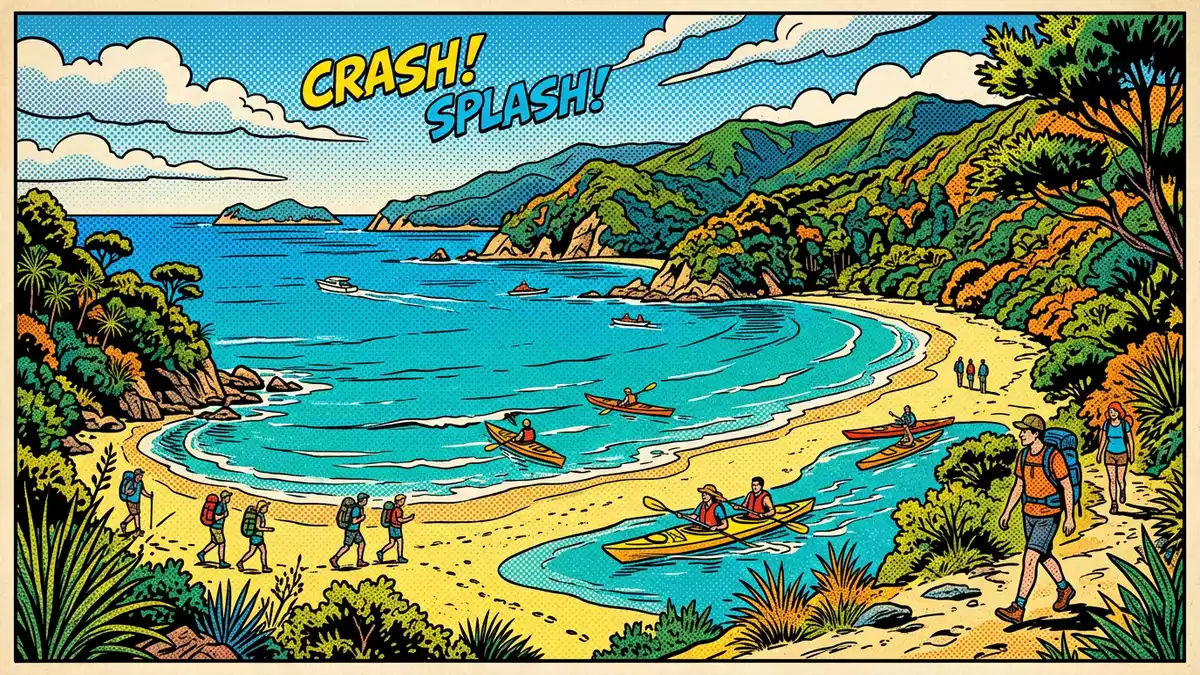
Abel Tasman National Park stretches along the northern edge of New Zealand’s South Island, with the small settlement of Marahau marking its southern landward gateway. Established as a national park in 1942 and named after the Dutch navigator Abel Tasman, it protects a compact coastal landscape where native forest drops towards a succession of sheltered bays and offshore islands.Established in 1942 The coastline here has become closely associated with the Abel Tasman Coast Track, a Great Walk standard route that links Marahau with northern trailheads and gives visitors a continuous line of beaches, headlands and inlets to explore on foot.Abel Tasman Coast Track
Golden beaches and sculpted granite headlands
Abel Tasman National Park is widely recognised for the way its forest-fringed golden beaches alternate with compact granite headlands, creating a coastline that feels both intimate and continuously varied.Renowned for golden beaches and granite cliffs From Marahau northwards, sandy bays such as Anchorage and Bark Bay lie between short promontories of sculptured rock, while small islands sit just offshore in Tasman Bay and Golden Bay, within the park boundary.Islands within the protected area
Much of the park’s interior is covered in regenerating shrubland and mixed forest, with beech and southern rata among the trees recorded in the river valleys.Mixed vegetation from both islands The vegetation has been noted for combining species typical of both the North and South Islands, a pattern that reflects the park’s position on the climatic and biogeographic boundary running through this part of New Zealand. Wildlife includes coastal and marine birds such as shags, gulls and terns along with forest species inland, and terrestrial mammals introduced over earlier centuries now live alongside restored native habitats.
A compact coastal national park
Abel Tasman National Park is the smallest of New Zealand’s national parks by land area, with published figures placing it at just over 22,500 hectares of protected terrain between Golden Bay / Mohua and Tasman Bay / Te Tai-o-Aorere.New Zealand’s smallest national park The protected strip runs inland from the coast for several kilometres, taking in steep hillsides, ridgelines and river catchments as well as the beaches and tidal estuaries most familiar from photographs.
The Abel Tasman Coast Track, one of New Zealand’s recognised Great Walks, runs for about 60 km (37 mi) one way between Marahau in the south and Wainui in the north, with access points at a series of bays.Coast Track length and termini A second, less frequented route, the Abel Tasman Inland Track, crosses the hill country between Tinline Bay and Torrent Bay, providing an alternative perspective on the park’s forest and terrain.Inland Track through the hills Together these tracks give walkers structured ways to experience the park’s compact scale: a continuous coastal line tied closely to beaches and headlands, and a more secluded inland corridor over higher ground.
Marahau as the southern gateway
Marahau stands at the southern end of Abel Tasman National Park and serves as the principal settlement immediately adjacent to the park boundary.Marahau as starting point Here the Coast Track begins by crossing the estuary on a causeway and following gentle gradients through open country and regenerating forest, easing walkers into the sequence of bays that define the southern part of the route.Causeway crossing from Marahau
The park as a whole lies within the Nelson–Tasman region, with Motueka, Kaiteriteri and Takaka named as nearby towns outside the boundary that function as wider access bases.Location at the top of the South Island Offshore, islands such as Tonga Island and Adele Island form part of the protected coastal landscape and contribute to the way the shoreline around Marahau and northwards alternates between enclosed bays, narrow channels and open stretches of Tasman Bay.
Visiting Abel Tasman National Park: what travellers from Western Europe should know
- Abel Tasman National Park sits at the northern end of New Zealand’s South Island between Tasman Bay and Golden Bay, with Marahau as the southern gateway settlement linked by road to regional centres in the Nelson–Tasman area.
- Terrain on the Abel Tasman Coast Track includes sustained sections of undulating path, exposed beaches and headlands, and occasional long staircases on forested slopes, so walking days involve repeated changes in gradient rather than level ground.
- The park is reached overland from Nelson and Motueka by coastal roads, and the shoreline is also served by water-based transport such as boats operating to bays that function as entrances to the Coast Track.
- The official language is English and the currency is the New Zealand dollar.
- Entry requirements depend on your nationality; UK travellers can check the FCDO travel advice at gov.uk/foreign-travel-advice, Irish travellers the Department of Foreign Affairs at ireland.ie.
Searching for Abel Tasman National Park on social platforms
These links open searches for Abel Tasman National Park on each platform.
Frequently asked questions about Abel Tasman National Park
Where is Abel Tasman National Park and how is it linked to Marahau?
Abel Tasman National Park lies at the top of New Zealand’s South Island between Tasman Bay and Golden Bay, with Marahau forming the southern landward gateway and starting point of the Abel Tasman Coast Track.
What can visitors expect on a first visit to the park?
Visitors encounter a compact coastal landscape of forest-fringed golden beaches, granite headlands, tidal estuaries and offshore islands, with established walking tracks providing structured access both along the shore and through the inland hills.
What makes Abel Tasman National Park distinctive among New Zealand’s national parks?
The park combines the country’s smallest national park area with an extended coastal walking route, vegetation that mixes species characteristic of both the North and South Islands, and the close relationship between beaches, islands and hill country around Marahau.


