
Abel Tasman National Park: golden coast and granite cliffs
Published on 09/03/2026 at 22:22 | Editorial responsibility: Rafael Müller, Editor-in-Chief AD HOC NEWS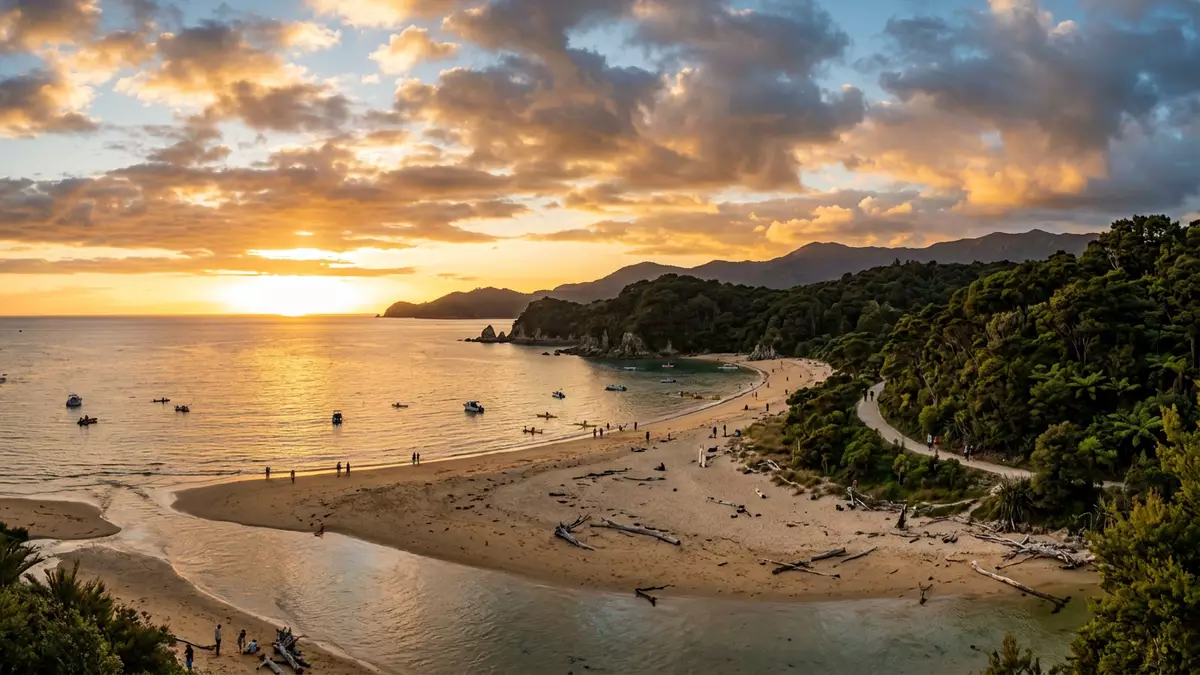
Abel Tasman National Park near Marahau is a narrow coastal landscape of golden beaches, sculptured granite cliffs and forested headlands. Established in 1942, it carries the name of Abel Tasman, the Dutch explorer linked to the first European visit to New Zealand in 1642.
Golden shore and granite edge
The coast gives the park its clearest character. Bays open onto pale sand, while the shore is cut by granite formations that have weathered into wave-worn platforms and rugged outcrops.golden beaches
That meeting of sand, rock and water continues inland in a quieter form. Beech forest, estuaries and sheltered inlets create a sequence of different surfaces within a compact park. The result is a coastal strip that changes texture from one bay to the next.wave-cut platforms
Abel Tasman, 1642 and 1942
The park’s name brings together two dates that frame its history. Abel Tasman passed this coast in 1642, and the national park was established in 1942, a century mark that ties the landscape to both exploration and conservation.
That historical layer sits lightly over the place itself. The coastline, forest and granite still read first as land and sea, not as monument. The name adds a historical thread without changing the terrain visitors see.Abel Tasman
Forest, estuaries and inland ridges
Beyond the shore, the park rises into forest and a more broken interior. Te Ara describes the inland area as reaching to 1,000 metres, with beech forest and a karst zone in the south-west corner.
That contrast matters because the park is not only a beach landscape. Granite gives way to marble in places, streams disappear into sinkholes, and the inland track system crosses a terrain that changes sharply over short distances.karst landscape
Visiting Abel Tasman National Park: what travellers from Western Europe should know
- Marahau is the southern gateway to the park. Roads lead there, and the coast is also reached by launch, water taxi or on foot.
- The Abel Tasman Coast Track follows the shoreline, and the inland track system crosses steeper, forested ground.
- The park sits at the top of the South Island, with Motueka, Takaka and Kaiteriteri named among the nearest towns.
- Boats and kayaks are part of the park’s everyday pattern of movement. Several islands can be reached on the water, while dogs are not allowed in the park.
Searching for Abel Tasman National Park on social platforms
These links open searches for Abel Tasman National Park on each platform.
Frequently asked questions about Abel Tasman National Park
Where is Abel Tasman National Park?
It lies at the top of New Zealand’s South Island, beside Tasman Bay and Golden Bay. Marahau is the southern gateway.
What does a visit involve?
Expect a coastal park shaped by beaches, forest, inlets and rock. Travel is by road to the edges, then by foot, boat, water taxi or kayak.
What makes the park distinctive?
The park combines a granite coast with a forested interior and a long shoreline track. Its name also connects the landscape to Abel Tasman and the year 1942.


