
Abel Tasman National Park and the golden bays of Marahau
Published on 09/16/2026 at 20:56 | Editorial responsibility: Rafael Müller, Editor-in-Chief AD HOC NEWS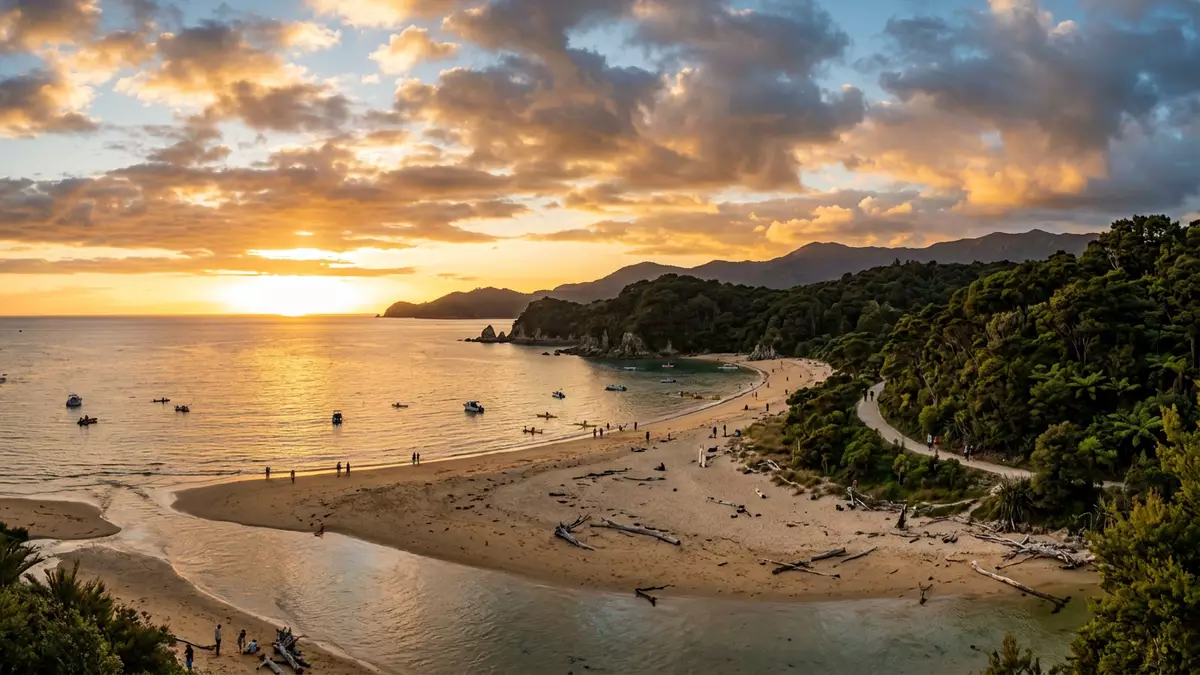
Abel Tasman National Park stretches along the north coast of New Zealand’s South Island, wrapping a series of golden bays and forested headlands between Tasman Bay and Golden Bay. Established in 1942 during the twentieth century, it takes its name from the Dutch explorer Abel Tasman, whose seventeenth-century voyage first brought Europeans to this part of Aotearoa New Zealand. Marahau, a small rural settlement on the coast, forms the southern gateway, where road access ends and the walking tracks and boat routes into the park begin.
Coastline of bays, headlands and clear water
Abel Tasman National Park occupies a strip of land between Golden Bay / Mohua and Tasman Bay / Te Tai-o-Aorere, forming New Zealand’s smallest national park by area.New Zealand’s smallest national park Its defining feature is the indented coastline, where forested hills drop to beaches of fine, pale sand and tidal inlets cut inland behind rocky points. At low tide broad estuaries open out in front of several bays, exposing sand flats and narrow channels, while at high tide clear water laps almost against the forest edge. Offshore, scattered islets and rock outcrops rise from the water, giving many views along the coast layered horizons of headland, island and distant bay.
Behind the shore, the park’s interior climbs through regenerating native forest and pockets of older bush. Beech and k?nuka trees line long stretches of track, joined by other coastal and lowland species adapted to the Tasman climate.beech forest with large k?nuka trees The hills are not extreme in height by alpine standards, but the slopes rise and fall enough to give frequent changes of perspective: views down to sheltered coves, outward to Tasman Bay, and across to the more open coasts beyond. In places the track runs close to the shoreline on terraces above the water, in others it turns inland to cross ridges and gullies before returning to the bays.
The Abel Tasman Coast Track from Marahau
The main way visitors experience Abel Tasman National Park is along the Abel Tasman Coast Track, a long-distance walking route that follows the shoreline between Marahau in the south and Wainui in the north.walking track between Marahau and Wainui The track extends for about 60 km (37 mi), linking bays, estuaries and headlands in a single continuous trail.60 km one-way coastal track Marahau serves as the southern entrance, with a Department of Conservation car park and information point near the start of the trail.
From Marahau the first section of the Coast Track crosses the local estuary on a causeway and then climbs gently through open country into forest. The formed path winds in and out of small gullies, passing above rocky coastline and occasional viewpoints over broad bays. Anchorage Bay, reached after a sustained walk from Marahau, is a characteristic Abel Tasman landscape: sweeping sand, a backdrop of bush-covered slopes and clear water where boats anchor offshore.guide to walking in the Abel Tasman North of Anchorage the track continues through further bays and forest sections, with side tracks to smaller inlets and to viewpoints above the main route.
Marahau as gateway settlement
Marahau lies at the southern edge of Abel Tasman National Park, facing Tasman Bay and backed by rolling farmland and forested hills.Marahau as gateway to the Abel Tasman It is sometimes described as The Abel Tasman Village, reflecting its role as a base for park visits. The settlement consists of houses, small lodges and local businesses spread along the shoreline and surrounding roads rather than concentrated in a single town centre. Its scale is modest, and the landscape remains largely dominated by sea, sand and hills rather than built structures.
Road access approaches Marahau from the direction of Motueka and Nelson, ending close to the park boundary. From there, travellers connect with the coastal environment on foot, by water taxi or by sea kayak, using services that depart from the beach and nearby jetties.main access points Marahau and Kaiteriteri The combination of a small settlement and immediate access to bays, forest and tracks gives Marahau a dual character: both a village with accommodation and services, and a threshold where the road network yields to walking paths and marine routes.
Visiting Abel Tasman National Park: what travellers from Western Europe should know
- Abel Tasman National Park lies on the northern coast of New Zealand’s South Island, with Marahau as a principal southern access point by road.
- The terrain along the Abel Tasman Coast Track includes formed paths, sustained gradients and sections crossing estuaries and headlands, requiring steady walking on varied surfaces.
- Nearby settlements such as Marahau and Kaiteriteri provide bases for exploring the park, linked to the coastal bays by water taxi services and other marine transport.
- The official language is English and the currency is the New Zealand dollar.
- Entry requirements depend on your nationality; UK travellers can check the FCDO travel advice at gov.uk/foreign-travel-advice, Irish travellers the Department of Foreign Affairs at ireland.ie.
Searching for Abel Tasman National Park on social platforms
These links open searches for Abel Tasman National Park on each platform.
Frequently asked questions about Abel Tasman National Park
Where is Abel Tasman National Park in relation to Marahau?
Abel Tasman National Park lies along the northern coast of New Zealand’s South Island, with Marahau at its southern gateway and road access ending near the park boundary.
What should visitors expect on a trip into the park?
Visitors encounter a sequence of forested hills, tidal inlets and golden-sand bays, linked by formed walking tracks and marine transport routes from settlements such as Marahau.
What makes Abel Tasman National Park distinctive among New Zealand parks?
The combination of an extended coastal walking track, sheltered bays and the small gateway village of Marahau gives Abel Tasman National Park a strongly coastal character within New Zealand’s national park system.


