
Abel Tasman National Park: a golden coastline from Marahau
Published on 08/21/2026 at 09:19 | Editorial responsibility: Rafael Müller, Editor-in-Chief AD HOC NEWS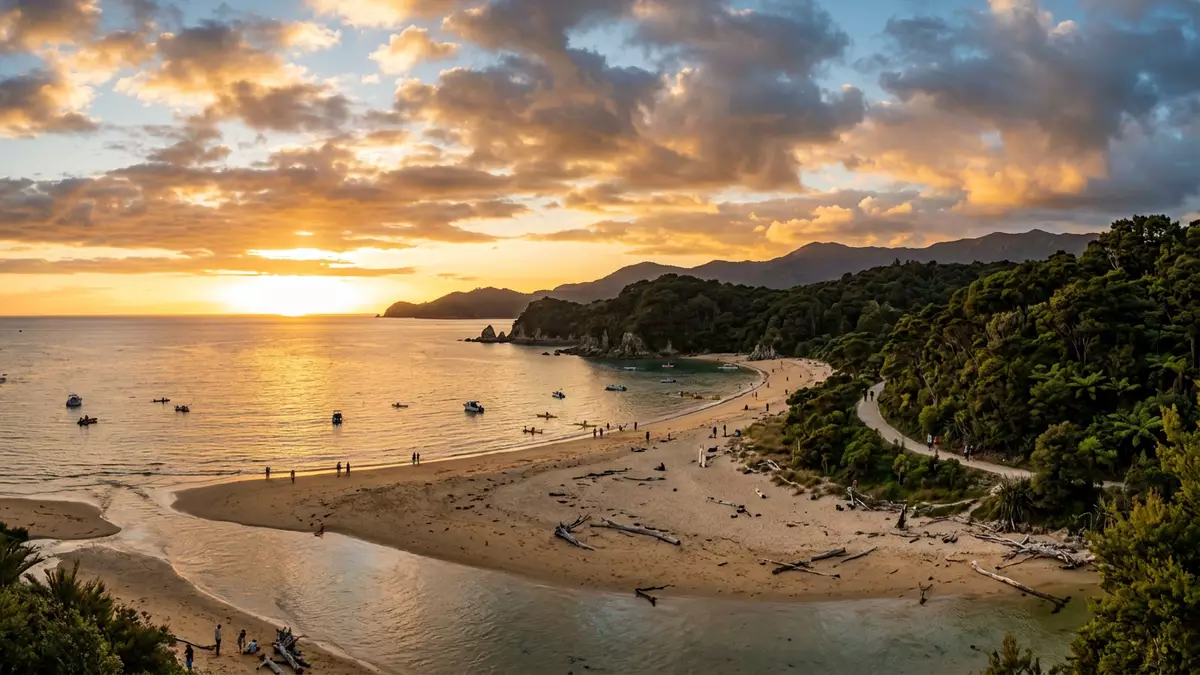
Abel Tasman National Park stretches along the northern coast of New Zealand’s South Island between Tasman Bay and Golden Bay, with the small settlement of Marahau at its southern edge. Established in 1942 and named after the Dutch navigator Abel Tasman, it protects a compact sweep of coastline where jade-green sea, golden sand and regenerating forest meet in a narrow band.
Coastal curves, islands and a compact scale
Seen from a boat leaving Marahau, Abel Tasman National Park appears as a continuous, forested coastline punctuated by a chain of bays, headlands and small offshore islands. The protected area lies between Tasman Bay and Golden Bay and includes islands such as Adele, Tonga and Fisherman, which sit just off the mainland and help to shelter the inshore waters.between Golden Bay and Tasman Bay Although its exact area is stated with minor variations in different sources, all agree that Abel Tasman is New Zealand’s smallest national park by land area, giving it a notably compact scale compared with other national parks in the country.New Zealand’s smallest national park
Inland from the beaches, low ranges such as the Pikikiruna Range rise behind the coast, and much of the park is covered in regenerating shrubland and forest. Descriptions of the vegetation by New Zealand reference works highlight an unusual mixture of species that are characteristic of both the North and South Islands, making the bush a point of interest as much as the shoreline.mixture of North and South Island vegetation Along the shore, estuaries, tidal inlets and sheltered bays create a varied edge between land and sea, with tidal flats in places and steep, forested slopes descending directly to the water in others.
The Abel Tasman Coast Track from Marahau
For many visitors from Western Europe, Abel Tasman National Park is experienced through the Abel Tasman Coast Track, a long-distance walking route that follows the shoreline from Marahau in the south to the Wainui area in the north.Coast Track from Marahau to Wainui The track is recognised nationally as one of New Zealand’s Great Walks and is administered and maintained by the Department of Conservation, which oversees facilities such as huts and designated camping areas along the route.one of New Zealand’s Great Walks Walkers move between a succession of named bays and inlets, with sections of the route passing through forested saddles and others following the margins of estuaries.
The Coast Track has several access points, but Marahau is described in official and tourism material as the southern gateway.Marahau is the southern gateway From here, the route immediately enters national park land and begins to traverse low headlands and beaches, with views back towards Tasman Bay and the hills around Motueka. Inland tracks also exist, reaching higher ground and giving different perspectives on the coastline, but the coast route remains the defining way many people come to know the park’s geography.
Marahau as gateway and shoreline settlement
Marahau itself sits at the southern entrance to Abel Tasman National Park and is widely described in regional tourism information as a gateway village for the coastal section of the park.gateway to the Abel Tasman It lies on the shore of Tasman Bay, and roads reach it from larger centres such as Motueka and Nelson, making it an established land access point. From the settlement, the park boundary is close enough that walking tracks begin near the end of the local road network, and water-based trips depart from the same stretch of coastline.
Regional descriptions emphasise that Marahau is both a rural community and a base for exploring Abel Tasman National Park, with water taxis, small boat services and sea kayak operators using its beach and small harbour facilities.stepping-off point for the park It shares this gateway role with nearby Kaiteriteri, further west along the bay, but Marahau is directly aligned with the start of the Coast Track and is therefore a common starting point for overnight and multi-day journeys into the park.
Visiting Abel Tasman National Park: what travellers from Western Europe should know
- Abel Tasman National Park lies on the northern coast of New Zealand’s South Island between Tasman Bay and Golden Bay, with road access from Nelson and Motueka to Marahau and other coastal settlements.
- The terrain combines coastal walking on firm paths with sections that rise over low headlands and through forest; tidal inlets and estuaries mean that some approaches to beaches involve longer journeys on foot around the bays.
- The park is reached by a mix of land and sea transport, with services such as water taxis and sea kayak trips departing from Marahau and nearby Kaiteriteri.
- The official language is English and the currency is the New Zealand dollar.
- Entry requirements depend on your nationality; UK travellers can check the FCDO travel advice at gov.uk/foreign-travel-advice, Irish travellers the Department of Foreign Affairs at ireland.ie.
Searching for Abel Tasman National Park on social platforms
These links open searches for Abel Tasman National Park on each platform.
Frequently asked questions about Abel Tasman National Park
Where is Abel Tasman National Park and how is it reached?
Abel Tasman National Park is on the northern coast of New Zealand’s South Island between Tasman Bay and Golden Bay, with road and sea access via Marahau and neighbouring coastal settlements.
What can visitors expect on a visit from Marahau?
Visitors beginning at Marahau encounter the southern end of the Abel Tasman Coast Track, a sequence of beaches, headlands and forest sections, with options to travel further along the coast by walking, small boat or sea kayak.
What makes Abel Tasman National Park distinctive among New Zealand’s national parks?
The park combines a compact area with a strongly coastal character, a mixture of vegetation types linked to both main islands of New Zealand and easy access from Marahau and other nearby settlements.


