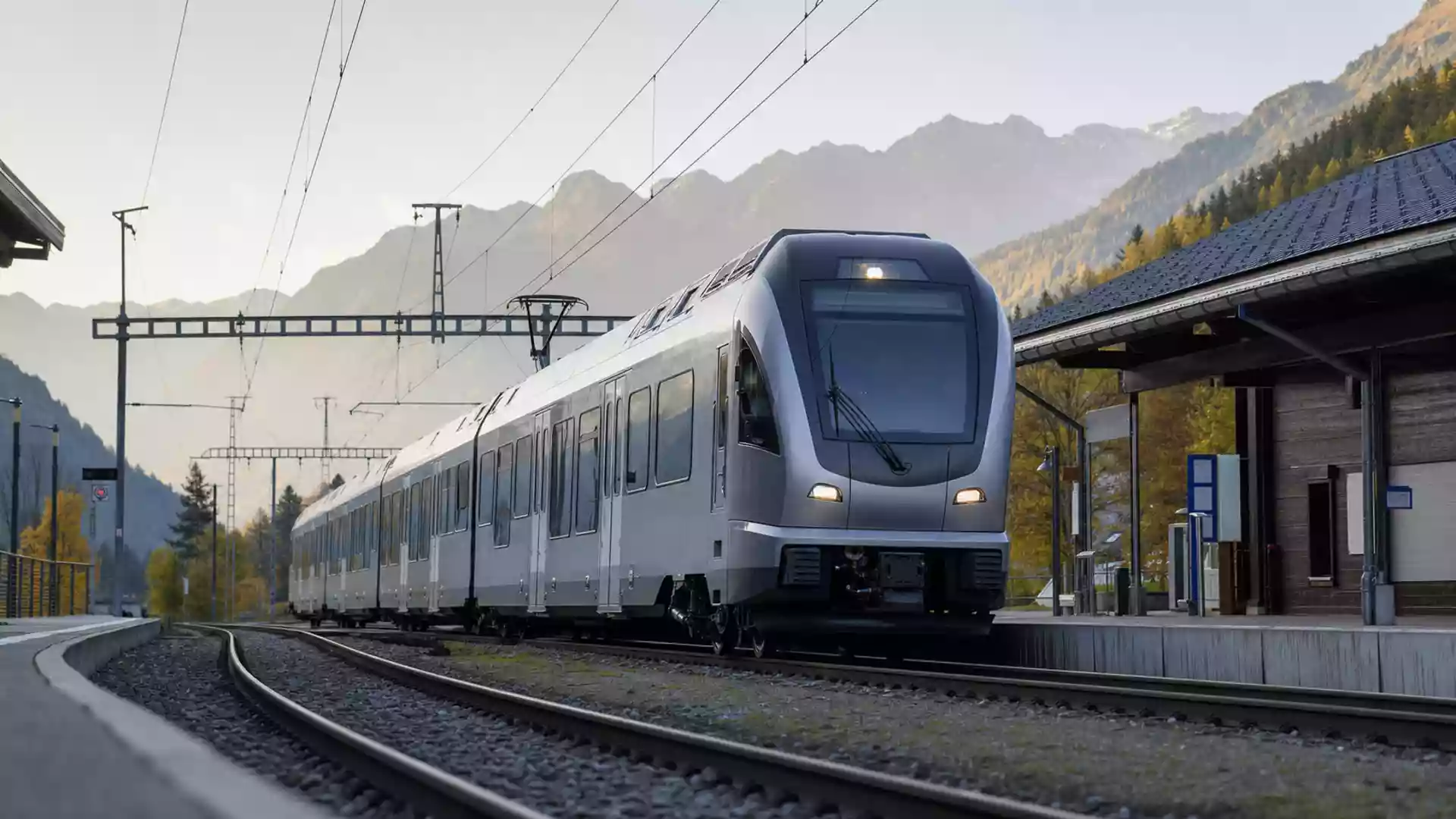
Stadler Rail's Order Book Is Full — Now Comes the Hard Part
Published on 11/27/2026 at 02:53 | Editorial boerse-global.de
Stadler Rail investors are being asked to judge a company on delivery rather than demand. A fresh "Underperform" rating from Bank of America, with a 26 CHF price target, knocked the shares down 8.6% and put the focus squarely on whether Europe's biggest order backlog in rail can be converted into profit. The stock last changed hands at EUR 31.44 in German trading.
The bearish call lands against a backdrop of genuine operational progress. Interim results published on 26 August beat both the prior-year period and analyst expectations, and management reaffirmed guidance for 2026 of revenue comfortably above CHF 5bn with an EBIT margin above 5%. The question is no longer whether Stadler can win work — it is whether that work pays.
Growth is arriving faster than margins
Revenue in the first half of 2026 climbed 40% to CHF 2.0bn, a pace that underlines the scale of the ramp-up. Profitability moved in the same direction but from a lower base: the EBIT margin reached 4.0%, up from 2.6% a year earlier. That is a better starting point, though hardly proof that the full-year target will be met.
Order intake tells a similar story of momentum. New orders totalled CHF 2.7bn in the first six months, compared with CHF 1.7bn a year ago, lifting the backlog to CHF 33.3bn. Such a pipeline means the outlook does not hinge on a handful of fresh wins. Yet a full book is a precondition for growth, not a substitute for efficient execution — the economic value only materialises when trains are built, handed over and billed at a rising margin.
Should investors sell immediately? Or is it worth buying Stadler Rail?
Infrabel selection adds optionality, not revenue
One potential addition to that pipeline came on 18 November, when Belgian infrastructure manager Infrabel named Stadler as preferred supplier for an initial 60 locomotives, with an option for 30 more. The distinction matters: preferred-supplier status is not the same as a signed and fully realised order. At its maximum, including maintenance, the volume could exceed EUR 1bn. Investors would be wise to track the contract stage rather than the headline figure.
A customer financing deal is not a new order
A separate announcement this week offered a reminder of how easily project news can be misread. EUROFIMA agreed a EUR 40m, eight-year loan for nine Stadler Servicejet emergency and firefighting trains destined for Austrian Federal Railways (ÖBB). The borrower is ÖBB subsidiary Rail Equipment GmbH & Co KG, so the money does not flow to Stadler as a corporate loan. It is customer-side financing for an existing project — not an addition to the order book.
That project, agreed in 2024, covers 18 hybrid vehicles with a contract value of EUR 230m. The EUROFIMA facility represents the second tranche of an ÖBB infrastructure framework and leaves both the vehicle count and Stadler's contract value unchanged. The European Investment Bank had already financed the scheme in August 2025 with EUR 120m, putting total costs — including spare parts, provisions and construction-period interest — at EUR 267m. That broader figure should not be confused with the pure vehicle contract value.
The Servicejets themselves are specialist machines: trimodal drives, top speeds of up to 160 km/h, capacity for as many as 324 evacuees, on-board firefighting systems and the ability to tow other trains. They are not standard passenger rolling stock, and the financing news carries no new earnings guidance from Stadler.
Valencia still clouds the schedule
The strongest counterargument to the growth story is operational, not commercial. Fallout from the October 2024 floods in Valencia is expected to weigh on costs and deliveries through 2027. More orders do not make that problem disappear; delayed handovers or extra costs could cap margin progress, leaving the backlog as evidence of demand but not protection against disappointing results.
Stadler Rail at a turning point? This analysis reveals what investors need to know now.
The medium-term margin ambition of 6–8% likewise rests on stable supply chains. That condition belongs in any assessment of the target, which is a goal rather than an achieved figure. The risk for Stadler is less a shortage of growth than a slower-than-hoped conversion of that growth into profit.
The annual report is the next test
So long as rising revenue comes with a higher margin, the bullish case holds; additional contracts would be a bonus rather than the main event. If margin improvement stalls, the large backlog loses much of its persuasive power as a valuation argument, and Stadler would first have to show how it intends to overcome the existing burdens. More volume alone would not answer that question. The next fixed date for investors is the annual report on 17 March 2027 — the moment to measure whether the company has delivered on its own targets, in earnings as well as sales.
Ad
Stadler Rail Stock: New Analysis - 27 November
Fresh Stadler Rail information released. What's the impact for investors? Our latest independent report examines recent figures and market trends.