Rheinmetall's Open-Source Gambit: Can Code and Contracts Outweigh a Halved Share Price?
Published on 09/09/2026 at 19:01 | Editorial boerse-global.de
The defense contractor best known for tank armor is now courting software developers. Rheinmetall has published the interface specifications for its "Battlesuite" military digital ecosystem—specifically the Onboard API and Tactical API—on GitHub, an unusual move for an industry that typically guards its proprietary technology closely. The stated goal is to create standardized interfaces that allow different military systems to integrate more seamlessly across vehicles and equipment.
The announcement lands amid one of the most paradoxical stretches in the company's recent history. On the operational front, Rheinmetall's order pipeline resembles a fire hose: contracts spanning multiple continents, programs, and product categories have been announced in rapid succession. Yet the share price tells a different story entirely—one of persistent erosion that has left the stock 50 percent below its October 2025 peak of 2,007.00 euros.
A Transatlantic Delivery Schedule
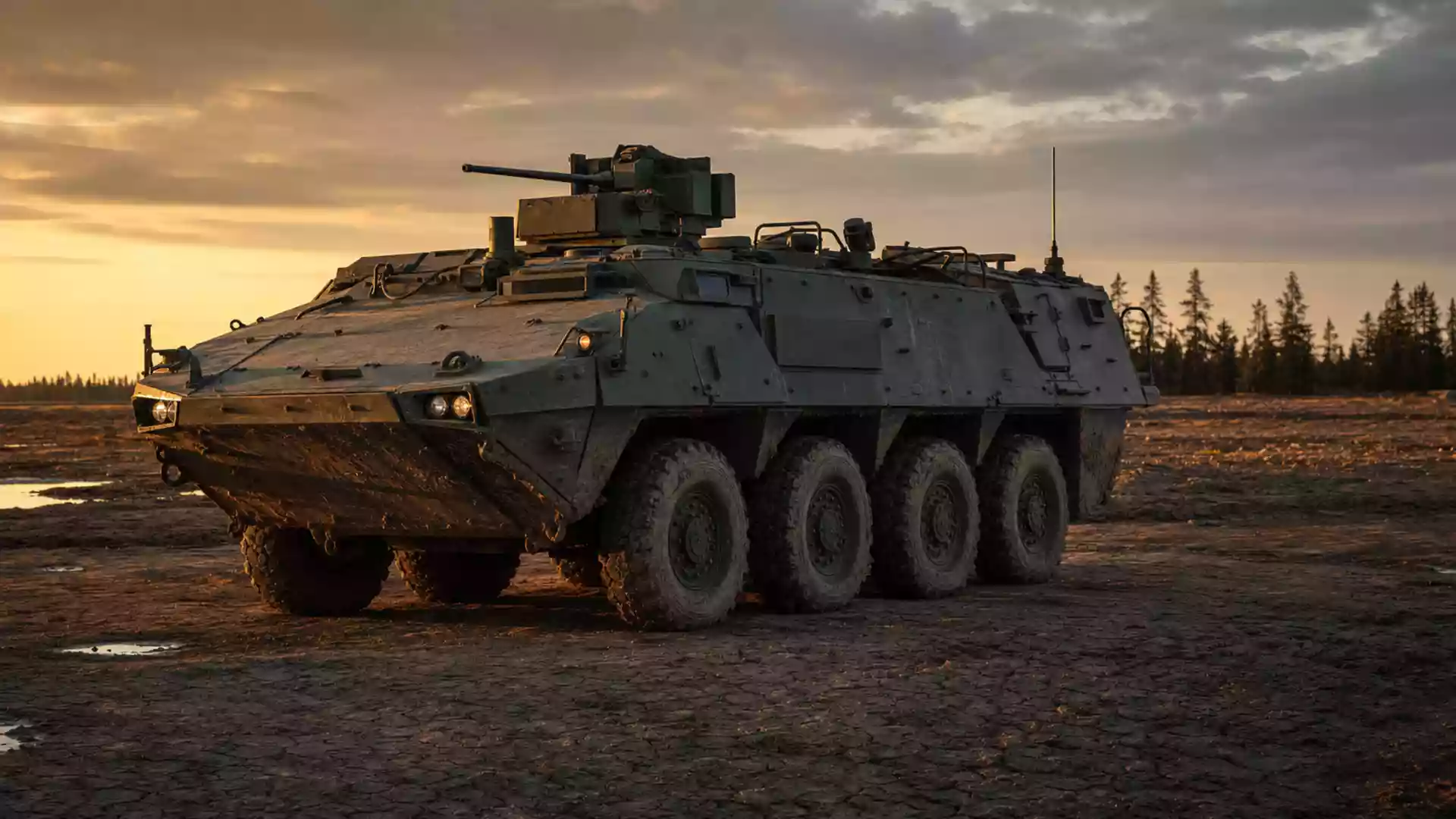
The latest operational news has a distinctly American accent. American Rheinmetall handed over the first Lynx XM30 infantry fighting vehicle prototype to the U.S. Army, part of a development and industrialization contract worth roughly 764 million US dollars. Seven additional prototypes are slated for delivery by year-end, and the program ranks among the most significant U.S. Army modernization efforts involving the German group's American subsidiary.
Days earlier, American Rheinmetall secured a 710,000 US-dollar order from Kongsberg Defence & Aerospace for machined components destined for MCT-30 turrets used in the USMC's ACV-30 program. Production will take place at the company's Lapeer and Lansing facilities in Michigan. And on Friday, Rheinmetall delivered replacement components for mobile aircraft launch units to the U.S. Navy, a follow-on order placed through the Canadian Commercial Corporation on behalf of the U.S. Department of Defense—a smaller contract in the single-digit millions, with deliveries scheduled between late 2026 and late 2028.
Europe is not being neglected. In late August, Rheinmetall unveiled investments of roughly 270 million euros at its Kassel site, covering drone testing, expanded tank production, and a new logistics center. CEO Armin Papperger has reiterated the company's ambition to secure vehicle orders worth approximately 12.4 billion euros from Germany's Arminius procurement program by the end of 2026—though that remains a medium-term target rather than a booked order. The parliamentary review of the Boxer vehicle bulk order is scheduled for December 9, with contract signing potentially following days later.
Should investors sell immediately? Or is it worth buying Rheinmetall?
The Numbers Look Strong—On Paper
The financials released this summer reinforce the narrative of a company firing on all cylinders. Second-quarter revenue climbed roughly 69 percent to 3.289 billion euros, while operating profit of 562 million euros came in nearly 20 percent above the market's 469.9 million-euro expectation. The order backlog surpassed 80 billion euros in the second quarter, buoyed by a string of major wins: a Skynex air defense order worth several hundred million euros in July, a Romanian megadeal valued at 5.7 billion euros covering tanks, air defense systems, ships, and ammunition in June, and a Bundeswehr contract for 149 mobile rescue stations valued at more than 500 million euros in mid-August—which, combined with an earlier order, pushes the total past 600 million euros.
Yet there are cracks beneath the surface. Rheinmetall has warned of a significantly negative operating free cash flow for the current year, weighed down by postponed advance payments and rising customer receivables—a concern that investors are monitoring closely given the already fragile market sentiment.
Why the Market Remains Unimpressed
The disconnect between contract flow and share price performance has become the defining feature of Rheinmetall's market narrative. The stock fell 3.5 percent on the day of the GitHub announcement, extending a slide that has erased 35 percent of its value since the start of the year. The secondary article records a slightly steeper same-day decline of 3.9 percent, with the shares trading at 1,009.00 euros after closing at 1,050.00 euros the previous day—a weekly drop of 7.7 percent. The stock now sits well below its 50-day moving average of 1,097.58 euros.
Market observers attribute the weakness to a combination of sector-wide concerns rather than company-specific failures. A rising oil price has weighed on the broader German equity market, dragging down European defense peers including BAE Systems and Thales, while U.S. counterparts Lockheed Martin and Northrop Grumman have moved higher. There is also an ongoing debate across the European defense industry about the future importance of drone technology relative to conventional weapons systems—a discussion that has injected uncertainty into valuations across the sector.
Earlier in the summer, a Spiegel report alleging that German Defense Minister Boris Pistorius plans to cancel the F126 frigate project added another layer of pressure. JPMorgan described the news as a "bitter setback" at the time, noting that Rheinmetall could miss its order intake targets as a result.
A Market Demanding Proof
Deutsche Bank Research reaffirmed its "Buy" rating with a 1,800-euro price target on September 1, citing leaked German defense plans for 2027—an assessment that looked optimistically at the medium-term investment case. But for now, the market appears to be weighting structural questions about the future of defense technology more heavily than individual contract announcements.
The December 9 parliamentary date for the Arminius program may prove pivotal. Rheinmetall's operational foundation—spanning U.S. and European contracts, prototype deliveries, and replacement parts—looks solid by any historical measure. The challenge is that investors seem to be asking a different question than whether the company can win orders. They want to know whether those orders represent the right bets for a defense landscape that is itself being reshaped by technology, politics, and budget realities. Until that question is answered to the market's satisfaction, even a steady drumbeat of good news may not be enough to reverse the slide.
Ad
Rheinmetall Stock: New Analysis - 9 September
Fresh Rheinmetall information released. What's the impact for investors? Our latest independent report examines recent figures and market trends.