
McDonald's Opens a Second Front: Selling Ad Space While Backing Its Franchisees
Published on 09/25/2026 at 03:02 | Editorial boerse-global.de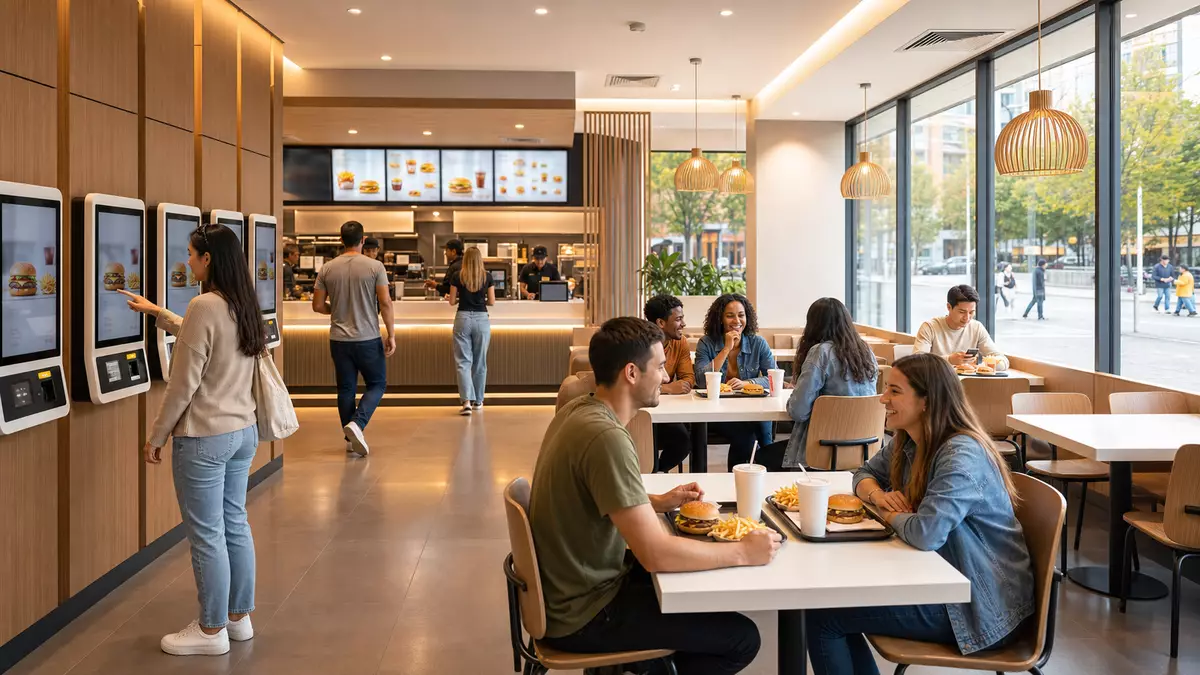
McDonald's is no longer content to make money only at the register. The Chicago-based chain has unveiled a plan to pull in roughly $1 billion in fresh revenue by turning its own restaurants and smartphone app into advertising real estate, a venture it calls the McDonald's Media Network. The concept, presented Wednesday, marks the company's first serious push to monetize the enormous foot traffic and digital engagement it already generates.
The network has been running in a pilot phase since August across 450 company-operated US locations. Ad inventory is to be sold across the McDonald's app, ordering kiosks, digital menu boards and in-restaurant screens. Research firm eMarketer values the US retail media market at $84 billion this year, giving the burger giant a sizable pool to tap. For a business built on selling meals, the appeal is straightforward: every customer interaction becomes a potential source of incremental cash flow.
Automation Takes Over the Drive-Thru
Running alongside the advertising effort is a broad technical overhaul of McDonald's locations. At the center sits Archy, an AI-powered ordering system that handles drive-thru requests in both English and Spanish with 90 percent accuracy. Management expects the technology to free up at least 50 labor hours per week at a typical restaurant. CFO Ian Borden was quick to stress that no job cuts are planned as a result.
Kitchen operations are getting their own upgrade. Specialized scales that verify order accuracy are already installed in 10,000 restaurants, and the company intends to double that footprint to 20,000 sites by 2028. A management platform called ArchIQ will further standardize back-of-house workflows.
Should investors sell immediately? Or is it worth buying McDonald's?
A Dividend Milestone Amid a Difficult Tape
The growth initiatives land against a backdrop of weakening demand at home. CEO Chris Kempczinski has warned that customer traffic across fast-food markets will likely flatline as inflation stays elevated. US comparable sales rose just 0.8 percent in the second quarter, a sharp slowdown from 2.5 percent a year earlier, and Borden expects a slight decline in the third quarter.
Investors have taken note. The stock ended the previous session at EUR 208.30, down 21 percent year to date and just 1.2 percent above its 52-week low of EUR 205.80. In German trading the shares have changed hands at EUR 210.60, reflecting a roughly 20 percent decline since January.
Yet the company delivered a counterweight on September 17, lifting its quarterly dividend by 4 percent to $1.93 per share. That increase extends an unbroken streak of annual payout hikes to 50 years — a distinction that makes McDonald's one of a small club of reliable income names.
The $8.5 Billion Question
What has unsettled parts of the market is the scale of the company's commitments to its own operators. Under a support program known as McDonald's NEXT, the chain plans to direct $8.5 billion to franchisees through 2036, with about $5 billion of that earmarked by 2030. The aid comes through a mix of rent relief and direct capital contributions.
That shifts the risk profile temporarily. McDonald's normally collects a large share of its earnings from fixed rent and royalty payments, but when the parent has to step in as a lender, the dynamic changes. Sales per store are also growing more slowly than usual, which puts the adjusted operating margin — after the support payments are subtracted — under a magnifying glass.
Analysts Split on the Risk-Reward Trade
Opinion on the Street is far from uniform. Dennis Geiger of UBS trimmed his price target on September 20 to $320.00 from $340.00 while keeping a Buy rating. Three days earlier, Citigroup cut its target to $310.00 from $345.00 but likewise maintained its buy recommendation. Both firms argue that McDonald's balance sheet is strong enough to absorb the financial burden, and that its decades-long dividend record guarantees steady returns to shareholders.
McDonald's at a turning point? This analysis reveals what investors need to know now.
The bear case draws directly from management's own commentary. Kempczinski has cautioned that stubborn inflation and stagnant traffic will keep weighing on the restaurant industry, and he sees no quick change in those conditions. If diners stay away, the billions funneled to operators will largely lose their effect. Should inflation remain high, even traditionally cheap fast-food outlets could lose price-sensitive customers. A prolonged stretch of flat traffic combined with rising operating costs would erode franchisee margins — and in the worst case, the company could need to inject further funds after 2030, squeezing buybacks and the room for future dividend increases.
What to Watch From Here
For shareholders, the calculus is fairly clear. As long as US comparable sales stay positive and rent relief remains within the planned $5 billion through 2030, the depressed valuation offers a reasonable entry point for long-term income investors. A turn into negative territory at home, however, would invite a downward re-rating.
Much now rests on Skye Anderson, who took over as Executive Vice President and President of McDonald's USA on August 4 and runs the company's most important single market. The next hard test of her strategy arrives with third-quarter 2026 results, when it will become clear whether traffic is still stuck in neutral or whether the brand can defend its pricing power.
Ad
McDonald's Stock: New Analysis - 25 September
Fresh McDonald's information released. What's the impact for investors? Our latest independent report examines recent figures and market trends.


