
Marvell Bets on Light: Silicon-Germanium Expansion Targets AI's Next Bottleneck
Published on 09/18/2026 at 11:31 | Editorial boerse-global.de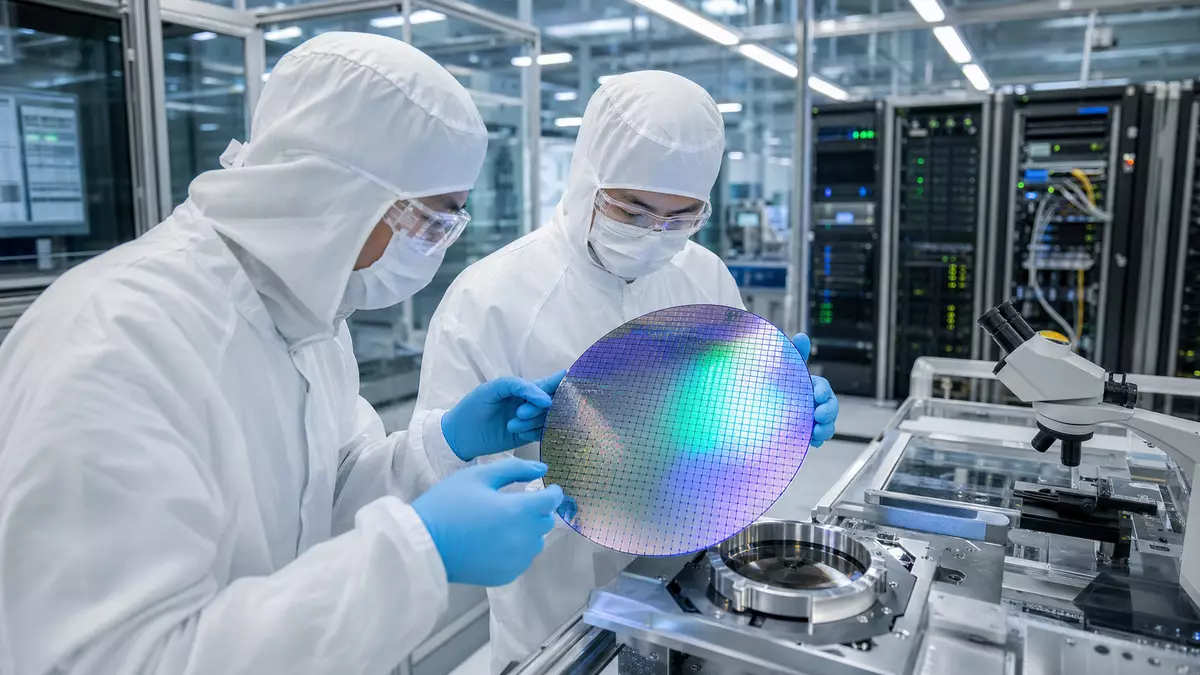
The artificial intelligence trade has spent two years fixated on raw compute — ever-larger accelerators, ever-deeper capital budgets for GPUs. What gets far less attention is the wiring between them. At 400 gigabits per second per lane, copper interconnects begin to fail after roughly a single meter, and the trillion-dollar buildout risks choking on its own traffic. That physical constraint is where Marvell Technology is placing its chips.
The Santa Clara-based semiconductor group has widened a multi-year manufacturing agreement with contract foundry GlobalFoundries, expanding silicon-germanium (SiGe) wafer capacity at the partner's Burlington, Vermont facility. SiGe forms the substrate for optical transceivers and for emerging architectures such as Near-Packaged Optics and Co-Packaged Optics. GlobalFoundries' SiGe lines are built for up to 200 gigabits per second per lane — the foundation for transceivers running at an aggregate 1.6 terabits per second, with a doubling to 3.2 terabits already sketched into the roadmap. By locking up capacity early, management is attempting to insulate itself from component shortages as hyperscalers race to link GPUs with minimal latency.
Security Play Runs in Parallel
Marvell is hedging its optical bet with a push into transaction security. Together with Microsoft and security specialist Utimaco, the company launched the public preview of Azure Payment HSM v2 across the US West and Western Europe regions. The offering pairs Marvell's LiquidSecurity hardware with Microsoft's cloud platform to safeguard PCI-compliant payment processing, card issuance and key management inside data centers. Industry observers size the market for hardware-based security modules at roughly USD 5 billion by 2033.
The two initiatives address very different parts of the same problem: as AI clusters scale, both the pipes carrying data and the locks guarding it become gating factors.
Should investors sell immediately? Or is it worth buying Marvell Technology?
A Stock Priced for Growth, Not Perfection
Wall Street's reaction has been constructive. Marvell shares changed hands at EUR 213.45, up 1.8% on the day, after gaining 4.8% in the prior session to close at EUR 209.70. Even so, the stock sits 26% below its June 52-week high — a reminder that the semiconductor sector's sharp re-rating has already baked in substantial cloud and AI contributions. The analyst community remains broadly bullish: of the coverage universe, 22 analysts rate the shares a buy against five holds, with an average price target of USD 298.38.
The bull case extends well beyond optical plumbing. Bank of America's Vivek Arya puts the addressable market for custom AI chips and processor interconnect at up to USD 300 billion by 2030, a pool Marvell would tap disproportionately if it lands. KeyBanc's John Vinh has set a USD 400 target, citing confidence in the long-term product pipeline.
The Numbers Behind the Narrative
Those projections rest on a business already expanding fast. In the second quarter of fiscal 2027, total revenue climbed roughly 37% year over year to USD 2.739 billion, powered by a data center segment that grew 46%. Management is guiding the current quarter to about USD 3.15 billion. Whether that pace holds depends largely on how quickly customers deploy new optical interface standards and Co-Packaged Optics in live data centers.
The competitive picture is less comfortable. Broadcom dominates the market for application-specific semiconductors by a wide margin, and observers expect it to retain the lion's share for years, leaving Marvell to defend a low-double-digit percentage slice. Customer concentration compounds the risk: in fiscal 2026, the ten largest customers accounted for about 82% of total revenue. A single hyperscaler shifting orders, favoring in-house silicon, or trimming infrastructure budgets would put growth targets in immediate jeopardy.
October 6 as the Next Marker
For investors, the dividing line is straightforward. As long as Marvell defends operating momentum in the data center segment above USD 3 billion per quarter, the broader uptrend stays fundamentally supported. A stall in custom ASIC projects or a slow ramp of new optical capacity would leave the shares exposed — though trading 28% below the 52-week high limits the downside from operational missteps. The next concrete catalyst is already circled: on October 6, Marvell holds its official investor day, where management must show how the expanded manufacturing footprint underpins its long-term margin targets.
The larger point for the AI supply chain is that compute alone cannot scale. Photonic interconnection has moved from experimental curiosity to hard prerequisite — and the companies that own the capacity to build it may prove as consequential as those designing the chips it connects.
Ad
Marvell Technology Stock: New Analysis - 18 September
Fresh Marvell Technology information released. What's the impact for investors? Our latest independent report examines recent figures and market trends.


