
CATL's Debrecen Lines Begin Trial Runs as Battery Maker Refreshes Storage Pricing and Adds European Freight Allies
Published on 09/25/2026 at 14:52 | Editorial boerse-global.de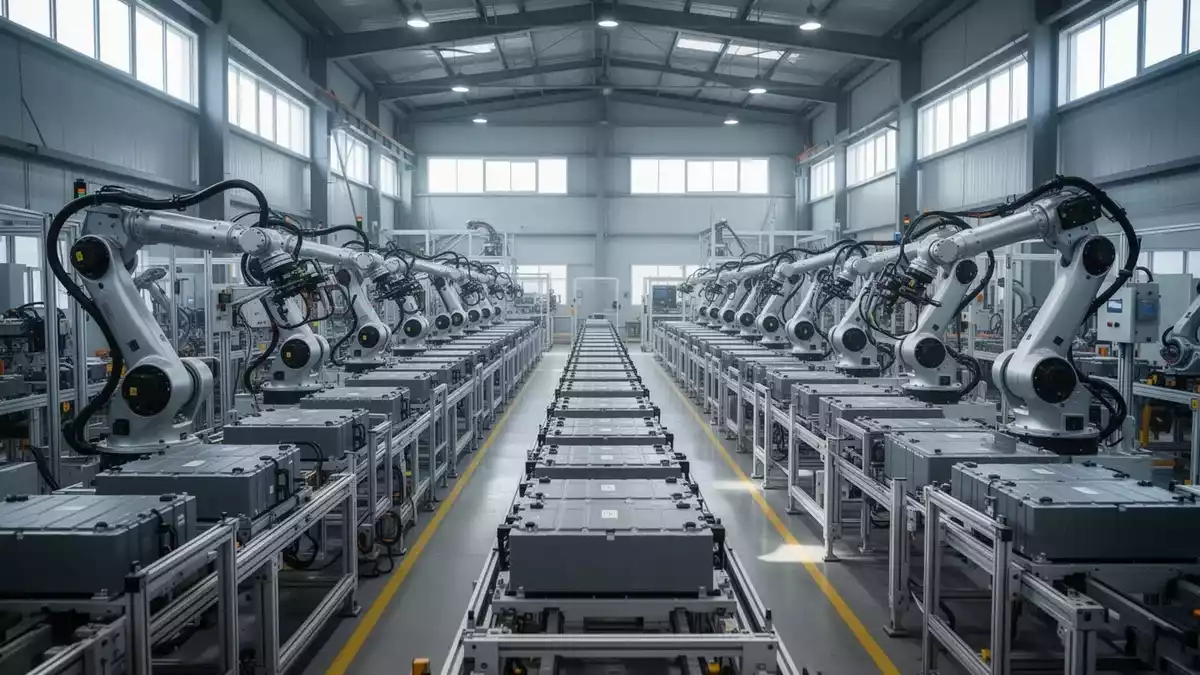
CATL has moved its Hungarian manufacturing bet from blueprint to hardware. Trial operations began Tuesday on the first two cell production lines at the company's Debrecen plant, following the completion of all regulatory approvals. The runs are meant to calibrate equipment ahead of full-scale output, and once the site is finished it will carry a designed annual capacity of 100 gigawatt-hours, making it the group's largest production base outside China.
The milestone lands in a week when the world's biggest battery maker was busy on several other fronts at once — raising fresh capital at home, resetting prices on its energy-storage catalog, and widening a web of partnerships across Europe, China and North Africa.
A seventh green bond, and a storage lineup in motion
On the financing side, CATL closed its seventh green technology innovation bond of the year on Tuesday, pulling in 4.5 billion RMB. The issue splits into a 4.0 billion RMB tranche carrying a 1.49% coupon and a 500 million RMB tranche priced at 1.55%.
Alongside the fundraising, the company adjusted its storage product lineup. Listed entry prices for 280-ampere-hour storage cells were lifted to 0.470 RMB per watt-hour, while 314-ampere-hour cells now start at 0.403 RMB per watt-hour. For the first time, a 587-ampere-hour storage cell also appeared on the public list, with an entry price of 0.415 RMB per watt-hour. CATL characterized the moves to media as a routine adjustment.
Heavy trucks, DHL, Kuehne+Nagel — and a plant in Egypt
The commercial-vehicle push is advancing in parallel. At the launch of its new TECTRANS II platform, which is designed for a maximum range of up to 1,000 kilometers, CATL signed a memorandum of understanding with DHL Group aimed at decarbonizing European road-freight corridors. Days later came a second cooperation agreement, this one with Kuehne+Nagel, covering electrification concepts for European transport fleets as well as a pilot for Qiji battery-swap systems on heavy trucks in China.
Should investors sell immediately? Or is it worth buying CATL?
CATL is also exporting its model further afield. In Egypt, it struck a partnership with BME to assemble battery packs for heavy commercial vehicles, contributing technology licenses, production equipment and training. That plant opens with an initial annual capacity of 1 gigawatt-hour, with plans to scale to as much as 5 gigawatt-hours over the longer term.
Buyback underway, tax change absorbed
Management has been equally active on the capital-return front. On September 11, CATL bought back 604,293 of its own A-shares on the Shenzhen exchange, spending exactly 199,978,827.46 yuan on the transaction.
The buyback unfolded against a stretch of visible market unease. In mid-September the stock logged its sharpest multi-day decline in more than a year, driven by speculation about production cuts and growing investor caution heading into the third quarter.
Chief technology officer Lin Jiubiao struck a calm tone Monday on China's new consumer tax on batteries, which took effect September 1. Speaking in remarks reported by Bloomberg, he acknowledged volume reductions and fluctuations on individual orders but pointed to newly opened demand pockets, saying the overall business for the current year remains unchanged and that the impact so far has been limited.
A home market that is no longer a given
That composure is being tested by a shifting customer base in China. CATL still held a 41.45% share of domestic drive-battery installations in August, according to media reports. Yet key clients are steadily broadening their supplier rosters. Li Auto has said it will move to self-developed batteries group-wide, meaning the new generation of its Li Mega model will no longer carry CATL cells. Xiaomi, for its part, agreed on September 4 to work with rivals CALB and Sunwoda on its Pengcheng vehicles. Other automakers are likewise turning to alternative suppliers such as Sunwoda and investing in their own development capacity.
With the domestic picture getting more crowded, overseas execution takes on added strategic weight — which is where Debrecen, and a separate energy-infrastructure play, come in. A mandatory filing with the US Securities and Exchange Commission shows CATL signed a cooperation agreement with the VNET Group on August 18. The two partners plan to build a three-tier ecosystem linking computing power and electricity supply at gigawatt scale.
Ad
CATL Stock: New Analysis - 25 September
Fresh CATL information released. What's the impact for investors? Our latest independent report examines recent figures and market trends.


