Waste Management stock trades steadily as earnings and cash flow support valuation
Published on 07/21/2026 at 12:39 | Editorial responsibility: Rafael Müller, Editor-in-Chief AD HOC NEWS
Waste Management stock continues to be anchored by the companys consistent earnings profile and strong cash generation, giving investors a relatively stable exposure to the US waste collection and environmental services market. Waste Management Inc. (ISIN US94106L1098) is widely recognized as the largest integrated waste management company in North America, and its recent financial results highlight how revenue growth, profitability, and disciplined capital allocation shape the current valuation. The group is listed on the New York Stock Exchange and is part of the S&P 500 index, which positions Waste Management stock within the broader universe of large cap US equities that many index and benchmark focused investors follow.
In the most recently reported full fiscal year, Waste Management generated multi billion dollar revenues, reflecting a diversified service mix that spans solid waste collection, transfer and disposal, along with recycling and resource recovery activities. Across this period, the company reported positive year over year revenue growth driven by pricing initiatives and targeted volume expansion in key commercial and industrial segments. Profitability metrics, including operating income and net income, also improved, underlining the ability of the business model to leverage incremental revenue into higher earnings. For many investors, this combination of revenue growth and earnings expansion is central to how they view Waste Management stock, particularly given the regulated and contract based nature of much of its revenue base.
Cash flow remains a core pillar of the investment case. Waste Management regularly reports substantial operating cash flow, which provides the foundation for capital expenditure on new collection fleets, landfill infrastructure, and recycling facilities, while still leaving room for shareholder returns through dividends and, when appropriate, share repurchases. Over its latest fiscal year, the companys free cash flow comfortably covered its dividend distributions, indicating that the dividend policy is supported by underlying cash generation rather than short term balance sheet adjustments. This cash flow profile is often cited by investors as a key reason for holding Waste Management stock over a multi year horizon.
Dividend payments themselves are another important metric for shareholders. Waste Management has a history of paying regular quarterly dividends, and over recent years the company has delivered incremental dividend increases in line with earnings and cash flow trends. The dividend yield, which reflects the annual dividend relative to the share price, tends to position Waste Management stock as a total return story that blends cash income with potential price appreciation driven by fundamental growth in revenues and profits. Even in periods where the share price trades sideways in the short term, the dividend stream can help underpin overall portfolio returns.
From a balance sheet perspective, Waste Management carries a mix of long term debt and equity that finances its substantial asset base, including landfills, transfer stations, and vehicle fleets. Leverage is managed within a range that aligns with the stable nature of the waste services business and the companys credit profile. The scale of the asset base means that depreciation and amortization are material components of reported earnings, but cash flow based measures, such as EBITDA and operating cash flow, provide useful insight into the companys ability to service debt, invest in growth, and maintain shareholder distributions.
Market capitalization is another area that investors watch closely, as it reflects the aggregate valuation the market assigns to Waste Management stock. The companys equity value places it within the upper ranks of the US industrial and services sector, and the inclusion in major indices like the S&P 500 can contribute to demand from passive and index linked funds. Market capitalization can shift with changes in share price, but the underlying driver remains the market assessment of the companys future earnings power, cash flow generation, and competitive positioning within the waste and recycling industry.
Revenue growth and margins matter
Revenue growth is a central focus in analyzing Waste Managements recent financial performance, because it signals both the health of underlying customer demand and the effectiveness of pricing strategies. Over the latest reported fiscal year, the company delivered clear year on year revenue expansion, reflecting higher average pricing for collection and disposal services as well as incremental volumes in select regions. Investors analyze the revenue mix between residential, commercial, and industrial customers, along with municipal contracts, to understand how resilient or cyclical the top line might be in different economic environments. A multi segment revenue base can help soften the impact of slowdowns in any single customer category.
Margins provide an equally important lens for understanding the earnings quality behind that revenue growth. Operating margin, which measures operating income as a percentage of revenue, captures how effectively the company controls costs such as labor, fuel, maintenance, and landfill operations relative to what it charges customers. Over the latest full year, Waste Managements operating margin improved compared with the prior year, indicating that cost discipline and pricing power combined to expand profitability. Even modest margin expansion can translate into meaningful incremental operating income when applied to a large revenue base, and investors often see this type of improvement as a sign that the company is successfully managing inflationary pressures and operational challenges.
EBITDA margin, which adjusts earnings before interest, taxes, depreciation, and amortization against revenue, offers another way to look at the operating performance. For a capital intense business like Waste Management, where depreciation related to landfills, vehicles, and facilities can be considerable, EBITDA can highlight the cash style earnings available to support debt service and capital investments. If EBITDA margins trend higher, it suggests that the company is improving its efficiency and pricing outcomes, which in turn can justify a more confident valuation for Waste Management stock.
Investors also evaluate segment level performance to identify which parts of the business are driving margin changes. Solid waste collection and disposal tends to be the core profit engine, but recycling and resource recovery operations can be more sensitive to commodity price cycles. When recycled material prices are supportive, this segment can contribute additional earnings and help boost consolidated margins. Conversely, weaker recycling prices can compress segment margins and weigh on consolidated results, which analysts factor into their valuation models for Waste Management stock by forecasting different commodity price scenarios.
Comparisons against prior periods are crucial in this context. Year over year margin trends show whether profitability is improving or deteriorating, while sequential quarter comparisons can highlight how seasonal factors or short term cost changes are affecting results. If operating margin in the latest fiscal year stands meaningfully higher than the previous year, investors will ask whether the drivers are sustainable, such as structural price increases or efficiency improvements, or whether they reflect one off factors like unusually favorable weather or temporary cost relief. Long term margin stability or gradual expansion tends to support a premium valuation for Waste Management stock because it points to a business capable of translating revenue growth into durable earnings.
Cash flow and capital allocation shape Waste Management stock
Cash flow metrics are often regarded as more telling than accrual based earnings for capital intense service companies, and Waste Management is no exception. Operating cash flow captures the cash generated by the companys core activities, including customer payments and working capital changes, and investors track this figure over time to ensure that reported earnings are backed by real cash inflows. Over its latest fiscal year, Waste Management reported strong operating cash flow, driven by solid profitability and disciplined management of receivables and payables. This cash flow is the starting point for funding capital expenditure, reducing debt, and returning money to shareholders.
Capital expenditure typically absorbs a significant portion of operating cash flow because the company must continuously invest in new trucks, containers, and facility upgrades to maintain service quality and regulatory compliance. Investment in landfill capacity and recycling infrastructure is also critical for long term growth. Analysts often compare annual capital expenditure to depreciation to assess whether the company is reinvesting sufficiently to sustain its asset base. If Waste Management invests at or above the level of annual depreciation, it suggests that the physical infrastructure is being maintained or expanded, which is essential for supporting future revenue and earnings.
Free cash flow, defined as operating cash flow minus capital expenditure, is the key figure available for debt reduction, dividends, and share repurchases. Over its latest fiscal period, Waste Managements free cash flow exceeded its cash dividend outlays, indicating that the dividend is covered by internally generated funds rather than reliance on new borrowing. This reinforces the view that Waste Management stock offers a relatively secure income stream for investors seeking exposure to essential services with steady cash distributions. The ratio of free cash flow to net income can also reveal how effectively accounting earnings convert into cash, with higher ratios generally viewed positively.
Debt management forms another axis of capital allocation. Waste Management carries long term debt to finance its asset base, but the company aims to maintain leverage within a range that supports its credit ratings and provides financial flexibility. Interest coverage ratios, which compare earnings or cash flow to interest expenses, help investors judge whether the company can comfortably service its borrowing costs. A strong interest coverage ratio reflects both the stability of Waste Managements earnings and the prudent sizing of its debt stack, which is relevant for how credit markets and equity investors price the risk associated with Waste Management stock.
Shareholder returns beyond dividends can come through share repurchases, which reduce the number of shares outstanding and can support earnings per share over time if valuation and timing are well managed. Waste Management has at times used buybacks as a tool to return excess cash to shareholders. Analysts typically compare the scale of repurchases to free cash flow and assess whether the company is balancing reinvestment needs with shareholder distributions. Well calibrated buyback programs can improve per share metrics without compromising the capacity to fund necessary capital expenditure.
For many investors, a holistic view of capital allocation is crucial. They weigh the combination of dividends, repurchases, capital expenditure, and debt management against the companys long term strategic priorities in waste collection, disposal, and recycling. If Waste Management maintains a consistent pattern of covering dividends with free cash flow, reinvesting adequately in its asset base, and keeping leverage at manageable levels, it supports the perception that Waste Management stock offers a disciplined, income backed investment aligned with long term infrastructure and environmental service themes.
More background on Waste Management
Investors who want to explore filings, presentations, and detailed segment data on Waste Management can review additional information and documents through specialized portals and the companys own corporate resources.
Waste and recycling services underpin operations
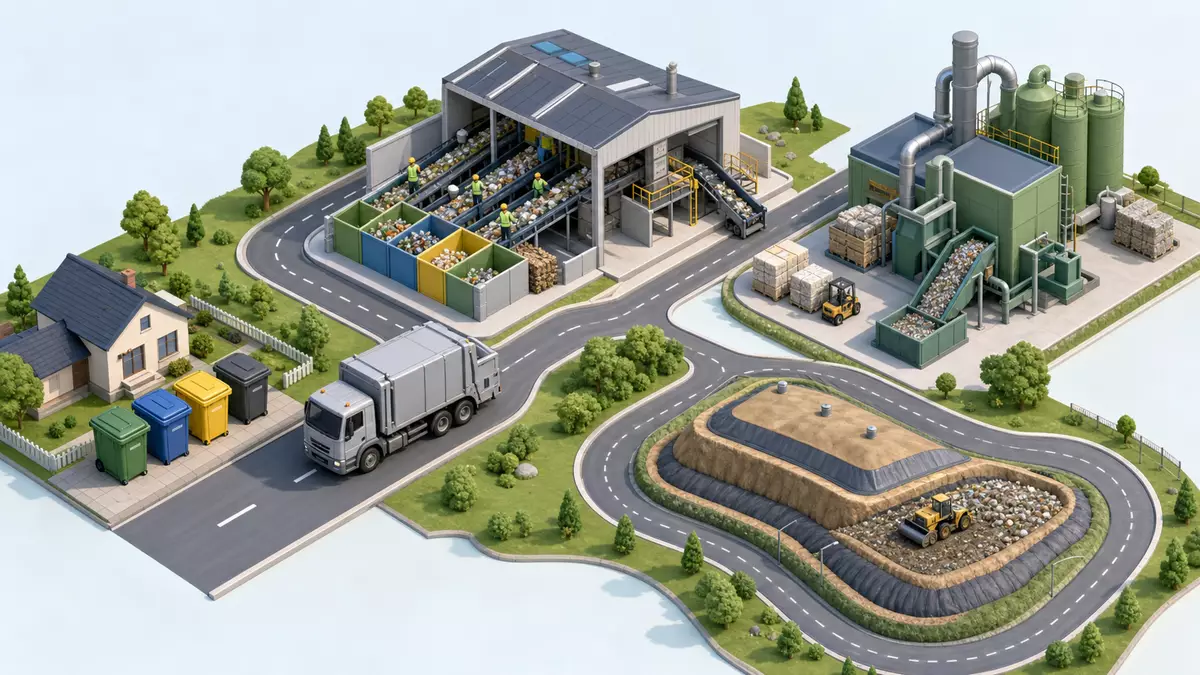
Waste Managements core operations span a broad range of services, with solid waste collection and disposal at the heart of its business model. The company serves residential neighborhoods, commercial properties, industrial facilities, and municipalities through scheduled collection routes and contracted arrangements. Collected waste is transported to transfer stations and landfills that Waste Management owns or operates, providing the company with vertically integrated control over key parts of the waste lifecycle. This integration is important because it allows the company to optimize logistics, manage compliance with environmental regulations, and capture value across the chain from collection through disposal.
Recycling and resource recovery have become increasingly prominent components of the business, both due to environmental regulations and customer demand for sustainable solutions. Waste Management operates materials recovery facilities where sorted recyclables, such as paper, cardboard, plastics, and metals, are processed and sold into commodity markets. The financial performance of these facilities can vary with market prices for recycled materials, creating a linkage between global commodity trends and segment profitability. Investors interested in Waste Management stock often track recycling trends as an additional factor influencing overall earnings and volatility.
Environmental services extend beyond traditional waste and recycling to include specialized offerings like industrial cleaning, hazardous waste management, and landfill gas recovery. In some locations, Waste Management captures methane generated from landfills and converts it into energy, which can be sold or used internally. These initiatives align with broader environmental and climate related goals and can generate incremental revenue streams while reducing greenhouse gas emissions. Over time, expansion in environmental services can diversify the companys earnings base and support new partnerships with industrial clients seeking comprehensive waste and environmental solutions.
Operational efficiency is central to maintaining competitive pricing and margins across these services. Route optimization, fleet maintenance, and investment in newer vehicles with lower fuel consumption all contribute to cost management. Technology systems that track collection routes, customer service requests, and regulatory compliance documentation help streamline operations. As Waste Management introduces more advanced digital tools, data analytics, and automation in sorting facilities, it aims to enhance efficiency and reliability, which can ultimately feed back into improved margins and cash flows that underpin Waste Management stock.
Customer relationships are managed through a mix of long term contracts, subscription arrangements, and municipal agreements. Contract length and renewal terms can influence revenue visibility and risk, particularly for larger commercial and municipal customers. Where Waste Management holds long term contracts with automatic renewal or indexed pricing, revenue stability tends to be higher. Investors evaluate the contract portfolio as part of their assessment of how resilient revenue might be during economic slowdowns or shifts in local government budget priorities.
Regulatory compliance is another operational pillar. Waste Management must adhere to environmental regulations at federal, state, and local levels, covering areas such as landfill design, leachate management, air emissions, and safe handling of hazardous materials. Compliance requires ongoing investment in monitoring, reporting, and facility upgrades, but also helps protect the company from regulatory penalties and reputational risk. A strong compliance record can be an intangible asset when bidding for new contracts or negotiating extensions, and it feeds into investor perceptions of risk attached to Waste Management stock.
Stock performance and valuation perspective
Waste Management stock performance over recent periods reflects a balance between defensive characteristics and exposure to broader economic trends. As a provider of essential waste collection and disposal services, the company benefits from relatively stable baseline demand, which can lend the shares a defensive profile compared with more cyclical industries. At the same time, revenue growth in commercial and industrial segments, recycling volatility, and macroeconomic factors such as fuel costs and labor inflation can influence earnings and share price dynamics.
Investors often analyze Waste Managements valuation through metrics such as price to earnings, enterprise value to EBITDA, and price to free cash flow. These ratios compare the market value of Waste Management stock and the companys debt to its earnings and cash flow, providing a sense of how the market prices the business relative to its financial performance. If the companys earnings growth is robust and margins trend higher, investors may justify valuation multiples at the upper end of the range observed for comparable infrastructure and services companies. Conversely, if margin pressures or regulatory uncertainties emerge, valuation multiples can compress.
Comparisons with peers in the waste management and environmental services sector also inform valuation views. Investors look at how revenues, margins, and leverage levels at Waste Management compare with those at other listed waste and recycling companies. If Waste Management consistently posts higher margins or stronger cash flow conversion than peers, it can support a valuation premium. On the other hand, if competitors deliver faster revenue growth or more diversified environmental service offerings, the market may adjust relative valuations accordingly. Peer analysis thus serves as a benchmark to contextualize Waste Management stocks pricing.
Technical factors such as index inclusion and fund flows can influence near term share price behavior. Because Waste Management is part of the S&P 500, it is held by a wide range of index trackers and benchmarked funds. Changes in index composition, sector rotations, and passive fund flows can generate demand or supply for the shares independent of company specific news. Long term investors typically focus more on fundamentals than short term technical drivers, but awareness of these forces can help explain certain price movements.
Dividend yield and payout ratio play a role in valuation as well. A moderate dividend yield supported by sustainable earnings and free cash flow can make Waste Management stock appealing to income oriented investors. The payout ratio, which compares dividends to net income, indicates how much of earnings is being returned to shareholders versus retained for reinvestment or debt reduction. If the payout ratio remains within a range that allows for both shareholder returns and reinvestment, it can reinforce confidence that the current dividend level is well supported.
From a risk standpoint, investors consider potential headwinds such as changes in environmental regulation, shifts in commodity prices affecting recycling, competitive pressures in key markets, and macroeconomic factors impacting customer volumes. They also weigh opportunities associated with increased environmental consciousness, demand for recycling and resource recovery services, and potential growth in landfill gas to energy projects. How Waste Management navigates these risks and opportunities will shape the longer term trajectory of earnings and, ultimately, the valuation of Waste Management stock.
Landfill and recycling infrastructure as product backbone
The practical backbone of Waste Managements offering is its network of landfills, transfer stations, materials recovery facilities, and vehicle fleets. These tangible assets form the product in a broad sense, supporting collection, disposal, and recycling services that customers purchase. Landfills are engineered facilities designed to safely contain waste while managing environmental impacts such as leachate and gas emissions. They require significant upfront capital investment, ongoing operational spending, and careful adherence to regulatory standards. The long life nature of these assets means they can support revenue generation over many years, underpinning expectations for Waste Managements future cash flows.
Materials recovery facilities, where recyclables are sorted and processed, represent another key asset class. Equipped with conveyors, sorting equipment, and balers, these facilities handle mixed recyclables from households, businesses, and municipalities. The output is marketable materials such as recovered paper, cardboard, metals, and certain plastics, which are sold on commodity markets. The economics of these facilities depend on throughput volumes, operating efficiency, and market prices. When commodity prices are supportive, recycling operations can contribute meaningful earnings; when prices are weaker, recycling margins can narrow, but the facilities still provide environmental benefits and meet regulatory and customer expectations around sustainability.
Vehicle fleets, including collection trucks and transfer vehicles, are the visible face of Waste Managements product offering. Customers experience the service through timely pickups and reliable waste removal, which hinges on well maintained and efficiently routed fleets. Investments in newer vehicles, including those with alternative fuel technologies, can reduce operating costs and emissions over time. Technology systems that monitor routes, fuel usage, and maintenance needs also enhance efficiency. For investors, the level of fleet investment and maintenance spending provides insight into how the company balances short term cost considerations with long term service quality and asset longevity.
Complementing these core assets are digital platforms and customer interfaces that support service delivery. Online portals, mobile apps, and customer service centers allow residential and commercial customers to manage service levels, billing, and support queries. Contract management systems and data analytics tools help the company organize complex municipal and commercial agreements, track compliance, and optimize renewal discussions. As Waste Management continues to upgrade its digital capabilities, the services it offers can become more responsive and tailored, potentially supporting customer retention and new business wins.
The expansion and modernization of this infrastructure are ongoing processes. Waste Management regularly evaluates opportunities to add new recycling capacity, upgrade landfill cells, or open additional transfer stations to increase geographic coverage and efficiency. Capital allocation decisions in these areas are closely tied to anticipated demand growth, regulatory changes, and competitive dynamics within specific regions. Investors monitoring Waste Management stock often pay attention to major capital projects and infrastructure development plans because these investments lay the groundwork for future revenue and earnings streams.
Environmental innovation now intersects with infrastructure planning. Projects such as landfill gas capture and conversion to energy, improved recycling technologies, and reduced emissions from vehicle fleets embody the companys efforts to align operations with environmental objectives. While some of these initiatives may require significant upfront investment, they can open new revenue opportunities, enhance regulatory compliance, and strengthen the companys brand among environmentally conscious stakeholders. Over the long term, a well executed infrastructure and innovation strategy can support Waste Managements competitive positioning and the attractiveness of Waste Management stock.
Waste Management stock and recent trading context
In the broader trading context, Waste Management stock tends to appeal to investors looking for a combination of defensive exposure and steady, income backed returns. The companys role in serving residential, commercial, and municipal customers with essential waste and recycling services anchors its earnings profile even when economic conditions become more challenging. As a result, the shares are often viewed through a lens that prioritizes cash flow stability, dividend support, and long term infrastructure investment rather than short term speculative catalysts.
Within portfolio construction, Waste Management stock can sit alongside other infrastructure, utility, and services names that collectively aim to provide ballast against more volatile growth exposures. Investors may compare its return profile with that of electricity, water, and gas utilities, as well as transportation and logistics companies that share some characteristics of capital intensity and regulated or contract based revenues. The precise role Waste Management plays in any given portfolio depends on the investors objectives, risk tolerance, and views on environmental, social, and governance themes.
Over multi year horizons, the share price trajectory of Waste Management stock reflects the interplay between earnings growth, dividend reinvestment, market valuation multiples, and macroeconomic cycles. When earnings and cash flow grow steadily and dividends are increased at a measured pace, the total return compound can be significant even if the share price does not experience dramatic swings. Conversely, periods of margin pressure or regulatory uncertainty can dampen share price progress, making dividend income and long term growth potential more central to the investment case.
Analysts who follow Waste Management typically produce forecasts and valuation models that project revenues, margins, earnings, capital expenditure, free cash flow, and dividends over several years. They also incorporate assumptions about recycling commodity prices, landfill utilization, and regulatory developments. While these models can offer detailed scenarios, investors ultimately need to weigh the underlying assumptions and consider how closely the projected path aligns with their own views of economic and environmental trends. Waste Management stock therefore sits at the intersection of financial analysis and broader structural themes around waste, recycling, and sustainability.
One of the recurring themes in discussions about Waste Management is the long term necessity of its services. Regardless of short term economic fluctuations, households, businesses, and municipalities will continue to generate waste that must be collected, transported, and processed. As environmental standards tighten and recycling expectations rise, the complexity and importance of waste management only increases. Waste Managements scale, infrastructure, and expertise position it to play a central role in meeting these needs, which underpins the fundamental rationale for considering Waste Management stock as a long term holding.
At the same time, investors remain attentive to how the company adapts to changes in technology, customer preferences, and policy frameworks. Innovations in waste reduction, reuse, and circular economy models, as well as shifts in packaging trends and consumer behavior, can influence waste generation and composition. Waste Managements ability to respond to these developments through service offerings, infrastructure adjustments, and partnerships will be an important factor in sustaining growth and protecting margins. In this evolving landscape, Waste Management stock represents not only a claim on current waste management services but also a stake in how the company navigates future environmental and resource challenges.
Key facts on Waste Management
- Company: Waste Management Inc.
- ISIN: US94106L1098
- Ticker: NYSE: WM
- Trading venue: NYSE
- Sector / Industry: Commercial Services & Supplies / Environmental & Facilities Services
- Index membership: S&P 500
Disclaimer regarding our articles: No investment advice, no buy or sell recommendation. Information on prices, companies, and markets is provided without guarantee; changes are possible at any time. Stock market transactions can lead to substantial losses. Our articles are created and reviewed in whole or in part automatically with the support of AI.