The Semiconductor Schism: Why Micron's Wednesday Moment Will Define the AI Infrastructure Bet
22.06.2026 - 12:45:26 | boerse-global.de
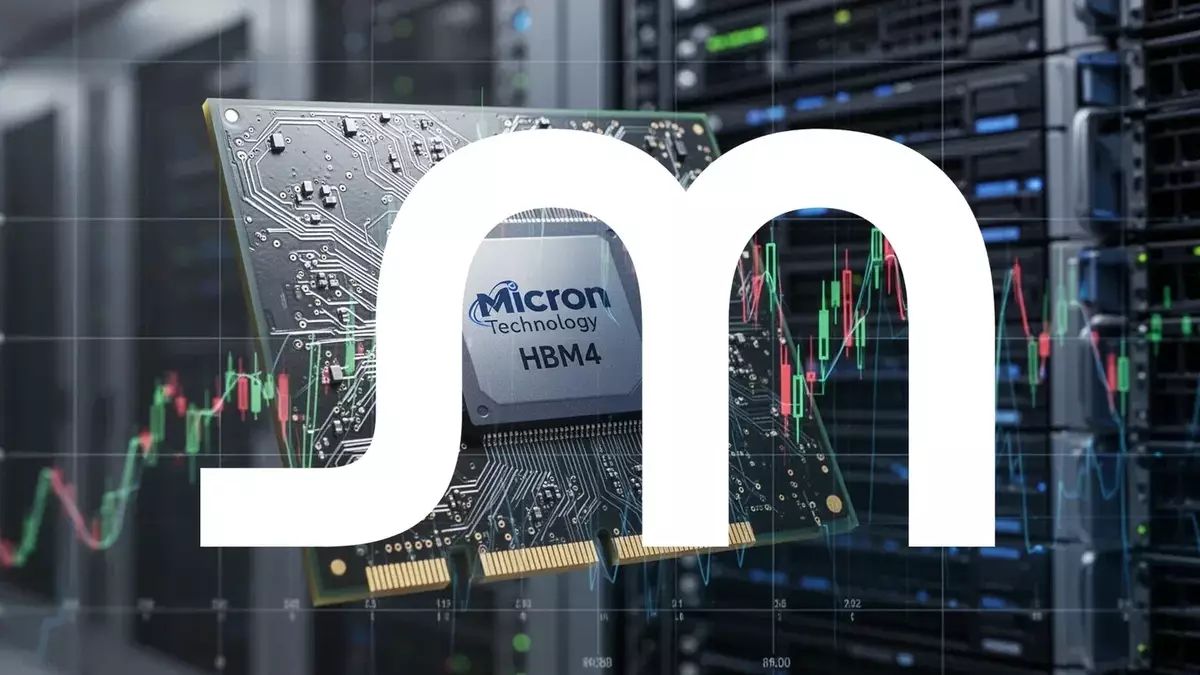
The chip industry has rarely looked more divided. On one side stand the infrastructure providers — Micron, SK Hynix, Nvidia, Infineon, and Broadcom — whose order books are so packed that capacity is spoken for years in advance. On the other sit software giants like Adobe, fighting to prove that generative AI can actually generate revenue. At the fault line lies Micron Technology, which reports fiscal third-quarter earnings on Wednesday and carries the hopes of an entire sector on its shoulders.
The memory maker’s stock trades at €1,020.20, less than half a percent below its 52-week high and up nearly 280% since January. Such a rally leaves no margin for disappointment. Analysts expect earnings per share of $19.72 on revenue of more than $34 billion — a jump of 932% and 270% respectively compared with the same quarter last year. The company’s own guidance points to roughly $33.5 billion in revenue at a gross margin around 81%, a level unprecedented in the history of the memory industry.
Demand for High Bandwidth Memory (HBM) is the engine. Micron’s HBM capacity is fully sold out through the end of 2026, and Nvidia has certified the company alongside SK Hynix and Samsung as a supplier for the Vera Rubin AI platform. Industry-wide capacity bottlenecks are expected to persist until at least 2027, giving manufacturers extraordinary pricing power.
The stress test for Wednesday is not just the headline numbers, but the forward guidance. If Micron fails to raise its forecast yet again, the stock’s richly priced multiple could trigger a sharp correction. The annualized 30-day volatility above 95% tells the story: the market is braced for either ecstasy or agony.
Should investors sell immediately? Or is it worth buying Micron?
The memory crown changes hands in Seoul
No single event better captures the scale of the HBM boom than SK Hynix’s ascent to the most valuable listed company in South Korea. On Monday, its market capitalization reached approximately 2,082.5 trillion won, edging past Samsung Electronics’ 2,081.3 trillion won — a throne Samsung had held since 2000. SK Hynix shares added another 5.61% on the day to hit 2,919,000 won, near their 52-week high.
The company controls roughly 61% of the global HBM market, far ahead of Samsung’s 17% and Micron’s 21%. That dominance was forged during the memory chip downturn, when SK Hynix kept investing while rivals cut back. First-quarter operating profit reached a record 37.61 trillion won, and operating margins hit historic highs. Customers such as Nvidia and Google are locking in long-term capacity. The high switching costs of HBM integration give SK Hynix pricing power that is virtually unheard of in the cyclical memory industry.
Next catalyst: a potential Nasdaq listing, which would broaden the investor base. Meanwhile, the next-generation HBM4 product is on track to cement the company’s lead, with management targeting a market share above 50%.
Nvidia’s bond market message: think in decades
Nvidia itself trades sideways at €182.56, consolidating after its epic run. The defining event of the past week was not a product launch but a debt offering: on June 15, the company placed $25 billion in senior notes — the largest bond issuance by any chipmaker in history. The deal was three times oversubscribed with order books of about $85 billion, allowing Nvidia to increase the original $20 billion size and tighten pricing.
The seven tranches span two to thirty years, with coupons between about 4.25% and 5.60%. A 30-year tranche maturing in 2056 is a wager that AI infrastructure will require financing for three decades — never mind that Nvidia ended the last quarter with $50.3 billion in cash and $50.3 billion in operating cash flow. The bond is not a funding necessity; it is balance-sheet architecture for the long haul.
The company deepened its strategic partnership with OpenAI, becoming the preferred partner for compute and networking. The first gigawatts of Nvidia systems are expected to go online in the second half of 2026. Analysts see a 12-month price target of $298.93 on average, with the highest estimate reaching $500.
Intel and the Apple gamble
Intel’s stock at €121.98 represents a gain of more than 260% since the start of 2026, when it traded near $37. The latest catalyst came from a Truth Social post by President Trump claiming Apple had agreed to jointly manufacture processors with Intel. The Wall Street Journal reported a tentative agreement; neither Apple nor Intel has confirmed. The mere possibility catapulted the shares above the 52-week high of €122.90.
Operationally, Intel has beaten its own revenue expectations for six straight quarters. First-quarter 2026 revenue came in at $13.6 billion, with the data center and AI segment growing 22%. Google awarded Intel Foundry a contract for more than three million TPU chips for production starting in 2028 — business that would otherwise have gone to TSMC.
Analyst opinion is deeply split, with an average 12-month target of $94.14, well below the current price. CEO Lip-Bu Tan has set a goal of decupling shareholder value in five to ten years. Formal foundry customer agreements are expected in the second half of 2026. Whether the Apple deal materializes will determine if Intel becomes a credible TSMC challenger or a valuation bubble.
Infineon: patent wins, patent losses
Infineon notched a daily gain of nearly 5% to €85.99, its highest in months and a doubling year-to-date. The company is the best-performing DAX constituent in 2026 by a wide margin.
A patent dispute over gallium nitride (GaN) power semiconductors illustrates the geopolitical fragmentation of the chip industry. The US International Trade Commission imposed an import ban on rival Innoscience — a clear victory for Infineon in the American market. Simultaneously, China’s Supreme People’s Court upheld a sales ban on Infineon’s GaN products in mainland China. Two rulings, two continents, two opposite outcomes.
Micron at a turning point? This analysis reveals what investors need to know now.
Operationally, Infineon is firing on all cylinders. Second-quarter fiscal 2026 revenue rose 6% to €3.812 billion, with a segment margin of 17.1%. Full-year guidance was raised to over €16 billion in revenue and roughly 20% margin. Free cash flow guidance was lifted by €250 million to €1.65 billion. Analysts have scrambled to raise targets: BofA Securities at €108, Morgan Stanley at €91, JPMorgan at €74. The average analyst target of €75.25 remains well below the current price, underscoring how fast Infineon’s rally has outpaced consensus.
The infrastructure story versus the software story
Broadcom offers another cautionary tale. The AI-XPV platform, a $35 billion initiative led by Apollo and Blackstone, aims to deliver over 20 gigawatts of compute capacity by 2028. The first deployment, starting mid-2026, will serve Anthropic. Broadcom’s AI chip revenue hit $10.8 billion in the latest quarter, up 143% year over year. Yet the stock fell more than 12% after earnings because the third-quarter guidance of $16 billion in AI chip revenue fell short of some hopes. Concerns over VMware pricing and China regulation add to the risk.
Adobe sits at the opposite end of the spectrum. Despite rolling out a sweeping AI update on June 18 — including a Creative Agent that automates complex workflows, integration with ChatGPT, Claude, and Microsoft 365, and a quadrupling of Firefly asset generation — the stock trades at €169.94, barely 2.5% above its 52-week low, down 40% year-to-date. The market is punishing a deliberate shift to a freemium strategy that depresses near-term subscription revenue, along with leadership changes. At a P/E ratio of about 11, the market is pricing in significant disruption from AI-native competitors.
Wednesday’s verdict
The next 48 hours will be decisive. Micron’s earnings report is the single most important event for the entire memory sector. A stock that has gained nearly 300% this year needs to prove that the scarcity premium is structural, not cyclical. Industry-wide capacity constraints, HBM4 certification from Nvidia, and sold-out capacity through 2026 all argue for the structural thesis. But at these valuations, “good” may not be enough — the market will demand raised guidance.
SK Hynix’s planned Nasdaq listing, Nvidia’s 30-year bond wager, Intel’s foundry gamble, Infineon’s GaN crossfire, Broadcom’s infrastructure pivot, Adobe’s monetization struggle — each tells a different story. The common thread is that the hunger for AI infrastructure remains insatiable. The question is which companies will still be standing when the feast is over.
Ad
Micron Stock: New Analysis - 22 June
Fresh Micron information released. What's the impact for investors? Our latest independent report examines recent figures and market trends.