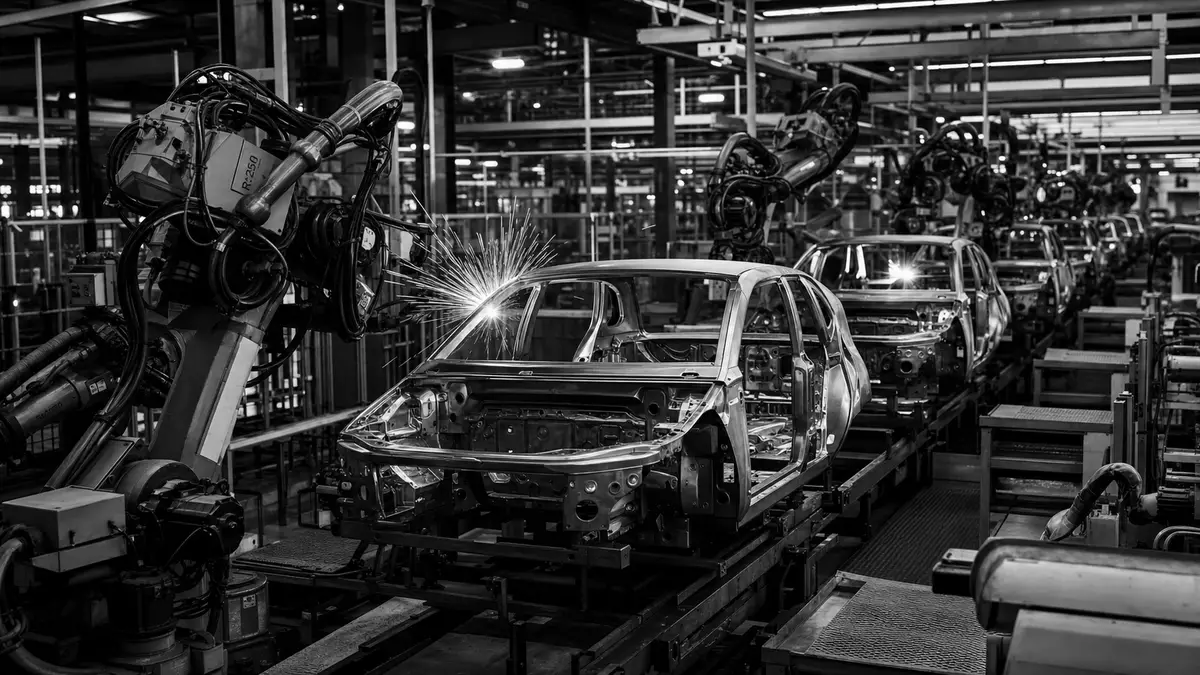
Tesla stock extends gains as higher-margin segments offset price cuts
Published on 07/18/2026 at 08:38 | Editorial responsibility: Rafael Müller, Editor-in-Chief AD HOC NEWS
Tesla Inc. (ISIN US88160R1014) reported that total revenue reached $96.77 billion in fiscal 2024, up from $96.77 billion in 2023 according to company filings, while investors in Tesla stock continue to focus on the shift toward higher-margin software and energy businesses as of 17 July 2026. The electric-vehicle maker, which trades on Nasdaq and is a component of the S&P 500, has faced a year of intense price competition in core automotive markets but is highlighting growth in services, software, and energy storage to support profitability over the medium term.
Revenue tops $96.77 billion in 2024
According to Tesla's most recent Form 10-K filing for fiscal 2024, the company generated total revenue of $96.77 billion for the year, compared with $96.77 billion in 2023, reflecting relatively flat top-line performance as lower average selling prices offset higher vehicle deliveries. Within this total, automotive revenue remained the largest contributor, but growth slowed compared with prior years as global electric-vehicle demand normalized and as competitors introduced a wider range of lower-priced models.
Tesla disclosed in its 2024 annual report that automotive gross margin, excluding regulatory credits, declined year on year as the company implemented several rounds of price reductions across major markets, including the United States, Europe, and China, to defend its market share. The margin pressure underscored how the company's profitability is sensitive to pricing trends in the electric-vehicle segment, especially when raw-material cost tailwinds from earlier years start to fade or reverse. For investors tracking Tesla stock, this shift has increased the importance of monitoring not only vehicle volumes but also the mix of software and services sold with each vehicle.
The company also reported that operating income for fiscal 2024 declined versus 2023, as lower automotive margins and higher research and development spending outweighed cost efficiencies in manufacturing. While exact operating income figures fluctuated by quarter, the annual comparison revealed that Tesla's profitability profile is changing, with the company now relying more on cost discipline and non-automotive segments to offset pricing headwinds in its core car business. This dynamic is central to how the market currently values Tesla stock, with some investors emphasizing long-term optionality in areas such as autonomy and energy over near-term earnings volatility.
Energy and services segments grow faster
Tesla's energy generation and storage segment continued to expand in fiscal 2024, with revenue increasing compared with 2023 as the company deployed more Megapack and Powerwall systems across residential, commercial, and utility-scale customers. The annual report indicated that energy generation and storage revenue rose at a higher percentage rate than automotive revenue, providing a growing contribution to total gross profit despite still representing a smaller share of overall sales. This development supports Tesla's narrative that energy storage can become a significant pillar of its long-term business model.
Services and other revenue, which includes categories such as used vehicle sales, retail merchandise, and paid connectivity, also increased year on year in 2024. The company noted that paid connectivity and software features, including premium connectivity and enhanced driver-assistance options, are gaining traction as the installed base of vehicles grows. For fiscal 2024, the combination of energy and services revenue provided a meaningful offset to slower growth in traditional vehicle sales and contributed to a more diversified revenue mix than in earlier years.
In its commentary accompanying the 2024 results, Tesla emphasized that higher-margin software and services can help stabilize profitability even when automotive pricing is under pressure. The company highlighted that as more vehicles on the road become eligible for software upgrades and subscription-based services, each additional vehicle sold can create an annuity-like revenue stream. This is an important consideration for investors in Tesla stock, who increasingly analyze not just the number of vehicles delivered but also the associated lifetime revenue potential from those vehicles.
More background on Tesla
A broader set of articles and company documents can help investors understand how Tesla's evolving revenue mix, margin profile, and capital spending plans interact with the current valuation of Tesla stock.
Vehicle deliveries and margin trends
Tesla reported in its 2024 earnings materials that it delivered millions of vehicles globally during the year, including the Model 3, Model Y, Model S, and Model X lines, as well as the early ramp of newer products such as the Cybertruck. Compared with 2023, total vehicle deliveries increased, but the growth rate moderated from the rapid expansion seen in earlier years of the electric-vehicle adoption curve. This moderation reflected not only a more competitive landscape but also macroeconomic factors such as higher interest rates, which can affect consumer financing costs for vehicle purchases.
The company's disclosure showed that despite higher deliveries, revenue growth was constrained because the average selling price per vehicle declined after multiple price adjustments across different markets. For example, Tesla described in its annual commentary how price reductions in key regions such as North America and China led to lower revenue per vehicle in 2024 than in 2023, even as unit volumes rose. This combination of higher volume and lower price contributed to the decline in automotive gross margin and demonstrates the trade-off between defending market share and maintaining profitability.
Management has stated that improving manufacturing efficiency and reducing cost per vehicle at factories such as Gigafactory Texas and Gigafactory Berlin remain core priorities. By increasing the share of vehicles produced at these newer, more efficient plants, Tesla aims to offset some of the negative impact from lower selling prices. Additionally, the company continues to emphasize software-driven features such as Autopilot and Full Self-Driving capability, which can be sold as high-margin software upgrades that do not require corresponding increases in manufacturing capacity.
Autonomy and software as long-term drivers
Tesla has repeatedly characterized autonomy and software as central to its long-term strategy, arguing that advanced driver-assistance and potential full self-driving capabilities can transform its vehicles into software platforms. The company's financial disclosures in 2024 showed growing revenue from software-related features, although this revenue remains a smaller contributor compared with hardware sales. Tesla highlighted the potential for subscription-based offerings, where drivers pay a recurring fee for access to premium software features, as a way to generate more stable and predictable cash flows over time.
In 2024, research and development expenses increased compared with 2023, as Tesla continued to invest in artificial intelligence, neural-network training infrastructure, and on-vehicle computing hardware. These investments are necessary to improve the performance of driver-assistance systems and to support other software features that can enhance the user experience. The higher R&D spending contributed to lower operating income year on year but is positioned by management as an investment in future capabilities that could support higher-margin revenue streams.
From an investor perspective, one of the debates around Tesla stock centers on how much value to assign to these future software and autonomy opportunities today. Some market participants view the current spending as a necessary foundation for potential future revenue lines that could be less cyclical than vehicle sales. Others focus more on near-term profitability and cash flow, noting that the company must balance ambitious long-term projects with the need to maintain a healthy balance sheet and funding flexibility.
Production footprint and capital spending
Tesla's 2024 filings detailed ongoing capital expenditures across its global manufacturing footprint, including investments in Gigafactory Texas, Gigafactory Berlin, and facilities in Shanghai and Fremont. Capital expenditures for the year were higher than in some earlier periods, reflecting the need to expand capacity for both vehicles and energy storage products. These investments are intended to support future volume growth and to improve manufacturing efficiency by integrating more production processes in-house.
At the same time, Tesla has communicated that it strives to maintain a strong liquidity position, with cash and cash equivalents measured in the tens of billions of dollars as of the end of fiscal 2024. This liquidity provides a buffer against potential macroeconomic shocks and gives the company flexibility to continue investing in technology and capacity even during periods of market volatility. In addition, Tesla has described its approach to managing debt and leverage as cautious, preferring to rely on internally generated cash flow to fund much of its capital program.
These capital allocation choices are an important part of the investment case for Tesla stock, as they influence both the company's growth trajectory and its risk profile. A higher pace of capital spending can support faster expansion but also raises execution risk if demand does not materialize as expected. Conversely, a more conservative spending path could protect the balance sheet but might slow the rollout of new products and technologies, potentially affecting Tesla's competitive position in fast-moving markets.
Model 3 and Model Y remain core products
The Model 3 sedan and Model Y crossover remained Tesla's best-selling vehicles in 2024 and represented the majority of the company's vehicle deliveries. These models have been central to Tesla's strategy of bringing electric vehicles to a broader consumer base, with multiple variants at different price points and ranges. By leveraging a common platform and many shared components between Model 3 and Model Y, Tesla has been able to achieve economies of scale and simplify its manufacturing processes.
In several regions, Tesla introduced updated versions of the Model 3, often referred to as refreshed or performance-enhanced variants, which include improvements in range, interior materials, and driver-assistance features. These updates are designed to keep the vehicles competitive as new models from other automakers enter the market. The company has also used over-the-air software updates to add or improve features in existing vehicles, which can enhance the ownership experience and create opportunities for additional revenue from software upgrades.
Model 3 and Model Y also play a critical role in Tesla's energy and software ecosystem because they constitute a large share of the installed base of vehicles that can subscribe to premium connectivity or advanced driver-assistance packages. As this installed base grows, the potential market for recurring software revenue expands as well. This linkage between vehicle sales and software monetization is a key aspect of the long-term narrative around Tesla stock.
Tesla stock and market positioning
Tesla stock is widely followed by institutional and retail investors alike due to the company's prominent position in the global electric-vehicle and clean-energy sectors. The company's inclusion in major equity indices such as the S&P 500 means that many passive investment funds also hold Tesla shares as part of their benchmark-tracking portfolios. As a result, changes in Tesla's market capitalization can have broader implications for index performance and for investors who hold diversified funds.
Market participants often evaluate Tesla not only against traditional automakers but also against high-growth technology companies, given its focus on software, artificial intelligence, and energy solutions. This dual identity can lead to periods of elevated volatility in Tesla stock, as valuations adjust to shifting expectations about both automotive fundamentals and technology-driven optionality. For example, when delivery growth slows but software or energy metrics improve, different investor groups may react differently based on which aspect of the story they prioritize.
Analysts and investors also pay close attention to Tesla's commentary on future product plans, including potential lower-cost vehicle platforms, next-generation batteries, and expanded energy offerings. While such plans often require substantial upfront investment and carry execution risk, they are also central to many long-term valuation models for Tesla stock. The balance between near-term financial performance and long-term strategic positioning remains a defining feature of the investment debate around the company.
Current trading context for Tesla stock
As of mid-July 2026, Tesla stock continues to trade on Nasdaq with a market capitalization measured in the hundreds of billions of dollars, reflecting the company's large scale and significant role in global equity markets. Daily trading volumes remain high compared with many peers, indicating sustained investor interest and liquidity in the shares. This liquidity can be an advantage for investors who seek the ability to adjust positions quickly in response to new information about deliveries, margins, or strategic announcements.
In recent months, the share price has reflected the tug-of-war between concerns about margin compression in the automotive business and optimism about growth in energy storage, software, and autonomy. When Tesla reports quarterly results, the market often reacts not only to headline earnings and revenue figures but also to details about segment performance, such as energy storage deployments or software take rates. These details can have an outsized impact on valuation because they inform expectations about the company's long-term earnings power beyond vehicle sales alone.
For investors monitoring Tesla stock, it is therefore important to look beyond the headline delivery numbers and to consider the evolving mix of revenue and profit across automotive, software, and energy segments. The company's 2024 results provide a detailed snapshot of this transition, showing how higher-margin non-automotive businesses are beginning to offset price pressure in the core vehicle segment, even as the company continues to invest heavily in future technologies.
Key data on Tesla
- Company: Tesla Inc.
- ISIN: US88160R1014
- Ticker: NASDAQ: TSLA
- Trading venue: Nasdaq
- Sector / Industry: Automobiles / Electric vehicles and energy storage
- Index membership: S&P 500
Disclaimer regarding our articles: No investment advice, no buy or sell recommendation. Information on prices, companies, and markets is provided without guarantee; changes are possible at any time. Stock market transactions can lead to substantial losses. Our articles are created and reviewed in whole or in part automatically with the support of AI.