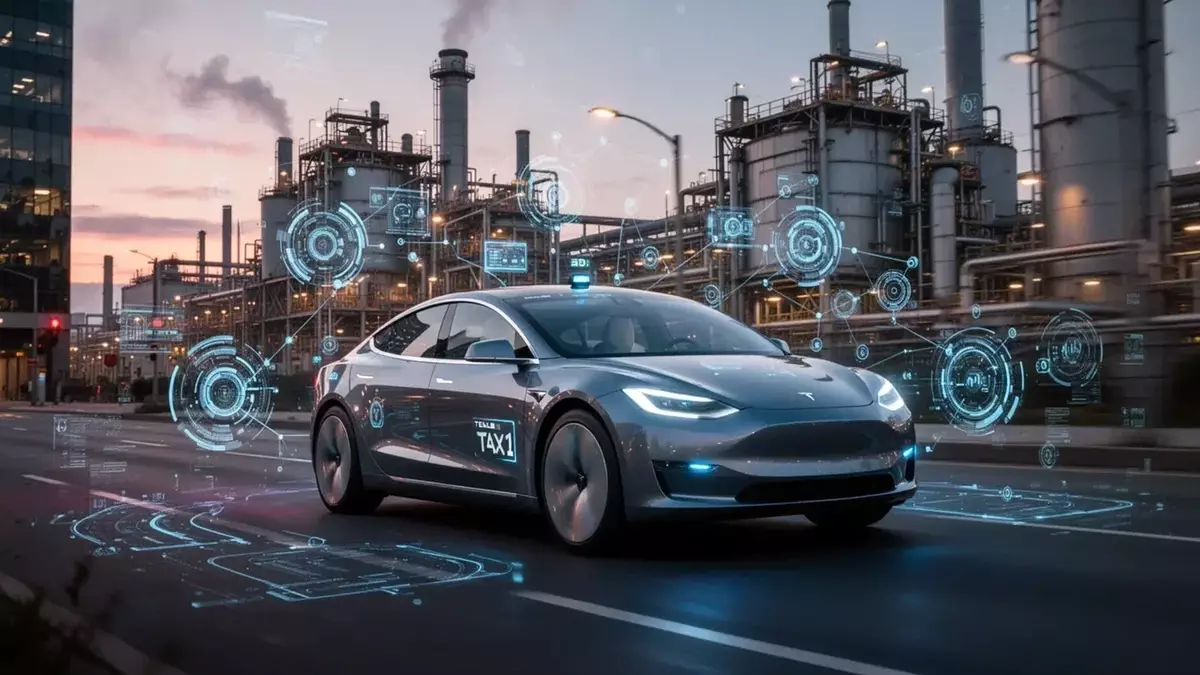
Tesla's $25 Billion AI Gamble Meets a Credibility Gap Over FSD Safety Data
16.06.2026 - 16:23:12 | boerse-global.de
Tesla is pouring money into its future at an unprecedented rate — the automaker bumped its 2026 investment plan to roughly $25 billion in April, up $5 billion from the January forecast. Yet even as CFO Vaibhav Taneja flags negative free cash flow for the rest of the year, the company faces a mounting credibility challenge on the very technology underpinning that spending spree: its Full Self-Driving software.
The tension between ambition and trust has left the stock in limbo. Shares slid 2% to €346.80 in recent trading, pushing the year-to-date loss to around 7%. That compares with the €354.25 level seen earlier in the week, when the stock was down roughly 5% for 2026. Technicals confirm the indecision: the relative strength index sits at 50.5, precisely neutral, while the price hovers 3.3% above the 50-day moving average but almost 1% below the 200-day average of €358. Analysts’ consensus target of €362 suggests the market sees little near-term upside from current levels.
The immediate trigger for the latest selloff was the release of documents showing that Tesla submitted its own safety data to Dutch and Swedish regulators to support FSD’s European rollout. Independent traffic researchers have slammed the figures as misleading marketing. Tesla claims the software is up to ten times safer than human drivers and that it could have prevented 32,000 deaths — a number based on the improbable assumption that every vehicle in the United States would be replaced by an FSD-equipped Tesla. Critics also note the company compares accident rates of cars with the assistant activated against completely different national averages.
Those regulators pushing through approvals are pushing back. The Dutch road authority RDW insists it conducts its own rigorous tests and does not rely on external marketing numbers. It issued a preliminary national type approval in April, and FSD is now operational under supervision in six countries: the Netherlands, Lithuania, Estonia, Belgium, and Denmark. Germany and France are still evaluating the system.
Should investors sell immediately? Or is it worth buying Tesla?
A full EU-wide green light remains elusive. The process requires at least 55% of member states representing 65% of the bloc’s population to vote in favor. The technical committee is scheduled to meet again on June 30 for further discussion, but no formal vote is on the table yet.
The regulatory stakes are high because Tesla is losing ground in Europe to Chinese rivals like BYD. To boost uptake, the company switched to a subscription model in May, charging €99 per month for FSD and eliminating the one-time purchase option. Meanwhile, a separate narrative is eroding the safety case: Chinese drivers are using small figurines to trick the interior camera into registering attention, letting Autopilot take over while the driver looks away.
That controversy unfolds against a backdrop of staggering capital deployment. The $25 billion earmarked for 2026 is roughly triple the company’s historical average annual spend of about $8.5 billion (2023: $8.9 billion, 2024: $11.3 billion, 2025: ~$8.5 billion). Taneja made clear on the April earnings call that the cash is directed at AI infrastructure to scale the robotaxi service and the Optimus humanoid robot. The robotaxi is already live in Austin, Dallas, and Houston, but material revenue is not expected before 2027 at the earliest.
The auto business remains the cash engine funding this transformation. In the first quarter, Tesla produced roughly 408,000 vehicles but delivered only 358,000, pushing global inventory to 27 days from 15 days in the prior quarter. Analyst Gordon Johnson of GLJ Research forecasts deliveries of around 426,000 for the second quarter — an official report is due early July. Even a strong quarter, however, would do little to justify a market capitalization near €1.3 trillion.
Energy storage, another pillar of the long-term thesis, hit a speed bump: deployments fell 38% from 14.2 GWh in the fourth quarter of 2025 to 8.8 GWh in the first quarter of 2026. Management attributes the drop to the project-based nature of the business and says full-year deployments will exceed 2025 levels. Production lines for the next-generation Megapack 3 are ramping up.
Tesla at a turning point? This analysis reveals what investors need to know now.
J.P. Morgan has already shifted its valuation framework to autonomous driving and robotics, projecting revenue growth from roughly $95 billion in 2025 to about $203 billion by 2030, driven by robotaxi and Optimus. That is the purest form of the bull case: the current stock price is a placeholder for a business that does not yet exist.
For much of the market, the question is whether Tesla’s $25 billion bet will materialize quickly enough — or whether the credibility gap over its own safety data will undermine the regulatory approvals needed to make that vision real. The 52-week low of €251, 41% below the current price, is a stark reminder of how fast sentiment can shift when timelines slip.
Ad
Tesla Stock: New Analysis - 16 June
Fresh Tesla information released. What's the impact for investors? Our latest independent report examines recent figures and market trends.