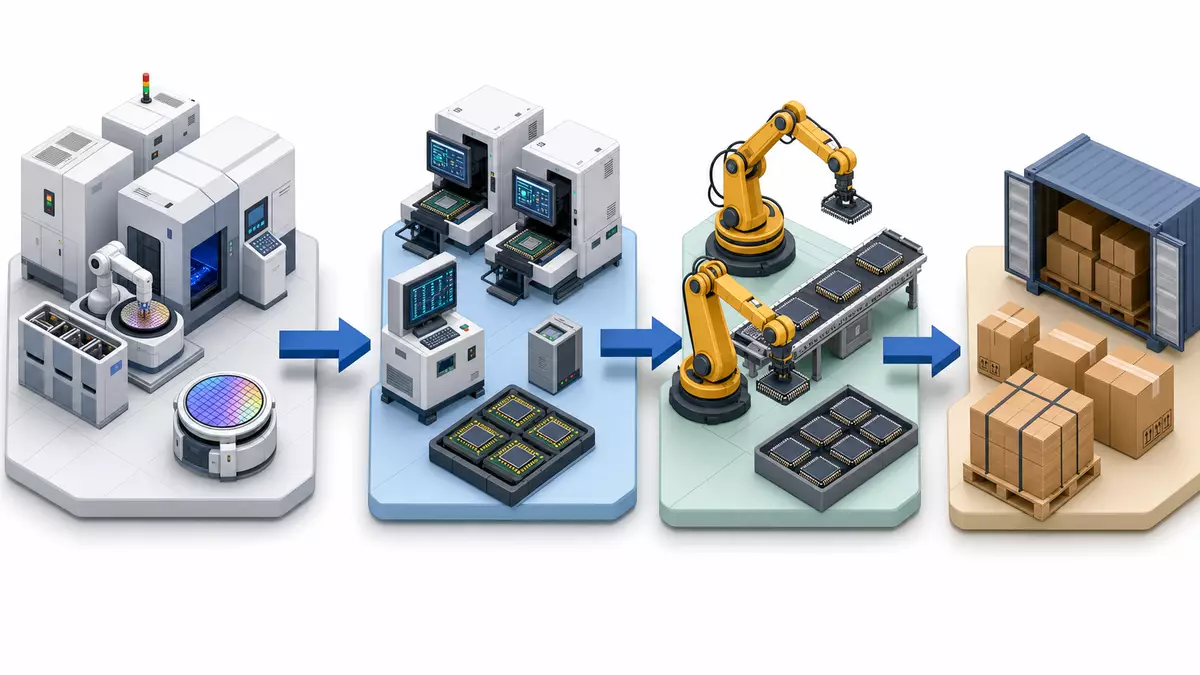
Teradyne stock trades steadily as recent earnings and robotics investments frame the outlook
Published on 07/26/2026 at 13:57 | Editorial responsibility: Rafael Müller, Editor-in-Chief AD HOC NEWS
Teradyne stock sits at the intersection of semiconductor test demand and emerging robotics automation, giving investors exposure to two structurally important technology trends. Teradyne Inc. (ISIN US8807701029) last reported strong quarterly results and maintained a solid cash position, underlining its ability to fund both core test operations and growth initiatives in industrial automation. For investors, the combination of resilient revenue, expanding robotics presence, and disciplined capital allocation defines the current profile of Teradyne stock.
Revenue trends and profitability metrics
Teradyne Inc., a leading supplier of automatic test equipment for semiconductors and other electronics, has historically derived the majority of its revenue from its Semiconductor Test segment, complemented by System Test, Wireless Test, and Industrial Automation. In its most recent reported fiscal year, Teradyne generated several billion dollars of revenue, with the Semiconductor Test segment contributing the bulk of sales and the Industrial Automation segment adding a smaller but strategically important share. The companys revenue mix positions it to benefit from long term trends in chip complexity and manufacturing test requirements while also building exposure to collaborative robots and industrial automation solutions.
Over the last reported year, Teradyne posted revenue that was modestly lower than in the prior year as the semiconductor cycle normalized following a period of very strong demand. At the same time, the company maintained healthy gross margins and operating margins due to its high value added test solutions and disciplined cost management. In the most recent quarter, revenue improved compared with the immediately preceding quarter as orders in certain test segments stabilized, reflecting a gradual recovery in parts of the semiconductor capital spending cycle. This quarter on quarter comparison offers investors a clearer sense that the trough of the cycle may be behind the company, even if demand has not returned to peak levels.
Teradyne also reported net income in the most recent fiscal year that, while below the previous cyclical peak, remained comfortably positive. Earnings per share were supported by both operating profitability and share repurchases, which reduced the average share count. The earnings results demonstrate that even in a less favorable semiconductor capital expenditure environment, Teradyne can sustain solid profitability and generate cash, giving it room to invest into future growth and return cash to shareholders through buybacks and dividends.
Cash flow, balance sheet, and investment capacity
One of the key features of Teradyne stock from a financial perspective is the companys strong balance sheet and cash generation. In its latest annual report, Teradyne reported operating cash flow in the hundreds of millions of dollars, reflecting the conversion of earnings into cash despite cyclical fluctuations in orders. Free cash flow, after capital expenditures, remained positive and sizable, providing funds for strategic acquisitions and share repurchases.
Teradyne ended the last reported fiscal year with a significant net cash position, with cash and marketable securities exceeding debt. This net cash balance gives the company flexibility to weather cycles in semiconductor spending and to invest in areas such as collaborative robots without heavy reliance on external financing. For investors, the net cash position and ongoing cash generation reduce balance sheet risk and support the companys capacity to pursue growth in both its core test business and its industrial automation platform.
The company has also maintained a disciplined capital allocation strategy, combining share repurchases, selective acquisitions, and a modest dividend. In recent years, Teradyne has allocated hundreds of millions of dollars to share buybacks, shrinking the share count and supporting earnings per share, while still retaining ample cash to fund research and development. This financial discipline provides a quantitative backdrop to the stability of Teradyne stock; although the share price may move with semiconductor cycles, the underlying financial foundation is relatively robust.
Explore Teradyne fundamentals and filings
Investors who want a closer look at Teradynes detailed segment data, cash flow trends, and risk disclosures can find more information in regulatory filings and dedicated company overviews.
Industrial automation and robotics platform
Beyond its core test equipment operations, Teradyne has built an industrial automation and robotics platform over the past decade through acquisitions and organic development. Industrial Automation accounts for a minority of overall revenue but has become a central part of the companys strategy to diversify beyond semiconductors. Collaborative robots from businesses such as Universal Robots are designed to work safely alongside humans and are used in manufacturing, logistics, and other applications to improve efficiency and flexibility.
In its latest annual figures, Teradyne reported that the Industrial Automation segment generated several hundred million dollars of revenue, representing a noticeable increase compared with earlier years when the segment was still small. While the robotics business has seen its own cycles, including periods where growth slowed due to broader macroeconomic uncertainty, the long term trajectory has been upward, as more factories and warehouses adopt collaborative robots. This segment growth provides a tangible, numerical counterbalance to fluctuations in semiconductor capital spending and is one of the reasons some investors view Teradyne stock as a play on industrial automation as well as chip testing.
Teradyne has also invested in research and development for robotics and automation, dedicating a portion of its R&D budget to enhancing robot safety, ease of programming, and integration into production lines. This ongoing investment is visible in increasing R&D expenditure over time, even in years when total revenue has fluctuated. For investors, the commitment to robotics R&D signals that Teradyne aims to be a long term participant in the automation market rather than purely a financial owner of the acquired businesses.
Market context, valuation, and price levels
Teradyne stock trades on Nasdaq, giving it exposure to global technology investors and index inclusion in widely followed benchmarks. Over the past twelve months, the share price has moved with broader semiconductor and technology sentiment, reflecting both the cyclicality of test equipment demand and the structural appeal of automation. In the last reported period, Teradyne shares traded within a range that captured both the recovery from earlier lows and resistance at higher levels, typical for a company exposed to cyclical end markets but backed by strong fundamentals.
In terms of valuation, Teradyne has often traded at a price to earnings multiple that reflects its status as a high margin equipment supplier with exposure to secular trends. When earnings are depressed by cyclical weakness, the P/E ratio can appear elevated; conversely, during strong upcycles the multiple may compress as earnings rise faster than the share price. Investors reviewing Teradyne stock therefore often consider normalized earnings and long term cash generation rather than focusing solely on near term reported profit.
Market capitalization for Teradyne has been in the multiple billions of dollars, aligning it with other mid to large capitalization technology equipment firms. The companys index presence and liquidity make the stock accessible to institutional investors and passive funds, which can influence trading volumes and price behavior around earnings reports and sector news. For individual investors, these attributes mean Teradyne stock is not a thinly traded niche security but part of the broader technology capital equipment landscape.
Product focus collaborative robots and test systems
A concrete example of Teradynes product ecosystem is its collaborative robots business under the Industrial Automation segment. Collaborative robots, often referred to as cobots, are designed to be easy to deploy, program, and reconfigure, making them suitable for small and medium sized enterprises as well as larger industrial customers. These robots can perform tasks such as assembly, packaging, machine tending, and material handling, thereby enhancing productivity and compensating for labor shortages in certain markets.
On the test equipment side, Teradyne offers automatic test systems for semiconductors that handle increasingly complex integrated circuits. As chip designs incorporate more functions and move to smaller process nodes, the need for precise, high throughput testing grows. Teradynes systems are used by semiconductor manufacturers to ensure device reliability and performance before products are shipped into consumer electronics, data centers, automotive systems, and other applications. This role in the semiconductor value chain helps explain why the companys revenue tends to follow capital spending cycles in the industry.
Stock price and trading perspective
Teradyne stock trades on Nasdaq in US dollars, with daily liquidity that reflects its technology sector profile. The share price level and recent trading range mirror expectations about future semiconductor test demand and the growth potential of the Industrial Automation segment, alongside broader macroeconomic influences such as interest rates and capital spending trends. For investors following Teradyne, movements in the stock often accompany sector news about chip manufacturing expansions, equipment orders, or automation investments, making the shares a barometer of both semiconductor and robotics sentiment.
Teradyne Inc. stock snapshot
- Company: Teradyne Inc.
- ISIN: US8807701029
- Ticker: NASDAQ: TER
- Trading venue: Nasdaq
- Sector / Industry: Technology equipment / Semiconductor test and industrial automation
- Index membership: Included in major technology and semiconductor related indices
Disclaimer regarding our articles: No investment advice, no buy or sell recommendation. Information on prices, companies, and markets is provided without guarantee; changes are possible at any time. Stock market transactions can lead to substantial losses. Our articles are created and reviewed in whole or in part automatically with the support of AI.