

Siemens Builds Out Three Growth Engines: SiC Data Center Chips, Defence Software, and Digital Locomotives
Published on 06/12/2026 at 18:24 | Editorial boerse-global.de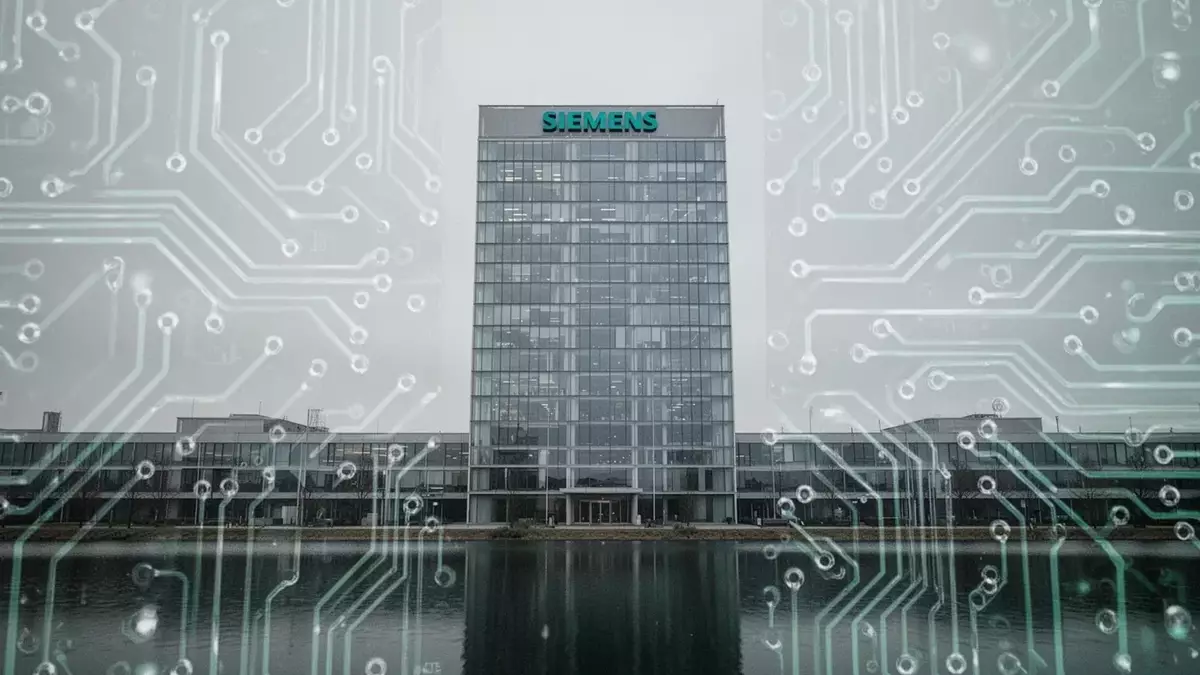
Siemens is widening its industrial reach on multiple fronts, from protecting data centers against power surges to arming military production lines and turning trains into rolling software platforms. The German conglomerate announced a partnership with Infineon on 8 June to embed silicon carbide (SiC) modules into its SENTRON 3QD2 circuit breaker, tapping a market turbocharged by the AI boom. At the same time, it has struck a deal with the state of North Rhine-Westphalia to set up a "Production Launch Centre Defence" (PLCD) that will apply Siemens' automation and digital manufacturing software to accelerate military hardware series production.
The SiC technology from Infineon allows faster switching, higher temperature tolerance, and lower energy losses than conventional silicon — precisely the attributes needed to manage the soaring power densities inside modern AI data centers. With hyperscalers packing ever more computing power into tight spaces, the risk and cost of outages have risen sharply. Siemens' SENTRON 3QD2, now equipped with Infineon's modules, aims to guard against short circuits and overloads in these critical environments. The move is less a breakthrough than a deliberate step into a fast-growing niche where demand is being driven by global AI infrastructure build-out.
On the defence side, the PLCD partnership marks a more dramatic shift for Siemens, which has traditionally stayed clear of weapons production. The company will supply software for automation and digital manufacturing, with the goal of cutting the time it takes to get innovations into military series production. Analysts interpret the move as a validation of Siemens' broader strategy to position itself as a provider of highly specialised industrial software, noting that national security increasingly relies on modern IT infrastructure.
Should investors sell immediately? Or is it worth buying Siemens?
The rail business, meanwhile, is undergoing its own quiet transformation. Siemens is redefining locomotives as modular software platforms where new functions can be delivered via digital updates rather than mechanical retrofits. Artificial intelligence monitors systems and flags faults early, slashing maintenance costs for operators. The approach has already won a string of new orders recently, underscoring the traction of digital services in the traditionally conservative sector.
The market has taken a mixed view of these developments. Siemens shares traded at €263.95 on the day of the Infineon announcement, a fractional dip of 0.4 percent, but the stock has gained roughly 9.6 percent since the start of the year and about 21 percent over twelve months. More recently, the share price slipped below its 38-day moving average but appears to have found support around €258, preserving the long-term uptrend that has been in place since spring.
One stabilising force is the dividend. DAX-listed companies are expected to pay out a record nearly €57 billion to shareholders in 2026, with Siemens counted among the heavyweights. Analyst consensus points to further upside: the average price target is €275, with the most optimistic forecast reaching €330. That optimism is rooted in Siemens' core industrial divisions — smart infrastructure and digital industry — which are riding the wave of data centre expansion fuelled by artificial intelligence.
The next concrete catalyst for the stock will come with the quarterly earnings release, when investors will see whether demand from the data centre segment is already flowing through to the bottom line. Until then, the trio of strategic moves — SiC circuit breakers, a defence software hub, and digital locomotives — provides a narrative of a conglomerate deliberately reshaping itself for a world where hardware and software are increasingly inseparable.
Ad
Siemens Stock: New Analysis - 12 June
Fresh Siemens information released. What's the impact for investors? Our latest independent report examines recent figures and market trends.


