Rocket Lab's Record Quarter Can't Shield It From Insider Profit-Taking, a Rival's Explosion, and SpaceX's IPO Shadow
03.06.2026 - 16:53:42 | boerse-global.de
The space sector has been rocked by a triple whammy in recent days, and Rocket Lab USA is bearing the brunt despite posting its strongest-ever quarterly numbers. The stock slid 15% in a single session on Monday to $123.32, and has tumbled further to around $118 — a drop of more than 21% from the all-time high of $151 set on May 27. What makes the sell-off particularly striking is that it comes as the company's fundamentals are hitting new highs of their own.
Insiders Cash In as Strength Turns to Weakness
Before the market turned south, four Rocket Lab insiders quietly moved a combined $18 million worth of shares, setting an early tone of caution. Director Alexander Slusky led the charge with a roughly $9 million sale, offloading 60,000 shares. President Marvin Clevenger sold 3,500 shares for about $513,000, while COO Frank Klein and chief legal officer Arjun Kampani also trimmed their positions. Both Klein and Kampani executed their trades through pre-arranged 10b5-1 plans, which limit the signaling power of insider moves. Even so, the coordinated profit-taking rattled retail investors and coincided with a broader sector correction.
An Explosion at Blue Origin and SpaceX's Looming IPO
The worst external blow came from an unexpected quarter: Blue Origin's New Glenn rocket suffered a dramatic engine test failure in Florida. Rocket Lab has no operational ties to Blue Origin, but the blast triggered a wave of risk aversion across the entire space industry, dragging down shares of unaffiliated companies. Investors, already edgy after months of strong gains, seized the opportunity to lock in profits — the stock was up over 60% year-to-date and trading in overbought territory.
Meanwhile, the persistent chatter around a SpaceX initial public offering added another layer of uncertainty. SpaceX is reportedly targeting a valuation between $1.75 trillion and $1.8 trillion, with plans to sell 555.6 million shares at $135 apiece to raise $75 billion. CEO Elon Musk pushed back against speculation that the valuation target had been trimmed, but the lack of clarity has created a classic "buy the rumor, sell the news" pattern that market watchers warn could reverse sharply after the pricing date.
Should investors sell immediately? Or is it worth buying Rocket Lab USA?
The Operating Reality: Record Revenue and a $2.2 Billion Backlog
The gulf between the stock's price action and the company's performance is stark. Rocket Lab generated first-quarter revenue of $200.4 million — a 64% jump year over year — with the space systems division contributing $136.7 million and launch services adding $63.7 million. Both segments beat analyst expectations. The backlog swelled to a record $2.2 billion, more than doubling from the prior year. In the first quarter alone, Rocket Lab signed 36 new launch contracts, a figure that surpasses the 21 missions it flew in all of 2025. Five of those contracts are dedicated bookings for the still-unflown Neutron rocket.
Defense contracts are pouring in as well. The Space Development Agency awarded Rocket Lab deals totaling over $1.3 billion for the Tracking Layer satellite network designed for missile defense, built on the company's Lightning platform. Separately, the U.S. Space Force contracted Rocket Lab for two geostationary satellites worth $90 million. These wins underscore the company's growing role in military space infrastructure.
Robotics and the Neutron Catalyst
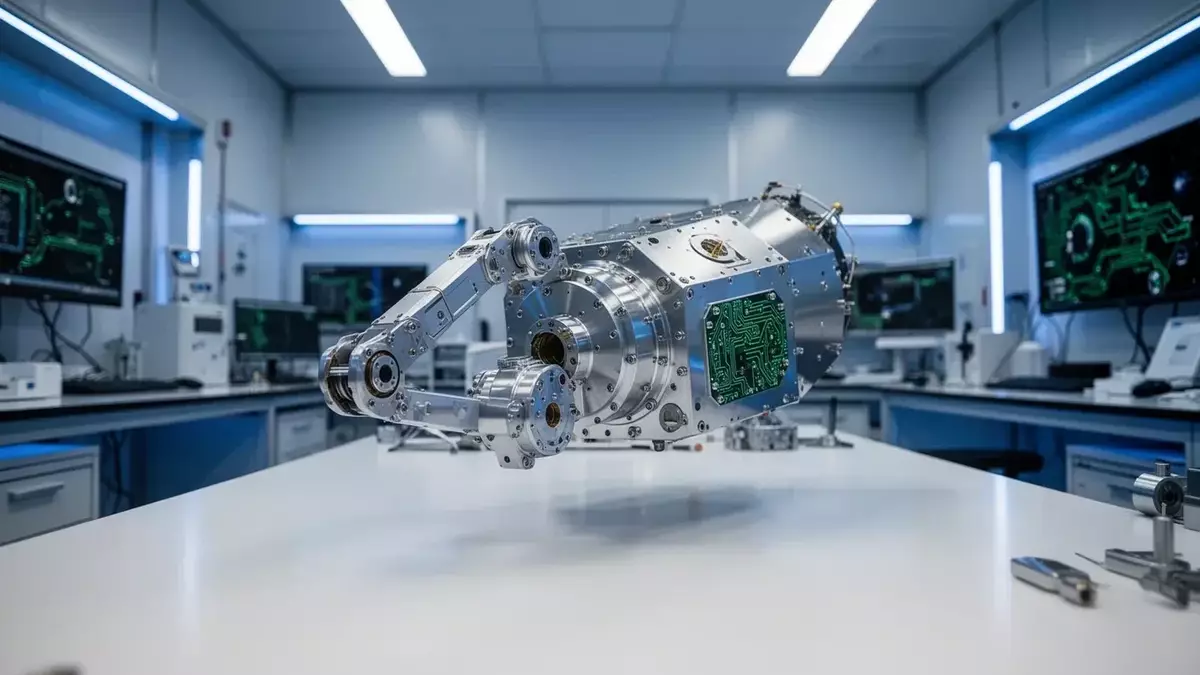
Rocket Lab recently closed its acquisition of Motiv Space Systems, now rebranded as Rocket Lab Robotics. The California-based developer brings proven flight heritage — its technology is inside NASA's Perseverance rover on Mars — and strengthens Rocket Lab's ability to produce critical components such as solar drive units and antenna controllers in-house. That vertical integration is especially valuable for power-hungry platforms like orbital data centers and large satellite constellations.
Rocket Lab USA at a turning point? This analysis reveals what investors need to know now.
The next major catalyst remains the Neutron rocket, whose first flight is now expected in the fourth quarter of 2026 after a fuel tank failure derailed the original 2024 timeline. Rocket Lab has already submitted its launch license application to the FAA. With over $2 billion in available liquidity, the company is well-financed to reach that milestone. A successful debut would not only close the gap with Blue Origin and other medium-lift contenders but could also make last week's sell-off a footnote. For now, though, investors are watching three separate storm clouds converge on a company that, by any operational measure, is flying higher than ever.
Ad
Rocket Lab USA Stock: New Analysis - 3 June
Fresh Rocket Lab USA information released. What's the impact for investors? Our latest independent report examines recent figures and market trends.