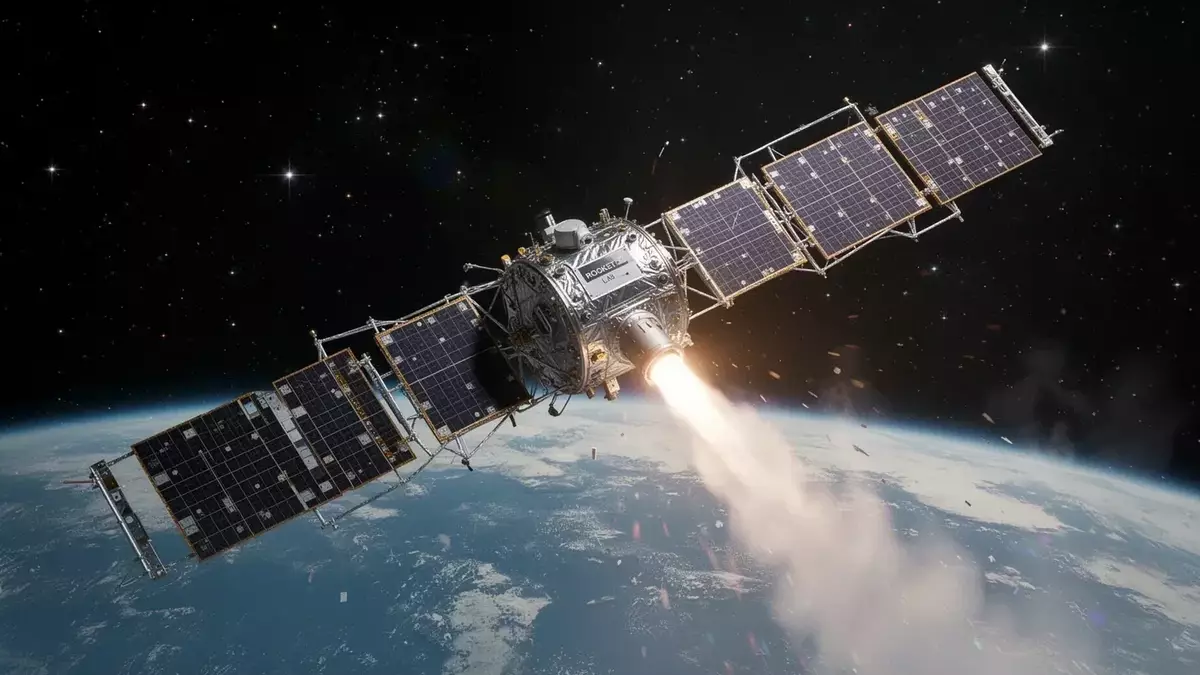
Rocket Lab's Index Entry Collides With Insider Cover and a Rocket on the Ground
19.06.2026 - 05:03:38 | boerse-global.de
Rocket Lab USA joins the Nasdaq-100 on Monday — a moment that typically funnels millions in passive inflows toward a stock. Yet the space company enters the index with a delayed launch, a top lawyer shuffling nearly $10 million in equity, and investors parsing whether the stock's long-term thesis is intact or stretched. The shares closed Friday at $103.81, down nearly 4% on the day and more than 30% below the 52-week peak of $151.00 touched in May.
Chief legal officer Arjun Kampani moved 88,000 shares worth around $9.5 million into an exchange fund on Thursday. The transaction was not a direct market sale — instead, it diversified his personal risk while leaving him with direct ownership of more than 264,000 shares. Such insider moves often raise eyebrows, especially when the stock is nursing a one-month loss of roughly 18% and a seven-day decline of about 10%. Still, Kampani is not cashing out; he is redistributing exposure.
The broader sell-off has taken Rocket Lab from its highs, but the decline does not yet look like a rout. The shares are trading almost exactly at their 50-day moving average of $103.84 — a level that could act as either a springboard or a floor. The 200-day average sits at $75.26, leaving the stock 38% above that longer-term trend line. Meanwhile, the relative strength index at 45 points to neutral consolidation rather than speculative exhaustion. Over the past 12 months, Rocket Lab has nearly quadrupled, and year-to-date the gain stands at roughly 37%.
Should investors sell immediately? Or is it worth buying Rocket Lab USA?
The operational narrative has hit turbulence. Management postponed the "Ten Owl of Ten" mission for Japanese radar-imaging company Synspective, citing additional technical checks on the Electron rocket. A new launch window has not been announced. The delay comes on top of lingering unease from an incident on June 11, when a suborbital HASTE test flight prompted the U.S. Space Force to flag an object in orbit. Rocket Lab quickly stated it "has never unintentionally placed objects in orbit," but the ambiguity has added volatility. The annualized 30-day volatility reading of around 141% underlines how every technical snag can amplify price swings.
All eyes are on the Neutron rocket — the medium-lift vehicle that could open constellation-building and security missions. Management detailed progress during the May update: first flight hardware integration, qualification of the Archimedes engine, and work on the second stage and reusability systems. First flight is still expected this year. But the market remembers the hydrostatic test failure at Wallops earlier this year, when the first-stage tank ruptured during a structural limits test. Rocket Lab says the test was designed to find those limits and that a replacement tank is already in production. Neutron remains the hinge: the stock's long-term believers are still on board, but each month without a successful flight raises the premium investors demand.
The company's strategy extends beyond launch vehicles. The recent acquisitions of Mynaric (laser communications) and Motiv Space Systems (renamed Rocket Lab Robotics) bring in-house optical links and precision mechanisms for spacecraft. The Gauss electric propulsion system, unveiled in April, targets commercial and defense satellite constellations. This vertical integration push is no random shopping spree — it aims to embed Rocket Lab deeper into the hardware stack of proliferated space architectures, reducing dependence on the single-product economics of rocket launches alone.
But the market has already priced in a great deal of future competence. With a market capitalisation of nearly €59 billion — a figure that places Rocket Lab far beyond the small-cap territory where it was once discovered — the stock needs execution, not just ambition. The distance from the 52-week low of $27.85 works out to a gain of roughly 273%, leaving little room for further narrative inflation without tangible, repeatable flight data. The Nasdaq-100 entry will force index funds to buy the shares, providing a mechanical floor. Whether that floor holds depends on whether Rocket Lab can convert its engineering ambition into industrial rhythm before the next Neutron milestone slips.
Ad
Rocket Lab USA Stock: New Analysis - 19 June
Fresh Rocket Lab USA information released. What's the impact for investors? Our latest independent report examines recent figures and market trends.