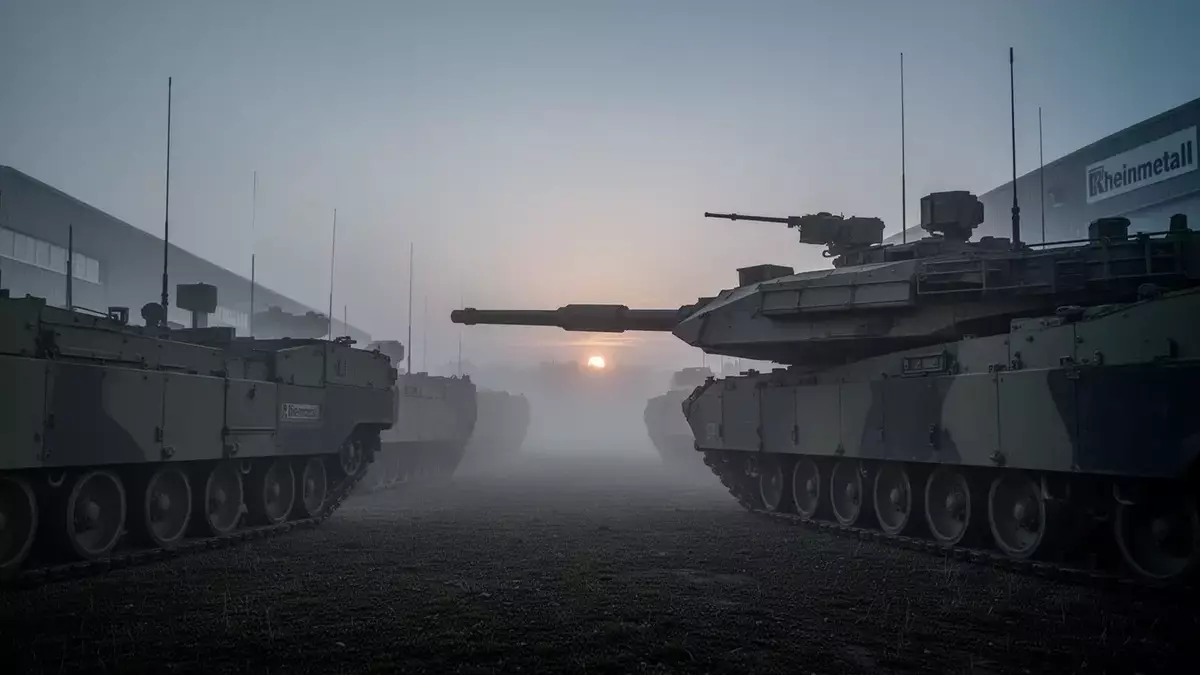
Rheinmetall's Pure Defense Pivot Leaves No Room for Error as MGCS Cracks
14.06.2026 - 06:35:33 | boerse-global.de
The numbers tell a story that no amount of trade-show fanfare can easily rewrite. Rheinmetall’s stock ended last week at €1,196.60, a 3.11% slide that deepened a months-long retreat. Since the start of the year the equity has shed roughly a quarter of its value, and over the past twelve months the loss exceeds 31%. The distance from the 52-week high of €1,995 now stands at about 40%, while the 50-day moving average of €1,322 remains a stubborn resistance level. With the 200-day line parked at €1,603.84 and a 30-day annualised volatility above 53%, the technical picture is one of an asset still searching for stable ground.
That search comes at a moment when Rheinmetall has deliberately stripped away its last safety net. In early June the group signed the sale of its Automotive division to AEQUITA, a deal that is still awaiting regulatory clearance but has already been priced in by the market. For years the heavy automotive exposure offered a convenient excuse for a lagging share price — a cyclical drag that could be blamed for the stock's underperformance. That excuse no longer exists. Rheinmetall is now a pure defence play, clearer in its narrative but also far more exposed to the sector's shifting winds.
And the winds in Europe's defence industry are blowing from contradictory directions. On the trade-show floor at Eurosatory in Paris, which opens on Monday, Rheinmetall is presenting a full arsenal of new hardware: a containerised missile launcher for the FV-014 system, a reconnaissance variant of the Lynx KF41 infantry fighting vehicle, a 155-mm L60 gun, the LongClaw glide bomb, and new maritime weapon systems. The company is also pushing into satellite-based reconnaissance through a partnership with ICEYE, aiming to bolster Germany’s space-based capabilities. These are the bricks and mortar of a long-term growth story built on a record order backlog of roughly €73 billion.
Should investors sell immediately? Or is it worth buying Rheinmetall?
But the political scaffolding around one of the central pillars of that story is showing serious cracks. The Franco-German Main Ground Combat System (MGCS) project, launched in 2017, is facing deep budget cuts in Paris — the French government is planning to slash funding by more than half. CEO Armin Papperger has warned that a French exit can no longer be ruled out. In nearly a decade, only €25 million has reached the four companies involved, and national interests have repeatedly blocked progress. The parallel FCAS air combat system is already considered a dead letter. Rheinmetall is now pushing the Leopard 3 as a bridge solution for the coming decade, but if the MGCS collapses entirely, management will have to recalculate long-term revenue forecasts that had counted on a heavyweight joint programme.
That uncertainty is feeding directly into the market's scepticism. Even as Europe’s rearmament drive industrialises and localises — reinforced by the EU’s SAFE instrument, which provides member states with loans for defence investment and joint procurement — investors are demanding proof that political will translates into deliverable earnings. A recent order from Romania, running under the EU Security Action for Europe programme and covering combat vehicles, air defence, ammunition and marine systems, is a step in that direction but not yet a conclusive demonstration of a scalable, predictable revenue machine.
The charts, meanwhile, offer little comfort. The relative strength index sits at 42.6, far from oversold territory, and the stock is only about 9% above its 52-week low of roughly €1,100. That puts it in an awkward zone: far enough from panic to allow a stabilisation scenario, but close enough to the low to remind holders that the floor is not deeply anchored. Until the 50-day average is reclaimed, every bounce may be interpreted as a selling opportunity rather than the start of a new uptrend.
Rheinmetall goes into the Eurosatory week with both an impressive product pipeline and a series of unresolved political and financial questions. The old hybrid structure has been shed. The new, pure defence identity is now under the microscope — and the market, having already priced the strategic clarity, is waiting for tangible evidence that the story will deliver.
Ad
Rheinmetall Stock: New Analysis - 14 June
Fresh Rheinmetall information released. What's the impact for investors? Our latest independent report examines recent figures and market trends.