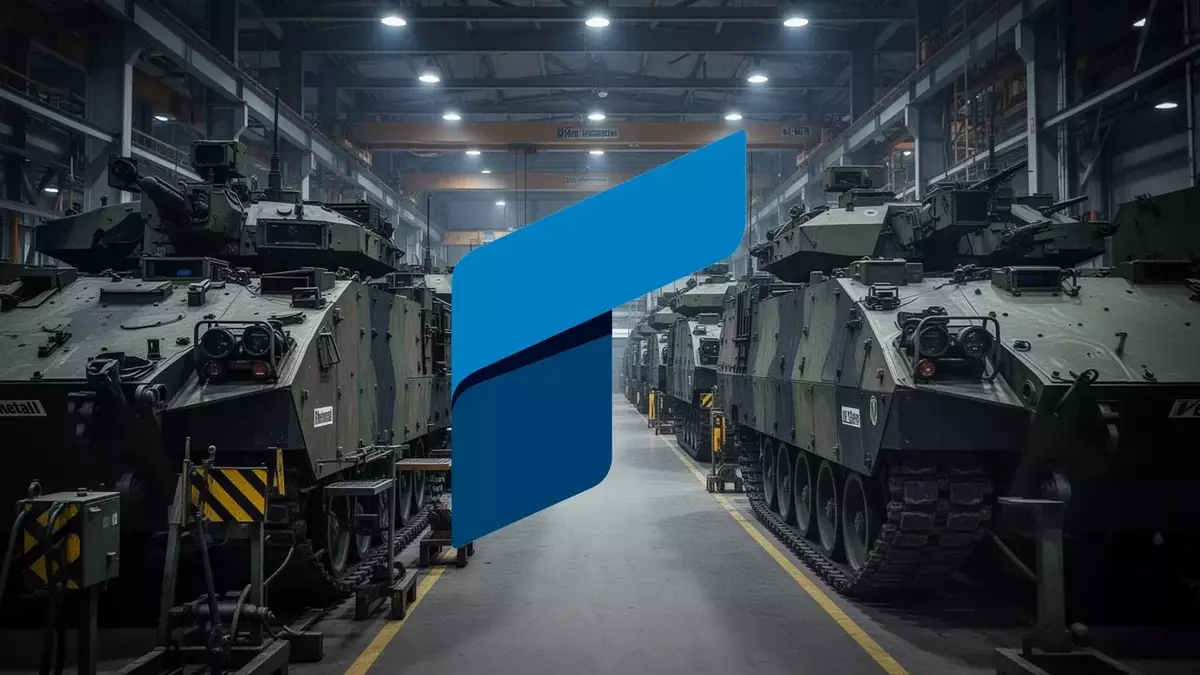
Rheinmetall’s Civilian Exit Closes a Chapter, but a Beaten-Down Stock Seeks a New Story at ILA Berlin
Published on 06/07/2026 at 09:22 | Redaktion boerse-global.de
Rheinmetall has signed off the sale of its Power Systems division for a preliminary €350 million, completing the company’s transformation into a pure-play defence group. Yet the timing could not be more awkward: the stock closed last week at €1,190, down nearly 8% on the week and 25.69% since the start of the year — a far cry from the 52-week high of €1,995. The contrast between operational ambition and market reception sets the stage for a crucial narrative test at this week’s ILA Berlin air show.
The buyer, private equity firm Aequita, takes over a division that generated roughly €2 billion in revenue in 2025 and employs 6,250 people. The sale, expected to close in the fourth quarter of 2026 pending regulatory approvals, strips away Rheinmetall’s last civilian leg. Management projects that without the lower-margin industrial business, the group’s operating margin will rise to around 19% in 2026, up from 18.5% last year. Revenue guidance for the full year remains unchanged at €14.0–€14.5 billion, implying growth of 40–45%.
The headline numbers look compelling on paper. As of March 31, Rheinmetall’s order backlog stood at €73 billion, up from €56 billion a year earlier and equivalent to roughly five times planned 2026 sales. But the market is watching the execution gap. First-quarter revenue of €1.94 billion, up 8% year on year, fell short of expectations. Management blamed strategic shifts into the second quarter, including expected truck handovers in Germany and the restart of a Spanish munitions plant, insisting the full-year forecast remains intact.
That makes the ILA, running from June 10 to 14, more than a routine trade fair. Rheinmetall occupies 840 square metres of exhibition space to showcase its post-automotive breadth. Highlights include Boeing’s autonomous Collaborative Combat Aircraft MQ-28 Ghost Bat, the loitering munition system FV-014, and a space surveillance joint venture that recently secured a multi-billion euro Bundeswehr contract for SAR satellite services. In Weeze, the company has built one of Europe’s most modern F-35 production lines in under 18 months. The message is clear: Rheinmetall now spans land, air, space and naval domains.
Should investors sell immediately? Or is it worth buying Rheinmetall?
Yet structural vulnerabilities persist. Graphite, essential for electronics, battery technology and composite materials in modern weapon systems, remains overwhelmingly processed in China. The defence industry is responding by forging ties with Western miners — Canadian projects such as Focus Graphite’s are seen as potential future supply lines for North America and Europe — but the dependency underscores the fragility that comes with a pure defence focus.
Geopolitical currents add another layer of uncertainty. Recent progress in Ukraine peace talks has weighed on defence stocks; US President Donald Trump and Ukrainian President Volodymyr Zelensky have said they are “significantly closer” to a deal. For Rheinmetall, whose share price soared during the structural re-rating of European defence, any short-term reduction in the escalation premium makes lofty valuation assumptions harder to sustain. The longer-term demand picture remains robust: SIPRI pegged European military spending at $864 billion, the highest ever recorded for the continent, while Germany plans defence outlays above €108 billion in 2026 and aims to hit NATO’s 3.5% of GDP target ahead of schedule.
Technically, the stock is treading water. The RSI of 39.6 signals neither oversold nor a clear trend reversal. The 50-day moving average sits at €1,344.32, 11.48% above the current price, while the 200-day average is at €1,620.26. The 52-week low of €1,099.80, touched in May, is roughly 8% below — a level that, if breached, would leave the share without obvious near-term support.
Rheinmetall at a turning point? This analysis reveals what investors need to know now.
The next hard proof point arrives on August 6 with half-year results. By then, investors will want to see that the first-quarter shortfall was genuinely a timing issue and that the €73 billion backlog is converting into revenue and margin at a faster clip. Until then, the ILA stage offers Rheinmetall a chance to reframe its narrative — but in a market that has already marked the stock down by over a quarter this year, words alone may not be enough.
Ad
Rheinmetall Stock: New Analysis - 7 June
Fresh Rheinmetall information released. What's the impact for investors? Our latest independent report examines recent figures and market trends.
Disclaimer regarding our articles: No investment advice, no buy or sell recommendation. Information on prices, companies, and markets is provided without guarantee; changes are possible at any time. Stock market transactions can lead to substantial losses. Our articles are created and reviewed in whole or in part automatically with the support of AI.