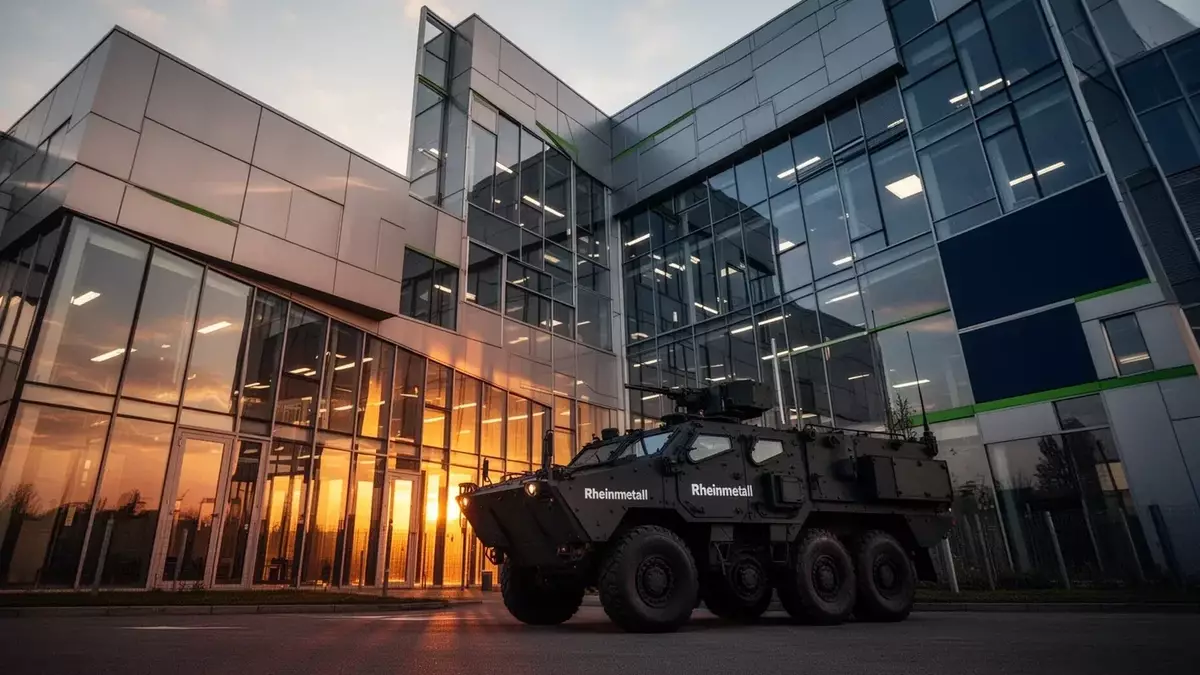
Rheinmetall Closes Book on Automotive Era, but Market Sees a Stock Down 25% on Execution Questions
Published on 06/05/2026 at 14:23 | Redaktion boerse-global.de
Rheinmetall has formally cut the last cord to its civilian past. This week’s signing of the sale agreement for the Power Systems division to private equity firm AEQUITA for a preliminary €350 million turns the Düsseldorf-based group into a pure-play defence company. The consummation is targeted for the fourth quarter of 2026, pending regulatory approvals. Around 6,200 employees will move with the divested unit, leaving roughly 34,000 staff within the restructured group.
The strategic logic is clear: Power Systems generated about €2 billion in revenue last year from the struggling automotive sector, while the defence segment booked roughly €10 billion. By shedding a lower-margin legacy business, Rheinmetall can channel more capital, management bandwidth and factory floor space into its three core military divisions – Weapon and Ammunition, Vehicle Systems, and Air Defence. Three sites plus the Neuss plant remain with the parent company for now, with Neuss slated for conversion into a satellite production facility.
Yet the market is refusing to reward the pivot. Rheinmetall’s stock has fallen roughly 25% since the start of the year and sits almost 40% below its September 2025 peak. The 52-week low of €1,099.80 was touched on 13 May, and the shares currently trade at €1,204.60, barely above the psychologically important €1,200 mark. Over the past week the decline accelerated to 7.09%, with a 30-day slide of 16.32%.
Investor skepticism persists despite an order backlog that has swelled to around €73 billion – more than five times annual sales. Only days ago Rheinmetall confirmed a €5.7 billion framework agreement with Romania covering armoured vehicles and ammunition. Germany’s Bundeswehr has also placed an order for more than 2,000 military trucks worth over €1 billion. The disconnect between a record pipeline and a depressed share price remains the central puzzle for analysts.
Should investors sell immediately? Or is it worth buying Rheinmetall?
One possible explanation lies in the operational headaches that accompany such an aggressive transformation. A military readiness report from 4 June 2026 highlighted that only about half of Germany’s Panzerhaubitze 2000 howitzers, Marder infantry fighting vehicles and Boxer armoured personnel carriers were combat-ready, citing spare-parts shortages and planning failures at the defence ministry. For Rheinmetall, that shortfall represents a double-edged sword: it underscores the urgent need for maintenance, spare-parts and modernisation services – a recurring revenue stream that could lift margins – but it also exposes execution risk if the group cannot scale up service capacity fast enough.
The next big stage to test the new narrative is the ILA Berlin air show from 10 to 14 June, where Rheinmetall will debut in its pure defence guise. Three systems are being showcased: the FV-014 loitering munition with a 100-kilometre range (already under a billion-euro framework contract with the Bundeswehr), the Skyranger 30 mobile air-defence system ordered by Germany, Austria and Denmark, and the MQ-28 Ghost Bat unmanned aircraft, developed in partnership with Boeing. Rheinmetall also won a nomination alongside KNDS for the US Army’s Mobile Tactical Cannon programme, keeping the RCH 155 howitzer in the competition.
Meanwhile, the group is exploring additional strategic moves. Reports have circulated that Iveco’s defence unit is up for sale, and Rheinmetall is named as a potential suitor alongside Leonardo and KNDS. Such a deal would accelerate consolidation in the European land-systems market – but any acquisition would add to the integration burden already weighing on the stock.
Rheinmetall at a turning point? This analysis reveals what investors need to know now.
The formal booking of the Romanian contract in the second quarter and progress on integrating maritime activities could provide catalysts, but the next hard deadline is the half-year report on 6 August. Until then, investors are likely to keep measuring Rheinmetall not by the size of its order book, but by how quickly it converts orders into deliveries, service revenue and – above all – earnings. The €200 million non-cash impairment charge tied to the Power Systems exit, while expected, is a reminder that the clean break carries costs too.
Ad
Rheinmetall Stock: New Analysis - 5 June
Fresh Rheinmetall information released. What's the impact for investors? Our latest independent report examines recent figures and market trends.
Disclaimer regarding our articles: No investment advice, no buy or sell recommendation. Information on prices, companies, and markets is provided without guarantee; changes are possible at any time. Stock market transactions can lead to substantial losses. Our articles are created and reviewed in whole or in part automatically with the support of AI.