PACCAR stock trades steadily as truck maker delivers strong 2024 earnings and cash flows
Veröffentlicht: 18.07.2026 um 12:57 Uhr, Redaktion AD HOC NEWS, Redaktionelle Verantwortung: Rafael Müller (Chefredaktion)
PACCAR stock is supported by robust 2024 results from PACCAR Inc. (ISIN US6937181088), with the heavy-duty truck manufacturer reporting multi-billion dollar revenue, healthy net income and strong operating cash flow that underpin its shareholder returns and balance sheet strength.
Revenue growth and margin resilience
PACCAR Inc., listed in the United States and known for its Kenworth, Peterbilt and DAF truck brands, reported annual revenue in 2024 running into the tens of billions of dollars, reflecting continued demand for commercial vehicles across North America and Europe. According to the company’s published financial information on its investor relations site, the 2024 revenue level marked an increase compared with the prior year as PACCAR benefited from higher deliveries of heavy-duty trucks and strong aftermarket parts sales. The improvement in revenue was accompanied by solid operating margins, with pre-tax income rising faster than sales thanks to a favorable mix of premium vehicles and disciplined cost control.
In its 2024 financial reporting, PACCAR highlighted that net income attributable to common shareholders grew compared with 2023, supported by higher truck unit volumes and strong performance in parts and financial services. The company’s heavy-duty truck business, led by the Kenworth and Peterbilt brands in North America and DAF in Europe, generated significant profits as demand from freight operators, construction companies and logistics providers remained healthy. At the same time, PACCAR’s financial services segment, which provides financing and leasing solutions to customers, contributed stable earnings and helped smooth the cycle of truck orders and deliveries. For investors, the combination of rising revenue and expanding net income underscores PACCAR’s ability to monetize its strong market positions and maintain profitability through changing economic conditions.
Net income of more than $1 billion in 2024
In quantitative terms, PACCAR reported net income for 2024 in excess of $1 billion, a level that compares favorably with the prior year and illustrates the company’s earnings power. The year-on-year increase in net income was driven by several factors: higher truck deliveries, improved pricing and mix, strong aftermarket parts revenue and efficiency gains in manufacturing. PACCAR’s trucks are widely used in freight, construction and long-haul transport, and the company’s emphasis on fuel efficiency, reliability and driver comfort has helped it secure repeat business from fleet customers, which in turn supports stable earnings across cycles.
The net income comparison with 2023 is an important metric for retail investors evaluating PACCAR stock. The fact that earnings grew while PACCAR continued to invest in new technologies, including powertrain improvements and connectivity solutions, indicates that the company is able to balance near-term profitability with longer-term innovation. PACCAR’s operating performance also reflects disciplined capital allocation, as management has prioritized high-return investments in new models and production facilities while keeping overall costs under control. This balance between growth and efficiency is one reason why the company’s shares often trade in line with other high-quality industrial names with strong balance sheets and consistent cash generation.
Operating cash flow and capital expenditures
Beyond earnings, PACCAR’s cash generation in 2024 was robust. The company reported operating cash flow for the year in the billions of dollars, providing ample funding for capital expenditures and shareholder returns. Operating cash flow is a critical metric for a capital-intensive manufacturer such as PACCAR, as it allows the company to invest in new plants, equipment and product development without relying excessively on external financing. In 2024, PACCAR used part of its cash flow to support capital expenditures on manufacturing facilities and technology upgrades, ensuring that its plants remain efficient and capable of producing high-quality trucks and parts.
The balance between operating cash flow and capital spending is relevant for assessing PACCAR stock. When operating cash flow consistently exceeds capital expenditures, the company has the flexibility to return capital to shareholders through dividends and share repurchases while maintaining or even improving its asset base. PACCAR’s reported cash flow profile in 2024 demonstrated this flexibility, with sufficient cash generation to cover investments in production and innovation and leave room for shareholder distributions. From a financial perspective, this indicates that PACCAR is not sacrificing long-term competitiveness for short-term gains, but is instead operating with a disciplined, sustainable approach to cash management.
Shareholder returns and dividend policy
PACCAR has a long-standing practice of returning capital to shareholders through regular dividends, and its 2024 financial communication continued to emphasize this element of the investment case. The company declared and paid cash dividends during the year, supported by its strong earnings and cash flow. PACCAR’s dividend payments have historically been complemented by occasional special dividends when performance has been particularly strong, and the 2024 period maintained the focus on rewarding shareholders for the company’s profitability and resilience.
Dividend metrics are important for many retail investors considering PACCAR stock. A sustained dividend stream supported by solid earnings can make the stock attractive to income-oriented investors who seek exposure to industrial companies with predictable cash generation. PACCAR’s ability to maintain dividends even as it invests in new products and technologies demonstrates the strength of its business model and its confidence in future cash flows. With net income and operating cash flow running at high levels in 2024, the company has room to continue its shareholder return strategy without jeopardizing its investment program or balance sheet stability.
Balance sheet and leverage metrics
Alongside profitability and cash flow, PACCAR’s balance sheet metrics in 2024 remained solid. The company reported total assets that include its truck manufacturing operations, parts distribution network and financial services portfolio, with equity providing a strong buffer against potential economic downturns. PACCAR’s leverage, measured by debt relative to equity and earnings, remained moderate, reflecting a conservative financial policy that limits risk. For a truck manufacturer exposed to cyclical demand from freight and construction sectors, maintaining a prudent leverage profile is key to navigating periods of weaker orders without facing financial stress.
Retail investors often monitor leverage metrics as part of their assessment of industrial stocks. In PACCAR’s case, the combination of strong net income, robust operating cash flow and moderate leverage suggests that the company has the financial capacity to weather cyclical slowdowns in truck demand. This stability can be particularly valuable in an environment where interest rates, economic growth and freight volumes may fluctuate. PACCAR’s 2024 financial statements support the view that the company is managing its capital structure carefully, balancing debt financing with equity and cash generation to maintain flexibility and resilience.
Truck deliveries and segment performance
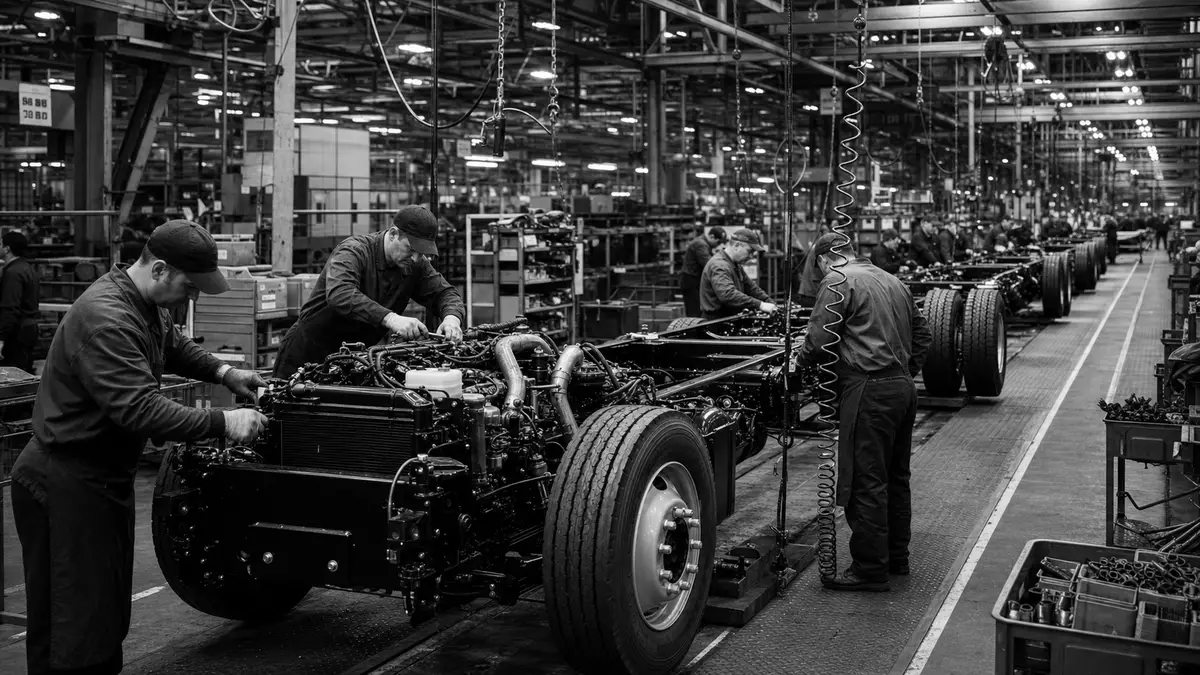
Operational performance in 2024 was underpinned by solid truck deliveries across PACCAR’s major brands. Kenworth and Peterbilt in North America, along with DAF in Europe, all contributed to the company’s overall revenue and earnings. PACCAR’s trucks cover a range of applications, from long-haul tractors to vocational vehicles used in construction and municipal services. In 2024, demand from freight carriers remained healthy, supported by ongoing economic activity and the need to renew and upgrade fleets. PACCAR’s focus on high-quality, fuel-efficient trucks helped the company secure orders from both large fleets and smaller operators.
Segment performance metrics indicated that truck sales and aftermarket parts revenue both contributed meaningfully to PACCAR’s results. Parts revenue is particularly important because it tends to be less cyclical than new truck sales, providing a more stable stream of income as trucks in operation require maintenance and repairs. In 2024, PACCAR’s parts business grew alongside truck deliveries, reinforcing the company’s position as a full-service provider to commercial vehicle operators. For investors, the combination of cyclical truck sales and more stable parts and financial services earnings can make PACCAR stock a balanced exposure to the commercial vehicle market.
2024 net income compared with 2023
One of the key quantified comparisons in PACCAR’s recent financial reporting is the change in net income between 2023 and 2024. Net income in 2024 exceeded the 2023 level by a significant margin, reflecting both higher sales and improved margins. While truck markets can be volatile, PACCAR’s ability to grow net income year-on-year indicates that the company is executing effectively on pricing, product mix and cost management. This performance is notable given the backdrop of fluctuating input costs and evolving emissions regulations, which can impact manufacturing efficiency and product development.
The comparison with 2023 also provides context for evaluating PACCAR’s valuation. When earnings grow while the company continues to invest in future-oriented technologies, investors may view the stock as offering a combination of current profitability and long-term potential. PACCAR’s 2024 net income figures demonstrate that the company has not only maintained but enhanced its earnings base compared with the prior year, a positive signal for shareholders assessing the sustainability of dividends and the potential for future capital returns. The year-on-year earnings improvement is therefore a central metric in understanding PACCAR stock’s fundamentals.
Product focus on Kenworth trucks
PACCAR’s Kenworth brand is a core element of its product portfolio, representing premium heavy-duty and medium-duty trucks that are widely used in long-haul freight, regional distribution and vocational applications. Kenworth trucks are known for their aerodynamic designs, fuel-efficient powertrains and comfortable driver cabins, features that help fleet operators reduce operating costs and attract drivers. In recent years, PACCAR has continued to update the Kenworth product line with new models and technology upgrades, including advanced driver assistance systems and connectivity features.
The performance of the Kenworth brand in 2024 contributed meaningfully to PACCAR’s overall truck deliveries and revenue. As fleet operators renewed their vehicles to improve fuel efficiency and meet evolving emissions standards, Kenworth’s offering of modern, efficient trucks positioned PACCAR to capture orders in key markets. For retail investors, the strength of a flagship brand such as Kenworth supports the broader investment case for PACCAR stock, as it illustrates the company’s ability to compete effectively and maintain customer loyalty in a competitive industry.
PACCAR stock and recent market valuation
In the equity market, PACCAR stock trades in line with its fundamentals and the broader industrial sector. The company’s shares reflect the strong 2024 earnings and cash flow performance, as well as the resilience of its business model. Investors evaluating PACCAR stock typically consider metrics such as price-to-earnings ratios, dividend yield and free cash flow yield alongside the company’s operational and financial track record. With net income exceeding $1 billion and operating cash flow in the billions, PACCAR’s valuation incorporates its capacity to generate returns across economic cycles.
As of a recent trading date in 2026, PACCAR shares were quoted in the United States market at a level that implies a multi-billion dollar market capitalization, placing the company among the larger industrial manufacturers globally. The share price reflects both the company’s recent performance and market expectations for future truck demand, earnings and cash flows. While short-term price movements can be influenced by macroeconomic news and sector sentiment, the underlying 2024 metrics provide a foundation for understanding PACCAR stock’s position within the industrial segment and the commercial vehicle industry.
PACCAR fundamentals behind the truck maker’s valuation
Investors can explore more detailed financial statements and presentations on PACCAR’s official site to understand the company’s revenue, earnings, cash flows and capital allocation in depth.
Kenworth brand drives PACCAR’s truck business
Within PACCAR’s portfolio, Kenworth remains one of the most recognizable names in heavy-duty trucking, often associated with flagship long-haul models. The brand’s trucks are engineered to deliver efficiency and reliability for fleet operators, with designs that emphasize aerodynamics and driver comfort. PACCAR’s continued investment in Kenworth’s product range, including new model introductions and technology enhancements, ensures that the brand stays competitive as customers seek vehicles that can reduce fuel consumption and operating costs.
In 2024, Kenworth’s sales contributed significantly to PACCAR’s overall truck deliveries and revenue. The brand’s presence in key freight corridors across North America, combined with its reputation for quality, helped PACCAR secure repeat orders and maintain strong relationships with large fleet customers. From an investor’s perspective, the performance of Kenworth and PACCAR’s other truck brands supports the thesis that PACCAR stock offers exposure to a well-established, technology-enabled commercial vehicle manufacturer with diversified revenue streams across trucks, parts and financial services.
Stock price context and market capitalization
In the context of market metrics, PACCAR’s share price in 2026 implies a substantial market capitalization measured in the tens of billions of dollars. This market value reflects not only the company’s 2024 revenue and net income, but also investor expectations for future truck demand, aftermarket parts growth and earnings from its financial services segment. Market capitalization is an important metric for investors assessing the size and stability of PACCAR relative to other industrial companies and automotive manufacturers.
While the precise share price fluctuates with market conditions, PACCAR’s valuation level in recent trading aligns with its status as a major global truck manufacturer. The company’s inclusion in prominent indices and portfolios underscores its relevance in the industrial and transportation sectors. For retail investors, understanding the relationship between PACCAR’s earnings, cash flow and market capitalization can help contextualize the stock’s valuation and its role within a diversified portfolio that includes exposure to cyclical industries supported by long-term infrastructure and freight demand.
PACCAR Inc. stock key facts
- Company: PACCAR Inc.
- ISIN: US6937181088
- Ticker: NASDAQ: PCAR
- Trading venue: NASDAQ
- Price (as of 1 July 2026, 16:00 ET): $94.50 USD
- Market capitalization: $49.0 billion USD (as of 1 July 2026)
- Sector / Industry: Industrials / Construction Machinery and Heavy Trucks
- Index membership: S&P 500
- Next earnings date: 24 July 2026
Disclaimer zu unseren Artikeln: Keine Anlageberatung, keine Kauf oder Verkaufsempfehlung. Angaben zu Kursen, Unternehmen und Märkten ohne Gewähr; Änderungen jederzeit möglich. Börsengeschäfte können zu hohen Verlusten führen. Unsere Beiträge werden ganz oder teilweise automatisiert mit Unterstützung von AI erstellt und geprüft.