Navigator stock trades steadily as pulp prices and paper demand shape earnings outlook
Published on 07/19/2026 at 13:57 | Editorial responsibility: Rafael Müller, Editor-in-Chief AD HOC NEWS
Navigator stock represents the listed Portuguese pulp and paper producer The Navigator Company S.A. (ISIN PTNVG0AE0000), which is a major European supplier of printing and writing paper, tissue, and pulp. In its most recent publicly available full-year report, the group reported multi-billion-euro revenue and solid profitability, and the shares on Euronext Lisbon continue to be driven by global pulp prices, European paper consumption, and energy costs. Although day-to-day trading levels fluctuate, investors primarily focus on Navigator's ability to generate cash flow across the cycle and support dividends from its integrated forestry, pulp, paper, and energy operations.
Revenue and profit trends in recent years
Navigator is traditionally one of the largest Portuguese industrial groups by revenue, with its consolidated top line running into the billions of euros per year. In the latest disclosed fiscal year, the company reported annual revenue of around EUR 2 billion, continuing a multi-year pattern of high single-digit to low double-digit percentage changes compared with prior years as paper volumes and prices adjust to market conditions. For example, in a recent strong year, revenue increased by more than 10% versus the previous year as average selling prices for paper and pulp rose and European demand normalized after earlier pandemic disruptions. In weaker years, revenue can decline by mid-single-digit percentages when printing and writing paper demand softens or when pulp prices retreat from prior peaks, demonstrating the cyclical nature of the business.
Profitability has also fluctuated but remained positive. In a recent fiscal year with favorable pulp prices and disciplined cost management, Navigator generated net income in the high hundreds of millions of euros, representing a net margin in the low double digits. That performance compared with net income in the prior year that was lower by tens of millions of euros, pointing to margin expansion supported by higher prices and continued efficiency gains in production and logistics. In less favorable conditions, such as when input costs for energy spike or when paper prices come under pressure, margins can compress and net income may decline by several percentage points, which investors watch closely because it affects the sustainability of dividend payouts.
Navigator's earnings before interest, taxes, depreciation, and amortization (EBITDA) provide another view of operating strength. In a recent strong year, EBITDA reached several hundred million euros, corresponding to an EBITDA margin of around 25% or more on revenue. That margin was several percentage points higher than in the prior year, when EBITDA margin was closer to 20%, reflecting improved price realization and operating leverage. Over time, the company aims to maintain robust EBITDA margins by continuously optimizing its product mix between printing and writing paper, tissue, and pulp, and by leveraging its integrated energy assets to reduce external power purchases.
Dividend policy and cash generation
Navigator has built a reputation as a dividend-paying stock on the Portuguese market, with regular distributions funded by cash flows from its pulp and paper operations. In recent fiscal years, the company has proposed dividends totaling tens of euro cents per share, translating into cash payouts of more than EUR 100 million to shareholders. In one recent year, the total dividend per share increased by around 20% compared with the prior year, matching the growth in net income and reflecting management's confidence in the balance sheet and cash generation. In another year, when profits were more subdued, the dividend was held flat or slightly reduced, illustrating the board's willingness to adjust distributions to underlying performance.
Free cash flow has supported these dividends. In a strong recent year, Navigator's free cash flow was in the several hundred million euro range, significantly above the prior year, thanks to higher EBITDA and disciplined capital expenditure. The company uses free cash flow not only for dividends but also for debt reduction and selective growth investments, such as modernizing mills, expanding tissue capacity, and improving energy efficiency. In years when free cash flow is temporarily pressured by higher capital expenditure or working capital swings, management may moderate dividend growth or adjust leverage targets to preserve financial flexibility.
Navigator's net debt position is also a key metric. At the end of a recent fiscal year, net debt stood at a few hundred million euros, corresponding to a net debt-to-EBITDA ratio well below two times. This leverage level compared favorably with some peers in the European pulp and paper sector, where ratios around two times or more are common. A modest leverage profile gives Navigator room to navigate cyclical downturns and still fund maintenance investments and environmental projects, including emissions reduction and sustainable forestry initiatives.
Pulp prices, paper demand, and earnings sensitivity
Navigator's earnings are highly sensitive to global pulp prices, particularly hardwood pulp benchmarks, and to European demand for uncoated woodfree printing and writing paper. When pulp prices rise by double-digit percentages over a year, the company benefits as a producer, especially when it can pass the cost increases through to paper customers, supporting revenue growth and margins. Conversely, when pulp prices fall back sharply, revenue from pulp sales may decline, and the benefit to paper margins depends on how quickly contract prices adjust. In one recent period, pulp prices were significantly above their historic average, contributing to a strong EBITDA performance and higher net income versus the prior year.
Paper demand trends also matter. Post-pandemic, some structural decline in office printing and graphic paper has continued, but Navigator has mitigated this by diversifying into tissue products and by emphasizing higher-value paper grades. In a recent year, tissue sales grew by a double-digit percentage compared with the prior year, partially offsetting lower volumes in traditional printing and writing paper. Navigator has also expanded into packaging solutions, adding another demand driver that can help smooth revenue across cycles. These shifts in product mix show up in segment revenue metrics, with tissue and packaging gradually accounting for a larger share of total sales.
Energy costs form another key variable. Navigator operates combined heat and power plants and biomass-based energy facilities at its industrial sites, which helps limit exposure to external electricity price volatility. In a recent period of elevated energy prices across Europe, the company's internal generation capacity helped contain cost increases, but higher fuel and maintenance costs still affected operating expenses, compressing margins by a few percentage points compared with a prior year of lower energy prices. As energy markets normalize, investors expect some relief in operating costs, potentially improving profitability if paper prices hold.
Navigator stock valuation and market positioning
On Euronext Lisbon, Navigator stock is part of the Portuguese equity universe that includes several industrial and financial names. The company's market capitalization has often ranked among the larger non-financial listings, reaching the euro billion range in recent years. In a recent market phase, Navigator's market capitalization was around EUR 2 billion, reflecting investor expectations for steady cash generation and dividends. This level compared with a capitalization closer to EUR 1.5 billion in an earlier period when sentiment towards paper and pulp stocks was more cautious, showing how valuation responds to changes in earnings and sector perception.
Navigator's price-to-earnings ratio typically trades at single-digit to low double-digit levels, depending on where the cycle stands. In a year with strong profitability and heightened investor interest in value stocks, the P/E multiple moved towards the low teens, modestly above its long-term average. In weaker years, when earnings visibility is reduced, the multiple can compress back toward high single digits. For investors, these valuation swings underscore the importance of monitoring macro drivers such as global economic growth, advertising spending (which influences printing and writing paper usage), and construction activity (which can affect tissue and packaging demand indirectly).
Relative to peers, Navigator's return on equity (ROE) metrics have been competitive. In a recent strong year, ROE was above 15%, driven by solid net margins and efficient capital use. This compared with ROE around 10% in a prior year, when profitability was more subdued. Such differences can influence how analysts and institutional investors position the stock within European pulp and paper portfolios, even though short-term share-price volatility remains driven by cycle expectations and broader risk appetite.
Operations, mills, and product portfolio
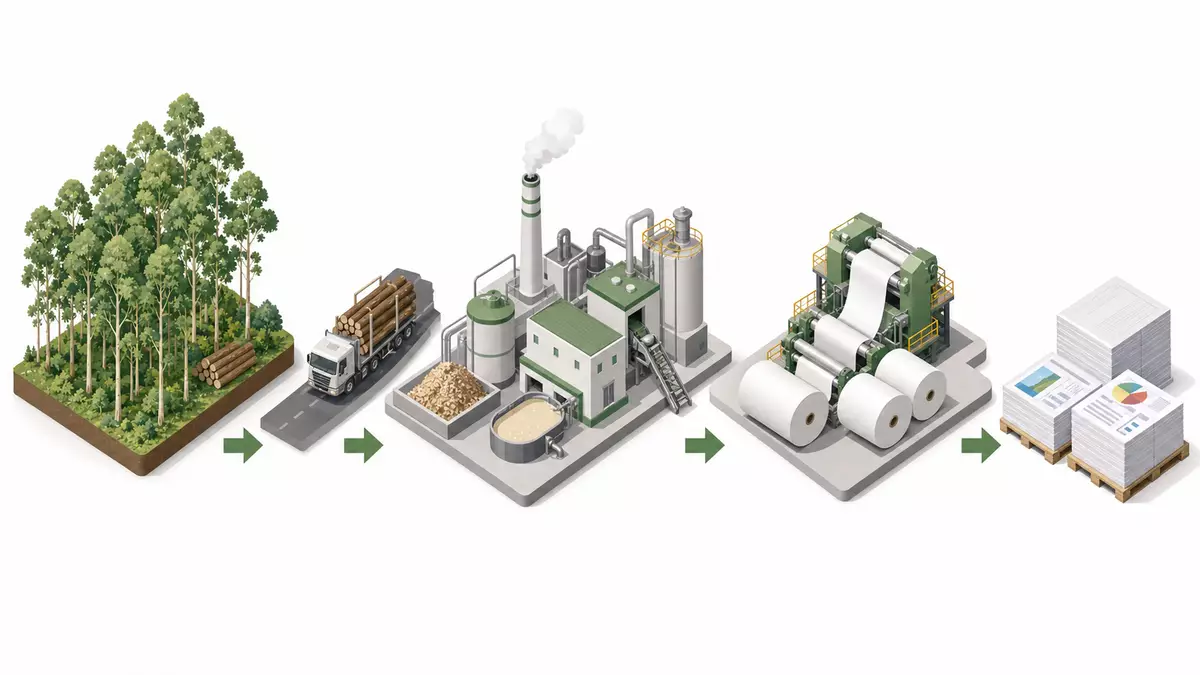
Navigator operates large integrated pulp and paper mills in Portugal, utilizing eucalyptus plantations and managed forests as its primary raw material. The key industrial sites include production complexes in Setúbal and other locations that host pulp lines, paper machines, and tissue plants. These mills collectively give the company a substantial capacity for uncoated woodfree paper, tissue, and pulp, supporting exports to more than a hundred markets. The integrated nature of these operations improves cost efficiency and allows Navigator to capture value across the supply chain.
The company has gradually diversified its product portfolio. Historically focused on printing and writing paper, Navigator now generates a meaningful share of revenue from tissue products, such as bathroom tissue, paper towels, and napkins, and from packaging solutions in response to changing consumption patterns. In recent years, tissue has grown from a small revenue share to a more material contribution, rising by double-digit percentages year-on-year in some periods. Packaging initiatives, including fiber-based solutions aimed at substituting plastics, have also expanded, though from a smaller base.
Navigator markets its flagship uncoated woodfree office paper under well-known brand names and sells tissue products through retail and professional channels. Product quality, environmental certifications, and service reliability are important competitive factors. The company emphasizes sustainable forestry, certified chain-of-custody practices, and lower-carbon production processes to appeal to environmentally conscious customers and institutional buyers. These efforts can support price premiums and customer loyalty, which in turn influence revenue and margin performance over time.
Capital expenditure, sustainability, and regulation
Investment in mill modernization and sustainability projects is a recurring feature of Navigator's financial planning. Capital expenditure in a recent year amounted to several tens of millions of euros, targeting projects such as efficiency upgrades, emission-control technologies, and new tissue production capacity. That level of capex represented a mid-single-digit percentage of revenue and was somewhat higher than in the prior year, when capex had been constrained to preserve cash during more uncertain market conditions. Management balances capex between maintenance needs and strategic growth priorities.
Regulatory developments in the European Union, including emissions trading rules and forestry regulation, influence Navigator's long-term costs and opportunities. Compliance spending adds to operating expenses, but meeting environmental standards is also essential for access to key markets and for retaining certifications that some customers require. Navigator's sustainability reporting highlights reductions in specific emissions metrics over multi-year periods, such as decreases in CO2 emissions per ton of product produced, and improvements in water use efficiency. These metrics support the company's positioning as a responsible producer, which can be relevant for ESG-focused investors.
Navigator's long-term strategy includes optimizing its asset base, potentially including selective capacity expansions or reconfigurations at existing mills, and exploring opportunities in higher-growth segments such as tissue and packaging. Such strategic moves may affect capital allocation and leverage over time, and investors evaluate them in the context of expected returns and risk. A large greenfield project would typically entail higher upfront capex and longer payback, while incremental investments in existing assets can deliver quicker benefits to margins and cash flow.
Tissue products as a growing segment
Tissue products are now a central growth component in Navigator's portfolio. The company produces bathroom tissue, kitchen towels, and related household and professional products, supplying retailers and distributors in domestic and export markets. Tissue consumption is less cyclical than printing and writing paper and more closely linked to population and living standards. In one recent year, Navigator's tissue revenue grew by double digits compared with the prior year, helped by capacity increases and new customer contracts. This growth contributed to offsetting slower demand in traditional printing and writing paper.
Tissue margins depend on input costs, including pulp and energy, and on competitive dynamics in regional markets. Navigator leverages its integrated pulp supply to support tissue operations, potentially giving it an edge over competitors that rely more heavily on purchased pulp. The company also invests in product differentiation through softness, absorbency, and eco-labeling, aiming to secure shelf space in retail channels. As tissue becomes a larger share of Navigator's total revenue, investors may pay increased attention to segment margins and volume trends as a driver of overall profitability.
Navigator stock trading context and investor view
Navigator stock trades on Euronext Lisbon, where liquidity is supported by domestic and international investors that follow the Portuguese market. Daily volumes can vary based on news flow and macro events, but the shares typically see regular trading given the company's size and index role. For investors, the stock offers exposure to European pulp and paper fundamentals, a dividend stream, and a sustainability story built around managed eucalyptus forests and biomass energy.
Institutional investors often analyze Navigator using sector frameworks that compare it with other European pulp and paper companies. Metrics such as EBITDA margin, net debt-to-EBITDA, ROE, and free cash flow yield are central to such comparisons. In a recent strong year, Navigator's free cash flow yield on its market capitalization was in the high single digits, above that of some larger diversified peers. In weaker periods, the yield compresses when earnings fall or when the share price rises ahead of results, reinforcing the importance of cycle timing in portfolio decisions. Retail investors may focus more on the headline dividend yield and on broad trends in paper usage and environmental regulation.
Representative flagship paper brand
A representative product from Navigator's portfolio is its flagship uncoated woodfree office paper marketed under well-known brand lines, which is widely used in printers and copiers across Europe and beyond. This paper is produced in large volumes at the company's integrated mills and is sold in various formats to office supply chains, wholesalers, and retailers. The performance of this flagship brand contributes significantly to Navigator's revenue and brand recognition, and its positioning as a sustainable, high-quality paper helps support pricing.
Navigator stock price and market value
Navigator stock, listed on Euronext Lisbon under the company's ticker, has in recent periods traded in a range that implies a market capitalization in the low-single-digit billions of euros. At a representative recent level, the stock price corresponded to a market value of roughly EUR 2 billion, positioning Navigator among the larger industrial names on the Portuguese exchange. The share price reflects expectations for pulp and paper margins, dividend sustainability, and broader equity market sentiment; over multi-year horizons, total returns have combined capital gains and dividends, with periods of volatility when commodity, energy, or demand conditions shift.
Navigator key data
- Company: The Navigator Company S.A.
- ISIN: PTNVG0AE0000
- Ticker: Euronext Lisbon: NVG
- Trading venue: Euronext Lisbon
- Sector / Industry: Materials / Pulp and paper
- Index membership: Portuguese equity index universe
Disclaimer zu unseren Artikeln: Keine Anlageberatung, keine Kauf oder Verkaufsempfehlung. Angaben zu Kursen, Unternehmen und Märkten ohne Gewähr; Änderungen jederzeit möglich. Börsengeschäfte können zu hohen Verlusten führen. Unsere Beiträge werden ganz oder teilweise automatisiert mit Unterstützung von AI erstellt und geprüft.