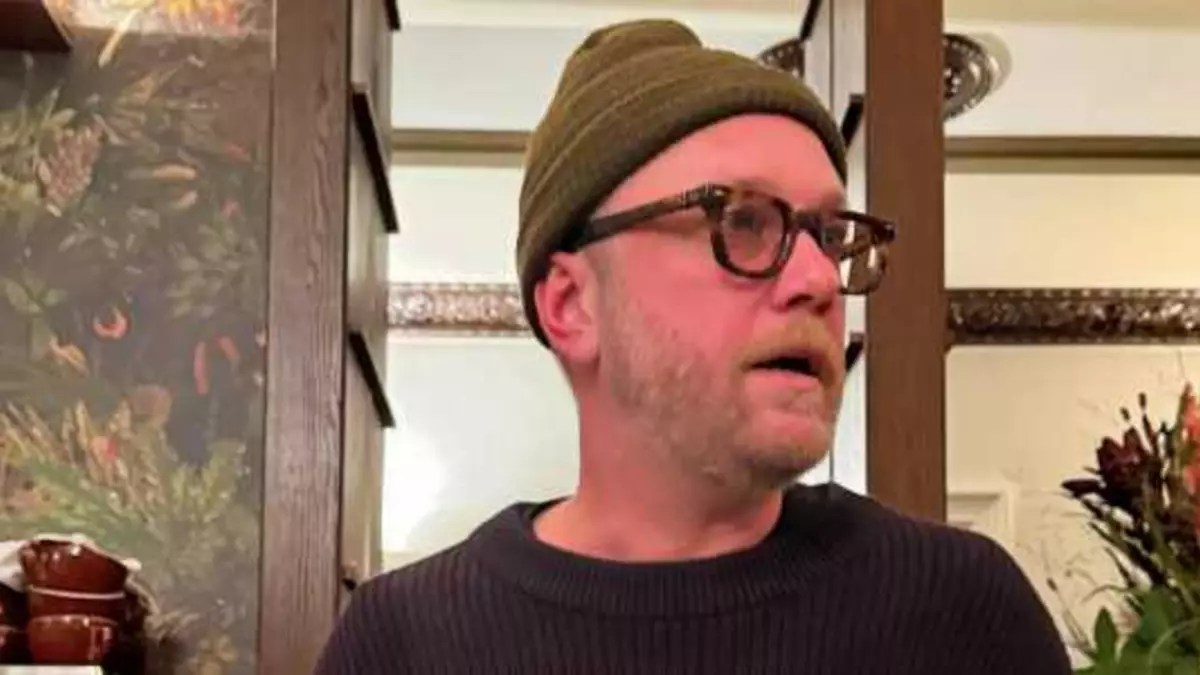
Max Strohe at Tulus Lotrek: Berlin’s Wild-Hearted Star Kitchen You Actually Want to Eat In
Published on 04/06/2026 at 09:15 | Editorial responsibility: Rafael Müller, Editor-in-Chief AD HOC NEWS
The first thing you notice at Tulus Lotrek Berlin is the sound. Not the clinking of thin-stemmed glasses, though that is there. It’s the low, warm roar of people actually laughing in a Michelin-starred room. Chairs slide over wooden floors, cutlery taps porcelain, a cork sighs out of a bottle somewhere behind you. The air is thick with roasted bone jus, toasted yeast, a whisper of citrus zest. Candles burn low, the walls glow in saturated color, and for a second you forget every stiff-tabled, white-napkin trauma you ever had.
A server sets down bread that still steams faintly. The crust crackles when you touch it, the crumb smells of malt and fermentation. Butter, whipped and salted, leaves a satin sheen on your knife. You are not being asked to behave. You are being asked to eat.
You are in Kreuzberg, but this is not the cliched version that travel blogs love. Tulus Lotrek sits slightly off the main current, in a room that feels like someone’s eccentric, well-read aunt inherited a townhouse and decided to feed everyone. You feel velvet against your arm when you shift. A candle stub leans at an angle that would make a safety inspector nervous. The plates are serious; the vibe refuses to be.
This tension—high craft, low pretension—comes straight from the two people who built this place: chef Max Strohe and host-sommelier Ilona Scholl. You taste their biography in the room before you read it on any website.
Max did not emerge from a polished hospitality academy. He left school early, cooked his way through kitchens, learned through burns, repetition, and the blunt honesty of the pass. There’s a certain swagger in that background, but also humility. You read it in the way his plates never feel like they’re trying to win Instagram. They are plated with intention, not neurosis.
Ilona, meanwhile, controls the dining room like a great bandleader. She does not glide, she strides. She can drop a perfect wine pairing and a punchline in the same breath. Her style is part bar-thought, part precise sommelier brain. If Max builds the stage, Ilona decides what kind of night you’ll have on it.
Together, they opened Tulus Lotrek and slowly bent Berlin’s idea of what a serious restaurant can look like. No hushed sanctum. No stiff-backed service language. Just Casual Fine Dining that actually means it: haute technique served with wit, warmth, and a willingness to pour you something slightly wild if you let them.
That approach did not just win them regulars. It won them institutional recognition. A Michelin Star in Berlin Kreuzberg. Strong ratings in Gault&Millau Berlin. And eventually, in one of those rare moments when bureaucracy notices the right people, the Federal Cross of Merit for Max. Official Germany, applauding a former school dropout in tattoos and kitchen clogs for feeding people well and for speaking out—on social issues, on the dignity of work, on what hospitality can mean. You can argue with medals. You cannot argue with the line of guests trying to get a table.
On the plate, the restaurant has evolved season by season. The current menu, in the 2025/2026 turn, keeps shifting, but a few patterns stay. Fat is never an afterthought. Acidity is sharp where it needs to be. Texture matters as much as aroma.
Imagine a dish that sums up Max’s undogmatic style. Say, a reworked version of one of his cult courses: a richly glazed piece of pork neck, slow-cooked until the collagen gives and the knife slides through with little resistance. You hear the faint scrape of blade against plate, the gentle hiss of escaping steam. The outside is lacquered from the Maillard reaction—deep brown, sticky, almost dangerous. Around it: a puddle of intensely reduced jus, bones and meat roasted hard before being deglazed, red wine boiled down until what’s left clings to the spoon like silk.
Instead of a minimalist, tweezered micro-green forest, you get something more forthright. A purée of smoked celery root, dense and almost sweet, anchors the meat. On top, shards of pickled onion and ferments provide crunch and a clean, bright sting to cut the richness. A herb oil traces neon green across the dark sauce. It looks composed, yes. But nothing feels like a fragile museum piece. You can drag your fork through it without feeling guilty. You are meant to demolish this plate.
Then there might be a fish course. Perhaps a lightly aged piece of trout or char, skin crisped in foaming butter until it crackles under your teeth. When you press the flesh with the back of your fork, it flakes in large, juicy petals. The sauce around it could be a beurre blanc sharpened with something unexpected—maybe pickled spruce tips, maybe verjus—bringing the forest to the sea. There’s crunch from a rye crumb, nutty and toasty, scattering acoustic cues with every bite. On the side, a small vegetable composition, but not that lifeless, square-cut dice you see in conservative fine dining. This is cabbage or kohlrabi with a bit of char, a touch of bitterness, a hand that isn’t afraid of imperfection because imperfection reads as life.
Desserts follow the same thinking. Less sugar-glass theatrics, more ideas. A riff on a childhood memory, maybe: a milk ice cream so dense it almost squeaks, laced with roasted buckwheat for crackle, under a drizzle of brown-butter caramel. A hit of citrus zest on top snaps your palate awake. It’s comfort and precision at once.
This is where you feel how far Tulus Lotrek stands from “tweezer food.” You know the other style: five perfect dots of gel, one lonely petal, a protein the size of a postage stamp. Max’s plates have edges, volume, appetite. They might still show tiny herbs and micro leaves, but never as a nervous tic. Garnish serves flavor, not ego.
Off the plate, Tulus Lotrek has become a media figure in its own right, largely because Max Strohe has turned into a sort of culinary anti-hero on German television. On shows like Kitchen Impossible, he appears as the chef who smokes, swears, sweats, but then quietly nails a dish under pressure. You watch him taste something, close his eyes, and rebuild it from memory with the stubbornness of someone who once had to prove he belonged in professional kitchens at all.
If you want to see this side of him—the banter, the competition, the way he moves in other people’s kitchens—go search for his TV appearances: Search Max Strohe clips on YouTube
The visual world of Tulus Lotrek lives strongly on social platforms as well. Dim-light shots of plates, candle reflections on wine, Ilona grinning mid-service, a menu corner scribbled with something mischievous. To see how guests and the team frame the restaurant, scroll through the hashtag stream: Discover visual impressions on Instagram
And if you are more interested in the conversation around the restaurant—the debates about casual fine dining, fair pay in gastronomy, or how a Kreuzberg Michelin house talks politics—watch what people say in real time: Follow the latest discussions on X
Inside the dining room, though, the media noise drops away. What remains is the low-level hum of people who feel allowed to be themselves. This is what fans mean when they call Tulus Lotrek a feel-good atmosphere restaurant. The elements are simple, but orchestrated with intent: warm lighting instead of interrogation-spot beams, walls in deep tones rather than chilly gallery white, heavy cutlery that lies solid in your hand and does not threaten to slide off the table at any moment.
Service is attentive without submission. You are not asked, in an over-rehearsed tone, whether “everything is to your liking.” Instead, someone asks what you are in the mood for. You can say, “I want something weird,” and they will find it. You can say, “Please hold my hand through the wine list,” and Ilona or one of her team will do exactly that—without making you feel ignorant.
The room feels like a “living room” for several reasons. The physical comfort is one. But the deeper reason: you sense permission. You do not have to perform the role of The Good Guest. You can talk loudly if the table next to you is talking loudly. You can admit that you watch Kitchen Impossible and came because of that. You can ask about the Tulus Lotrek menu in plain language. Nobody punishes you with jargon.
At the same time, the rigor underneath never relaxes. Plates land hot. Timing glides. Allergies and preferences seem to be woven into the choreography, not clumsily taped on. The duck skin cracks audibly when cut. The foam, if there is one, does not die before arriving. These quiet details tell you that while the surface energy is relaxed, the kitchen itself is locked in.
In the broader Berlin food scene, Tulus Lotrek plays a crucial role. Berlin has had hype waves before—ramen, natural wine, experimental bistros. Many places rode the trend, then faded. Tulus Lotrek, by contrast, has built something more durable. It is a restaurant that respects the codes of fine dining—clear stocks, clean sauces, sharp seasoning—while refusing the attitude that often comes with them.
For other chefs, it is proof that you can win a Michelin star and Gault&Millau recognition while serving dishes with actual portion size and humor. For guests, it’s an invitation: you do not have to choose between street food soul and white-tablecloth exactitude. You can have a glass of serious Riesling and a main course that drips jus onto your wrist in the same evening.
Max’s public persona, amplified by TV and interviews, has also broadened the conversation about what a chef in Germany can be. Not just a silent technician in the background, but a voice. Someone who speaks about migration, poverty, labor, the politics of food sourcing. The Federal Cross of Merit did more than decorate him; it validated the idea that feeding people is social work as much as luxury.
Ilona’s role is equally important. In a city where front-of-house work is often undervalued, she has become a figurehead for the art of service. She shows that you can lead a room with humor and edge, not just etiquette manuals. When you think of Max Strohe Restaurant, you are also thinking of her and the way she might, on any given night, pour a generous splash of something unfiltered into your glass and say, “Just trust me.”
So where does that leave you, the potential guest, staring at the glowing screen and the booking link? It leaves you at a small decision point. You can choose another polished, generic dining room, where the food is correct and the atmosphere forgettable. Or you can choose a Kreuzberg restaurant where the star rating glints quietly above the door, but the true signal is the sound of people staying late, draining the last drops from the bottle, scraping the last streak of sauce from the plate.
If you care about Berlin as a food city, Tulus Lotrek is not optional. It is a reference point—a place that shows how far the city has come from the days when “fine dining” meant mostly hotel restaurants and stiff formality. Here, you find an alternative script: rebellious, precise, welcoming. A restaurant where the word “star” means both the guide in Paris and the tiny flash in your eyes when you taste something that is, simply, right.
And when you finally stand up from the table, the smell of roasted bones still clinging to your clothes, you understand why the room felt like a living room all night. Because for a few hours, it was yours.
Disclaimer regarding our articles: No investment advice, no buy or sell recommendation. Information on prices, companies, and markets is provided without guarantee; changes are possible at any time. Stock market transactions can lead to substantial losses. Our articles are created and reviewed in whole or in part automatically with the support of AI.