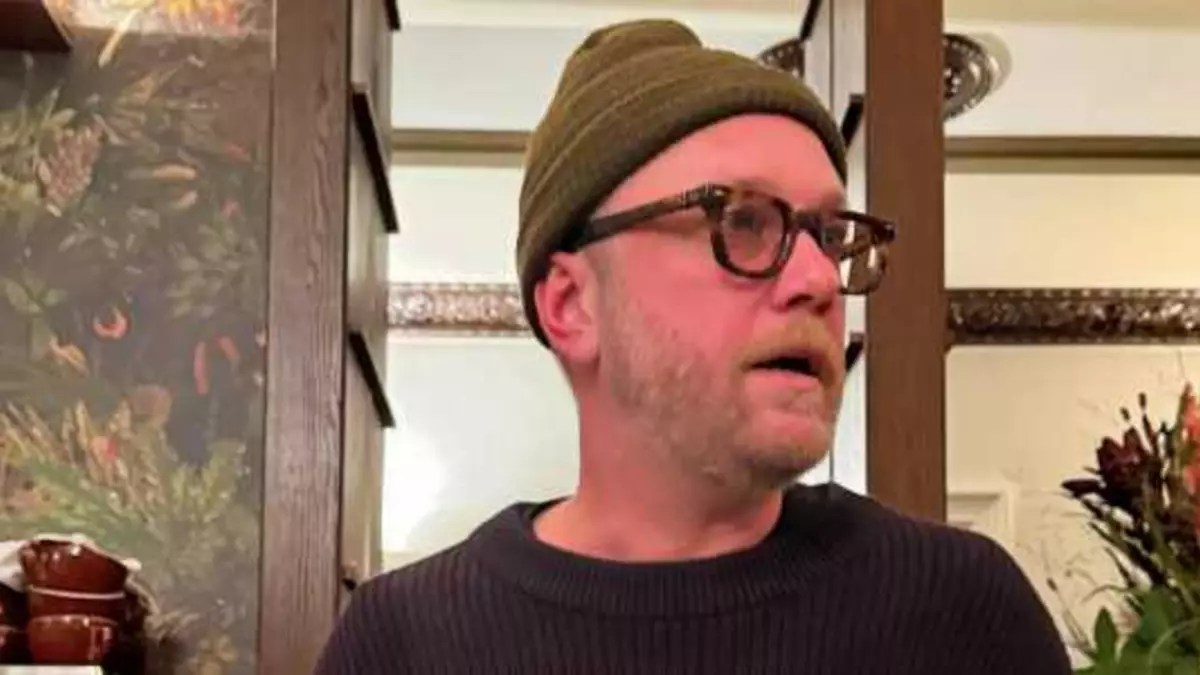
Max Strohe at Tulus Lotrek: Berlin’s Wild-Hearted Michelin Star You Need to Taste
Published on 04/13/2026 at 09:15 | Editorial responsibility: Rafael Müller, Editor-in-Chief AD HOC NEWS
The first thing you hear at Tulus Lotrek Berlin is not the clink of crystal. It is laughter. A quick burst from the bar, a chuckle from a corner table, the soft thud of plates as a server lands another course with relaxed precision. The room smells of roasted meat and browned butter, of citrus zest and a faint whiff of yeast from the bread that is just now cracking open on the next table. Candles burn low. Hip-hop sways under the murmur of conversation. You sit down and realize: this does not feel like a shrine. It feels like a place that expects you to eat.
You catch the glow of the open kitchen from your seat. No cold spotlight, more like a backstage area under warm bulbs. A pan hisses as fat hits metal; the Maillard reaction announces itself in a thin line of smoke. Someone shaves something over a plate—maybe bottarga, maybe truffle, maybe both, because restraint is not the house religion here. You smell acidity in the air, sharp and bright, like someone just dragged a Microplane across a lemon directly in front of your nose.
In this space, the idea of Casual Fine Dining finally stops sounding like a trend deck term. You are in Kreuzberg, not in a hushed hotel lobby. You feel your shoulders drop. This is a Michelin-starred room, yes, but your sneakers are safe, and so is your appetite.
The Protagonists: School Dropout, Sharp Tongue, Federal Cross of Merit
To understand why this room feels like this, you need to know the duo holding it together: chef Max Strohe and front-of-house force Ilona Scholl. On paper, his path makes little sense to rigid CV culture. No Abitur, no polished pedigree, a guy who bailed on school and stumbled through kitchens and odd jobs. But he stuck with the heat, the cuts, the burns. He learned in cramped brigades where the exhaust never quite worked and in dining rooms where nobody talked about Instagram angles. He learned to cook food that people actually wanted to finish.
Scholl, meanwhile, turned the front of house into something between neighborhood therapy and stand-up routine. She is the first smile you see, the first honest opinion you get, and the last voice you hear when you stagger out into the Kreuzberg night. She is not interested in pretending you are at Versailles. She is interested in making sure you eat incredibly well, drink precisely what you did not know you wanted, and feel, for a few hours, like the star of the room.
Together they built Tulus Lotrek Restaurant in a corner of Berlin that did not seem to cry out for white tablecloths. They named it after Toulouse-Lautrec, the painter of brothels and bars rather than kings and courts. The reference matters. It hints at a preference for humanity over hierarchy, for the blur of pleasure over rigid form.
Over the years, the accolades came. A coveted Michelin Star in Berlin Kreuzberg. Strong ratings from Gault&Millau Berlin. Then, something you do not expect for a man who loves fat, garlic, and dirty jokes: the Federal Cross of Merit. Not for plating, but for his outspoken engagement with refugees, with social projects, with the political edges of hospitality. A school dropout with Germany’s highest civilian honor pinned to his chest. The contrast suits him.
Cuisine Without Tweezers: An Undogmatic Plate
When your first course arrives, you understand what Max means when he calls his cooking undogmatic. The plate is beautiful, yes, but not sterilized. There is no grid, no obsessive cube, no tower that collapses at the first touch of a fork. The food looks like it wants to be eaten, not photographed from eight angles while the sauce dies on the lip of the plate.
Imagine a dish built around aged pork neck. The meat carries a dark, almost lacquered crust from a patient sear. You drag your knife through it; the fibers give, not in a dramatic collapse, but with the quiet resistance of perfect cooking. On the tongue, there is smoke, fat, a hint of sweetness from a long-reduced jus that has been mounted with butter until it shines like black silk. Beside it, a sharp, almost bracing element: maybe fermented kohlrabi, shaved into thin ribbons, slicked in an emulsion scented with mustard seed and apple vinegar. The crunch snaps against the softness of the pork; acidity slices through the fat. You feel your palate wake up.
This is not tweezer food. The cabbage does not stand at attention like a tiny regiment. The sauce is not painted in perfect, soulless dots. It runs, as sauce should. It finds its way into every corner of the plate, glossing textures, inviting bread. You will drag that bread through it until your plate looks scandalous. No one here will judge you. They might even bring more bread.
A second plate might start from something humbler still: a root vegetable, say celery or beet, roasted until its edges char, its interior goes almost custardy. Over it, a foam that is not about air but about taste—brown butter, nutty and loud, punched up with anchovy or miso. The scent rises first: hazelnut, toast, a whisper of caramel. When you cut in, the knife slides through the vegetable like through a soft cheese. On the palate, earth and umami crash into each other. There is crunch from fried crumbs or seeds, rough enough to make itself known between your teeth. The luxury is not in a truffle shaving tax. It is in the sense that someone has thought, and tasted, and tasted again, until every bite lands.
And then the desserts. You might expect something fragile, sugar-blown, technically impressive. Instead, you get something that feels like comfort hacked by a flavor chemist. A still-warm tart shell with a filling that tastes like lemon curd but hits with more depth, maybe spiked with yuzu or bergamot. The scent is almost floral, citrus oil sprayed directly into your nose as you lift the fork. A salty note from a precise pinch of sea salt. A bitter edge from charred peel in the cream. Your spoon sinks in and the filling wobbles but holds. Not too much gelatin, no rubber. The balance keeps you chasing the last smear on the plate.
This is Tulus Lotrek Menu logic: structure, but not rigidity. Techniques from classic French kitchens, yes, but filtered through Berlin chaos. Max cooks like someone who trusts your appetite more than the algorithm.
Media Heat: From Kitchen Impossible to the Feed
Of course, a chef this outspoken could not stay confined to one kitchen. You might have first seen Max Strohe on television, sweating and swearing his way through “Kitchen Impossible,” holding his ground against Tim Mälzer in foreign kitchens, decoding grandmother recipes under time pressure. On screen, his mix of brute honesty and real vulnerability made him stick out in a lineup of macho posturing. He looked like what he is: a cook who prefers the stove to the studio, but who knows that the modern game is played on both.
If you want to see how that TV persona translates back into plates, you can go hunting for clips. They show the same uncompromising generosity that lands in front of you in Kreuzberg.
Surrender a few minutes to his on-screen chaos and precision here: Search Max Strohe clips on YouTube
The digital echo does not stop at television. On Instagram, you find a flood of low-light table shots: wine glasses catching candlelight, thick sauces, fingers stealing the last bite of something. Guests document the room the way you will: not just the plates, but the people, the jokes, the menu cards stained with jus.
For a visual hit of what your own table might look like, start scrolling here: Discover visual impressions on Instagram
And because every strong opinion attracts a counter-opinion, the debates spill onto X. There, food writers, locals, and curious visitors argue about whether this is Berlin’s best restaurant, whether the looseness counts as charm or chaos, whether the pricing matches the star. Max himself occasionally throws in a comment, half joke, half manifesto; you can almost hear his voice in the short lines.
If you like to read the arguments before you book your own seat, join the noise here: Follow the latest discussions on X
Living Room, Not Temple: Atmosphere & Service
What makes Max Strohe Restaurant so disarming is not only what lands on your fork. It is what happens in the space between the courses. You sit in upholstered chairs that feel borrowed from someone’s cool aunt, not from a design catalog. The light is low but not theatrical. Art on the walls feels chosen, not staged. The distance between tables is enough for privacy but not enough to kill the hum of the room. You can hear the couple next to you debating which dish won the night, and that sounds like an invitation, not an intrusion.
The staff move like they know every square meter by muscle memory. They pour, clear, and describe without sliding into memorized monologues. You ask about a wine; instead of reciting soil types and altitude, your server tells you, “It tastes like sour cherries left in the sun,” and you understand immediately. When they bring a pairing from the Gault&Millau Berlin-praised list, they talk to you, not over you. If you want technical detail, they have it. If not, they give you a story instead.
The feel-good atmosphere here is not an add-on. It is the core product. There is structure, of course: a tasting menu with calibrated pacing, a brigade that tracks every dietary quirk you mentioned in your booking. But the vibe leans intentional looseness. You can laugh loudly without a head turning. You can ask for more bread three times. You can confess that you have no clue about natural wine and watch your server light up at the chance to guide you without condescension.
It is this blend of high craft and unfiltered warmth that makes the place feel like a living room. A living room with better glassware and absolutely no microwave, but still. You might find Ilona herself topping up your glass while telling you which table just got engaged, or which regular has been coming here since opening night. The stories become part of the seasoning.
Relevance for Berlin: Why It Matters
Berlin’s food scene has spent the last decade accelerating. New concepts flash and vanish. Neo-bistros multiply. Tasting menus stretch into the night behind anonymous doors. Amid that constant churn, Tulus Lotrek Berlin has staked out a rare position: fiercely personal, stubbornly idiosyncratic, and yet open-armed. It is not the most minimal, not the most experimental, not the most performative. It is something trickier to pull off: it is profoundly itself.
In a city famous for informality, many high-end restaurants still lean on stiff codes borrowed from older capitals. Max and Ilona refuse that template. Their Casual Fine Dining is not just jeans with caviar. It is a redefinition of what serious cooking can look like when you remove the fear factor. You feel welcome here whether you can parse the word “jus” or not.
On a plate level, the restaurant keeps Berlin honest. The cooking is rich, but not lazy. There is no comfort curtain of fat to hide sloppy seasoning. Acidity, bitterness, smoke, crunch—all the structural elements of good flavor—show up, clearly articulated. Dishes evolve with the seasons, with the market, with Max’s current obsession. That might mean a course centered on offal without apology, or a fish course where the sauce is louder than the fillet on purpose. It might mean a dessert that leans savory, leaving you alert rather than dulled.
On a cultural level, the presence of a chef with a Federal Cross of Merit standing in front of a Kreuzberg stove sends a quiet message: gastronomy matters. Not as glamour, but as craft, as social practice, as a place where questions of origin, labor, inclusion, and joy collide on a daily basis. Max uses his visibility—from Kitchen Impossible to talk shows—to drag those topics out of the back of the house and into the public square.
For you, as a guest, all this meta-talk condenses into something very simple. You book. You arrive. You sit down in that living-room-light. You smell stock that has been reducing for hours. You hear a cork pop, a table laugh, a pan roar. A plate lands in front of you with something that looks a bit too generous, a bit too fragrant, a bit too saucy for any algorithm. You pick up your fork. At that moment, the debates around Michelin Star Berlin Kreuzberg rankings stop mattering.
What remains are taste, warmth, memory. The crunch when you break the crust of a slow-roasted vegetable. The silk of a perfectly reduced jus soaking into the crumb of your bread. The slight rasp in your throat from laughing too hard between courses. The way Ilona looks you in the eye at the door and says, “See you next time,” as if it were a certainty, not a hope.
You step back out into the street. Kreuzberg hums. Your clothes smell faintly of roasted meat and candle wax. Your phone already buzzes with friends asking, “So? Was it worth it?” You have your answer. And if you want them to stop asking and start tasting, you know what link to send.
Disclaimer regarding our articles: No investment advice, no buy or sell recommendation. Information on prices, companies, and markets is provided without guarantee; changes are possible at any time. Stock market transactions can lead to substantial losses. Our articles are created and reviewed in whole or in part automatically with the support of AI.