LPKF Laser's Tumultuous Week: Short Sellers Pile In, CEO Buys Shares, and Shareholders Revolt Ahead of AGM
Published on 06/01/2026 at 16:11 | Redaktion boerse-global.de
Two hard-to-reconcile narratives are competing for investor attention at LPKF Laser & Electronics. One points to a revolutionary glass-substrate technology that could transform advanced chip packaging. The other points to deteriorating fundamentals, a 28% weekly stock plunge, and a growing swarm of short sellers betting against the stock.
Hedge funds Voleon Capital Management and Marshall Wace have stepped up their bearish wagers in recent weeks. Voleon increased its net short position from 2.02% to 2.13%, having steadily built it since crossing the reporting threshold at 1.70% at the end of April. The timing is telling: short bets mounted just as the stock touched its five-year high of €29.20, a stunning 264% rally from the year's low of €5.35. But the rally reversed sharply. The shares now trade at €20.90, down 4.57% in Friday's session alone and more than 28% lower than a week ago. That still leaves the stock well above its 200-day moving average of €8.95, a sign that a sizable bull case remains intact.
Chief executive Klaus Fiedler seems intent on backing that bull case with his own money. On May 19, he bought LPKF shares at €21.00 per share — a vote of confidence that carries extra weight given the weak quarterly numbers published just days earlier.
LIDE Technology: The Promise and the Timeline
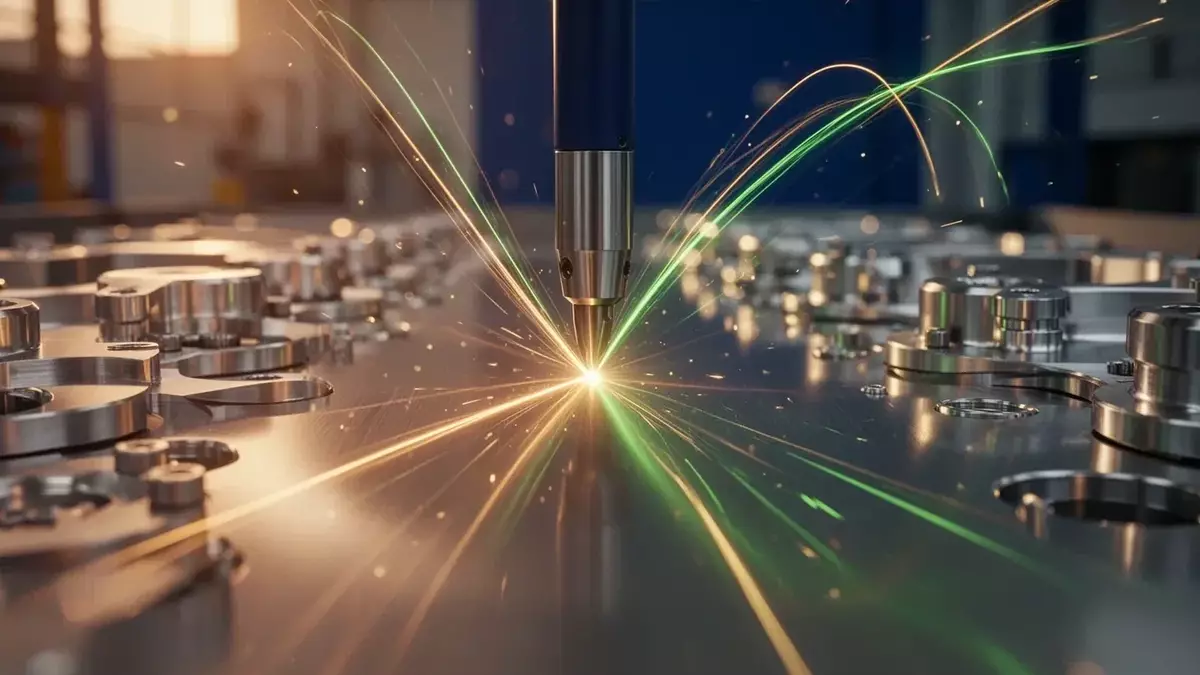
The stock's surge and subsequent correction both trace back to the same catalyst: LPKF's patented Laser Induced Deep Etching process, or LIDE. The technology enables precision processing of glass substrates and is widely viewed as a key enabler for next-generation chip packaging, particularly in co-packaged optics where glass-based interposers are expected to replace silicon.
Should investors sell immediately? Or is it worth buying LPKF Laser?
Sector tailwinds have bolstered the narrative. Nvidia is investing $500 million in Corning, betting on glass-based solutions, while TPK Holding and ASE Technology are planning a pilot line for through-glass vias — the exact interface LPKF's equipment addresses.
But the technology is still in the customer qualification phase. Management expects to sign initial production orders in the second quarter of 2026. A broad ramp-up is not anticipated before 2027, and high-volume production remains at least three years away, with 2029 the earliest target. The timeline means LPKF's share price is pricing in revenue that has yet to materialize.
Weak Numbers Provide Short Sellers with Ammunition
The first quarter of 2026 laid bare the gap between future promise and current reality. Revenue slumped 32.4% year-on-year to €17.1 million, driven primarily by a collapse in the solar segment as customers delay investment while the industry transitions to perovskite cell technology. EBIT swung to a loss of €6.9 million, deepening from a €3.9 million loss a year earlier.
One bright spot: order intake rose to €24.1 million, giving a book-to-bill ratio of 1.4 — meaning LPKF booked more new orders than it shipped in revenue. Management's full-year guidance of €105 million to €120 million in revenue and an adjusted EBIT margin between -3.0% and +4.5% explicitly excludes any potential large-scale orders from the advanced packaging segment. No dividend will be paid; the retained earnings of roughly €7.6 million will be carried forward in full.
Shareholder Rebellion and a Board Refresh
The operational stress has spilled into corporate governance. Dissident shareholders have filed counter-motions ahead of the annual general meeting scheduled for June 10 in Hanover. The opponents are demanding that the management board be denied discharge and that the company immediately launch a capital increase to fund a more aggressive push into the advanced packaging market — escalating the battle over CEO Fiedler's "North Star" restructuring plan, which targets double-digit operating margins by 2028 through cost cuts rather than rapid expansion.
LPKF's supervisory board recommends rejecting the counter-motions. At the same time, a board seat is opening up. Deputy chairman Dr. Dirk Michael Rothweiler will not stand for re-election. His proposed successor is Dr. Arne Schneider, CEO of Elmos Semiconductor, who brings deep expertise in the chip industry as well as financial reporting and audit experience. Schneider's appointment, if approved, would run through 2029 and is seen as an institutional anchor for LPKF's strategic pivot toward semiconductor applications.
LPKF Laser at a turning point? This analysis reveals what investors need to know now.
Also on the AGM agenda: the appointment of an auditor for the 2026 financial year and a by-law change that would allow future meetings to be held within a 50-kilometer radius of the company's headquarters.
What Happens Next
The next major milestone is the half-year report in July. By then, investors will want to see whether LPKF can convert its LIDE pipeline into signed production contracts — or whether the hedge funds' bearish thesis will gain the upper hand. The outcome of the AGM on June 10 could be equally decisive, as shareholders decide whether to back management's gradual approach or force a more aggressive capital allocation strategy.
For now, LPKF is caught between a technology story that has captured the market's imagination and a set of financial realities that leave little margin for error. The CEO has placed his own bet on the stock. The short sellers have placed theirs. The next few weeks will reveal which side has better information.
Ad
LPKF Laser Stock: New Analysis - 1 June
Fresh LPKF Laser information released. What's the impact for investors? Our latest independent report examines recent figures and market trends.
Disclaimer regarding our articles: No investment advice, no buy or sell recommendation. Information on prices, companies, and markets is provided without guarantee; changes are possible at any time. Stock market transactions can lead to substantial losses. Our articles are created and reviewed in whole or in part automatically with the support of AI.