Intel’s High-NA Push and Washington’s MATCH Act Pull ASML in Opposite Directions
Published on 06/10/2026 at 17:57 | Redaktion boerse-global.de
The Dutch lithography giant has enjoyed a breathtaking run — a 123% surge over twelve months and a spot as Europe’s most valuable listed company. But the view from the top is growing more complicated. ASML now faces a rare simultaneous challenge: a strategic split between its two biggest customers over next-generation technology and a fresh wave of US export controls that threaten its lucrative China business.
A Rift in the Lithography Roadmap
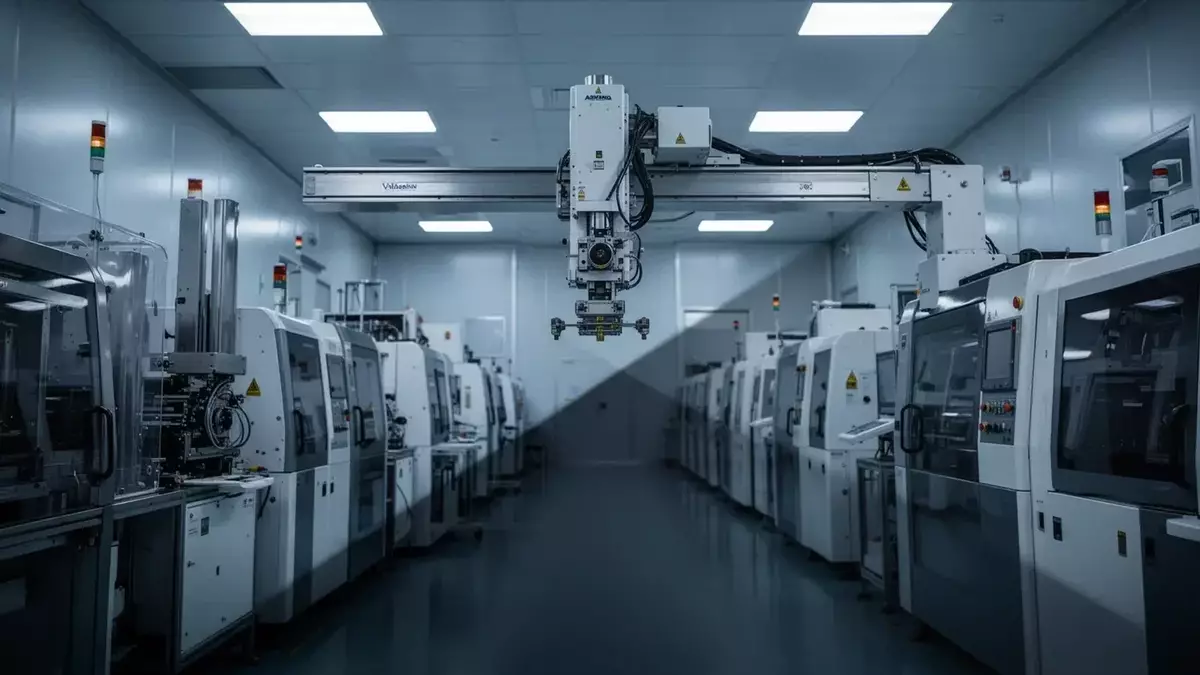
At the heart of the tension lies the transition to High-NA EUV, the next leap in chip-making precision. Intel has bet aggressively, securing the bulk of early production slots for the TWINSCAN EXE:5000 series — machines that cost around €400 million apiece and can print features 66% smaller than their predecessors. These tools are essential for sub-2-nanometer chips, the kind that will power the next generation of AI accelerators.
TSMC, however, is pumping the brakes. The Taiwanese foundry sees no urgent need to abandon its existing Low-NA EUV tools and has questioned whether the staggering cost of High-NA can be justified in the short term. The divergence means ASML’s near-term growth hinges disproportionately on Intel’s ability to ramp its fledgling foundry business successfully. Analysts are left wondering whether one customer’s enthusiasm can offset another’s caution.
Washington’s Next Blow: The MATCH Act
Compounding the strategic uncertainty is a regulatory threat that goes well beyond earlier export restrictions. The MATCH Act — short for the Multilateral Alignment of Technology Controls on Hardware — currently being debated in the US would extend curbs to older DUV immersion systems, which form the backbone of China’s semiconductor fabrication. Even more damaging, it would limit servicing of those machines. Service contracts are high-margin for ASML, and China still accounts for roughly 20% of group revenue.
Should investors sell immediately? Or is it worth buying Asml?
The Dutch government has already pushed back, with trade minister Sjoerd Sjoerdsma formally objecting to the extraterritorial reach of the law. But Washington has shown little appetite for compromise in recent years. CEO Christophe Fouquet has warned publicly that excessive regulation could push Chinese customers to develop their own alternatives — a risk to ASML’s long-term grip on the market.
A Market That’s Catching Its Breath
The stock has reflected these crosscurrents. After hitting an all-time high of €1,726 in early June, ASML shares have retreated to around €1,516–€1,537 — roughly 4% below the peak. The 200-day moving average sits at €1,078, leaving the current price about 40% above that level — comfortable, but not overheated. The relative strength index has eased to 63, signaling that the euphoria of recent months is fading.
Year-to-date gains remain impressive at around 53–55%, and the 12-month return of 123% still ranks among the best in European equities. Yet the tone of the market has shifted. Investors are moving from AI-driven fantasy to the hard realities of investment cycles and geopolitical friction. The consolidation we are seeing is not a vote of no confidence in the technology; it is a recalibration of the operating environment.
The Terafab Wildcard
A third layer of complexity comes from the demand side. The so-called Terafab project in Texas — a massive semiconductor initiative involving Elon Musk and other hyperscalers — signals a structural shift. End users of AI compute capacity are no longer content to wait passively for foundry output. They want direct influence on the lithography roadmap. That places ASML at the center of a strategic web that now includes chip designers, cloud giants, and sovereign governments.
Asml at a turning point? This analysis reveals what investors need to know now.
Monopoly Meets New Realities
None of this diminishes ASML’s fundamental moat. It remains the sole producer of EUV lithography systems — a monopoly in the most critical technology for advanced chips. But the narrative has acquired new chapters. Geopolitics, diverging customer strategies, and regulatory overreach are no longer background noise; they are core variables in the valuation equation.
The real test will come in the second half of 2026, when the fate of the MATCH Act becomes clear, and when Intel’s High-NA ramp either delivers or disappoints. For now, owning ASML is a bet on the 2-nanometer cycle — and on the ability of Dutch diplomacy to soften Washington’s next move.
Ad
Asml Stock: New Analysis - 10 June
Fresh Asml information released. What's the impact for investors? Our latest independent report examines recent figures and market trends.
Disclaimer regarding our articles: No investment advice, no buy or sell recommendation. Information on prices, companies, and markets is provided without guarantee; changes are possible at any time. Stock market transactions can lead to substantial losses. Our articles are created and reviewed in whole or in part automatically with the support of AI.