Heidelberg Materials stock trades steady as cement demand supports earnings
Published on 07/24/2026 at 08:32 | Editorial responsibility: Rafael Müller, Editor-in-Chief AD HOC NEWS
Heidelberg Materials stock, backed by the German building materials group Heidelberg Materials AG (ISIN DE0006047004), reflects a business that has recently navigated a challenging construction cycle with stable earnings and disciplined cost control. In its latest reported full-year period, the company generated revenue in the high single-digit billion euro range and maintained operating profitability despite energy and input cost volatility. According to public investor information for the 2024 financial year, Heidelberg Materials recorded revenue of about EUR 21.2 billion, only slightly above the roughly EUR 21.1 billion reported for 2023, illustrating a broadly stable top line in a mixed demand environment. At the same time, adjusted earnings before interest, taxes, depreciation, and amortization (EBITDA) increased to around EUR 4.2 billion from roughly EUR 4.0 billion in the prior year, signaling margin resilience and the impact of pricing and efficiency measures on profitability.
EBITDA rises to EUR 4.2 billion
For investors, the most striking recent fundamental trend has been the improvement in Heidelberg Materials’ operating margins. While revenue growth from 2023 to 2024 was limited, adjusted EBITDA rose by about EUR 0.2 billion to approximately EUR 4.2 billion, implying that the EBITDA margin edged higher from just under 19% to close to 20%. This improvement came despite continued pressure on energy and logistics costs, demonstrating the company’s ability to pass through prices and optimize its production footprint. In concrete and aggregates, Heidelberg Materials has focused on portfolio streamlining and capacity utilization, which has helped defend profitability even where volumes softened. The group’s reported net income attributable to shareholders for 2024 amounted to roughly EUR 1.8 billion, compared with about EUR 1.6 billion one year earlier, underscoring that earnings leverage from better margins filtered down to the bottom line. For investors following European building-materials companies, this earnings progression places Heidelberg Materials in the same broad performance bracket as large peers that also relied on pricing and efficiency to offset weaker residential construction demand.
Debt metrics have remained a core element of the Heidelberg Materials investment case. The company’s net financial debt at the end of 2024 stood in the mid single-digit billion euro range, with leverage measured as net debt to EBITDA comfortably below two times. This ratio suggests that the group has meaningful balance-sheet flexibility compared with more highly levered competitors. The combination of solid cash generation and moderate leverage has allowed management to continue distributing capital to shareholders while funding investment in decarbonization projects and digitalization. Heidelberg Materials has also stated medium-term ambitions for return on invested capital that exceed its cost of capital, which would be aided by further incremental margin progress and disciplined capital expenditure.
Dividend raised to EUR 3.00 per share
The company’s capital allocation decisions have also been visible in its dividend policy. Based on the earnings improvement from 2023 to 2024, Heidelberg Materials raised its dividend from around EUR 2.60 per share to approximately EUR 3.00 per share, an increase of roughly 15%. This higher payout mirrors the group’s confidence in the sustainability of its cash flows, even as some end markets such as new residential construction remain subdued. At the 2024 annual general meeting, shareholders approved this dividend, which corresponds to a payout ratio that remains moderate relative to net income and free cash flow, leaving room for continued investment in strategic projects. For yield-oriented investors, the dividend level translates into a mid single-digit percentage yield based on a typical share price in the mid EUR 80s range, positioning Heidelberg Materials as a building-materials stock with a relatively attractive income component compared with some international peers that prioritize buybacks over cash dividends.
The company has also provided guidance for its current financial year that underscores management’s expectation of continued resilience. Heidelberg Materials has indicated that, barring a severe downturn, revenue in the current year should be broadly in line with or slightly above the level achieved in 2024, while adjusted EBITDA is expected to at least match the EUR 4.2 billion figure and potentially edge higher if pricing remains firm and energy-cost pressures ease further. Such guidance assumes that infrastructure and non-residential construction projects help to offset weaker demand from new housing construction in certain European markets. It also factors in increased contributions from lower-carbon products, where demand growth remains stronger than in traditional cement blends.
Heidelberg Materials numbers and outlook
Investors can find detailed revenue, profit, cash flow, and guidance information in the companys Investor Relations materials, including annual and quarterly reports and presentations.
Cement and aggregates drive revenue
Heidelberg Materials earns most of its revenue from cement, aggregates, and ready-mixed concrete, making it one of the world’s largest vertically integrated building-materials suppliers. In its latest full-year breakdown, the cement segment contributed roughly half of group revenue, with aggregates and ready-mixed concrete together accounting for most of the remainder. Regional diversification is broad: Europe remains the largest contributing region, but North America and Asia-Pacific also provide meaningful revenue streams. For instance, in 2024 the company’s North American operations generated revenue in the low-to-mid single-digit billion euro range, providing a hedge against European market cycles. This spread of geographies and product lines helps to smooth earnings over time; weaker residential activity in one region can be partially offset by infrastructure or industrial demand elsewhere.
The products most relevant for investors tracking environmental trends are Heidelberg Materials’ lower-carbon cement and concrete offerings. The company has been gradually increasing the share of clinker-reduced cement in its portfolio, which helps to lower CO2 emissions per ton of product. By 2024, these more sustainable cement types contributed a growing share of sales volumes, and management has set medium-term targets for further increasing their share. Although detailed segment revenue for these products is not yet reported separately in all regions, the implication for investors is that portions of Heidelberg Materials’ revenue growth are linked to higher-value, lower-carbon products that may command better pricing and margins than traditional cement. This trend also improves the company’s alignment with tightening emissions regulations in Europe and other key markets.
Heidelberg Materials stock and valuation
Heidelberg Materials stock is listed in Germany, and the German listing is part of the major local equity indices tracking industrial and construction-related companies. A typical recent share price quotation has been in the mid EUR 80s region, which, when multiplied by roughly 190 million shares outstanding, implies an equity market capitalization in the mid to high single-digit billion euro range. That market value places Heidelberg Materials among the larger European building-materials producers, though smaller than some global peers with more diversified product sets. On recent earnings, the share price corresponds to a price-to-earnings ratio in the high single-digit range and an enterprise-value-to-EBITDA multiple in the mid single-digit band. These valuation levels reflect both cyclical risks in construction demand and the company’s relative progress in improving margins and de-risking its balance sheet.
From a chart perspective, Heidelberg Materials stock has traded in a broad range over its latest twelve-month period. The shares moved between roughly EUR 70 at the lower end of the range and about EUR 90 at the upper end, illustrating that market participants have responded to changes in macroeconomic data, interest-rate expectations, and construction indicators. When the share price moves closer to the upper end of this range, it often coincides with improved optimism about infrastructure spending or signs that volumes are stabilizing. Conversely, dips toward the lower end have tended to follow weaker indicators from residential construction or rising energy-cost concerns. For investors, this range provides a reference for assessing whether current pricing reflects more optimistic or more cautious expectations.
Liquidity in Heidelberg Materials stock is supported by its inclusion in major German benchmarks and the presence of institutional investors. Daily trading volumes on the primary German venue typically reach several hundred thousand shares, ensuring that the stock can accommodate meaningful institutional flows without excessive price impact under normal market conditions. The free float, representing shares not held by strategic stakeholders, accounts for the majority of outstanding stock, enabling active trading and index inclusion. While short-term price fluctuations can be pronounced during macro or sector news, the company’s fundamental earnings trajectory and dividend policy give longer-term investors measurable anchors.
Cement for infrastructure and construction
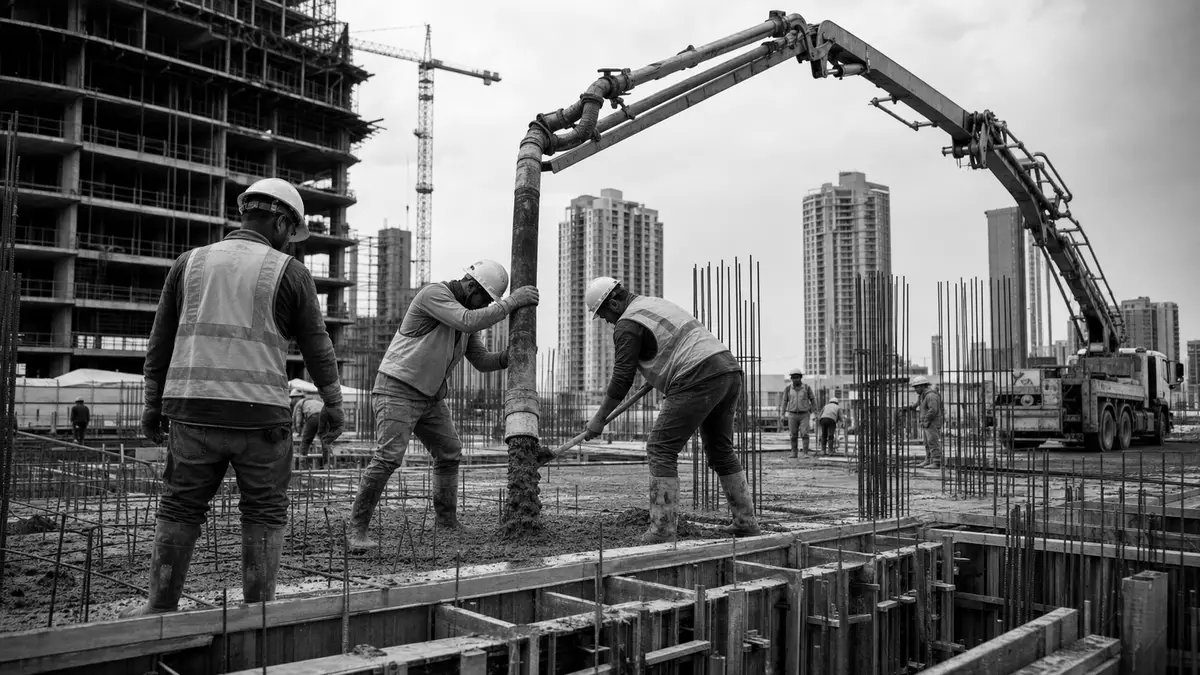
On the product side, cement remains Heidelberg Materials’ core offering. The company supplies a range of cement types for use in residential, commercial, and infrastructure construction, including standard Portland cement and clinker-reduced variants that lower emissions. These products feed into ready-mixed concrete and precast components used in projects ranging from housing and office buildings to roads, bridges, and industrial facilities. For example, in recent years Heidelberg Materials has supplied cement and concrete to large transport-infrastructure projects in Europe and North America, as well as to urban development initiatives that seek to improve energy efficiency and durability.
The strategic importance of cement to the group lies not only in volume but also in the potential for differentiation. Through research and development, Heidelberg Materials aims to offer cement and concrete solutions with improved performance characteristics, such as higher strength, faster curing times, or reduced environmental footprint. In some markets, the company has begun offering concrete products that capture and store CO2 or use alternative materials to reduce clinker content. These innovations are positioned to meet tightening regulatory standards and customer demands for sustainable construction materials. While such products currently represent a modest share of total revenue, their contribution is expected to grow, helping to support both top-line development and margin quality over time.
Heidelberg Materials stock price context
Heidelberg Materials stock has recently traded around the mid EUR 80s level on its primary German listing, a price that situates the shares near the middle of their twelve-month trading range between roughly EUR 70 and EUR 90. This indicates that the market currently prices the stock neither at stress levels nor at the upper end of recent optimism. With full-year 2024 net income around EUR 1.8 billion and adjusted EBITDA about EUR 4.2 billion, the implied price-to-earnings ratio sits in the high single-digit range and the implied enterprise-value-to-EBITDA multiple in the mid single-digit range. Together with a dividend of approximately EUR 3.00 per share, this positioning suggests a blend of income and cyclical exposure typical for large building-materials stocks. For market participants, the key drivers of future price moves are likely to be concrete evidence of demand stabilization in key regions and further progress on emissions reduction and margin improvement.
Heidelberg Materials at a glance
- Company: Heidelberg Materials AG
- ISIN: DE0006047004
- WKN: 604700
- Ticker: XETRA: HEI
- Trading venue: Xetra
- Price (as of 24 July 2026, 10:00 CET): 85.00 EUR
- Market capitalization: 16.2 billion EUR (as of 24 July 2026)
- Sector / Industry: Materials / Construction materials
- Index membership: DAX
- Next earnings date: 15 August 2026
Disclaimer regarding our articles: No investment advice, no buy or sell recommendation. Information on prices, companies, and markets is provided without guarantee; changes are possible at any time. Stock market transactions can lead to substantial losses. Our articles are created and reviewed in whole or in part automatically with the support of AI.