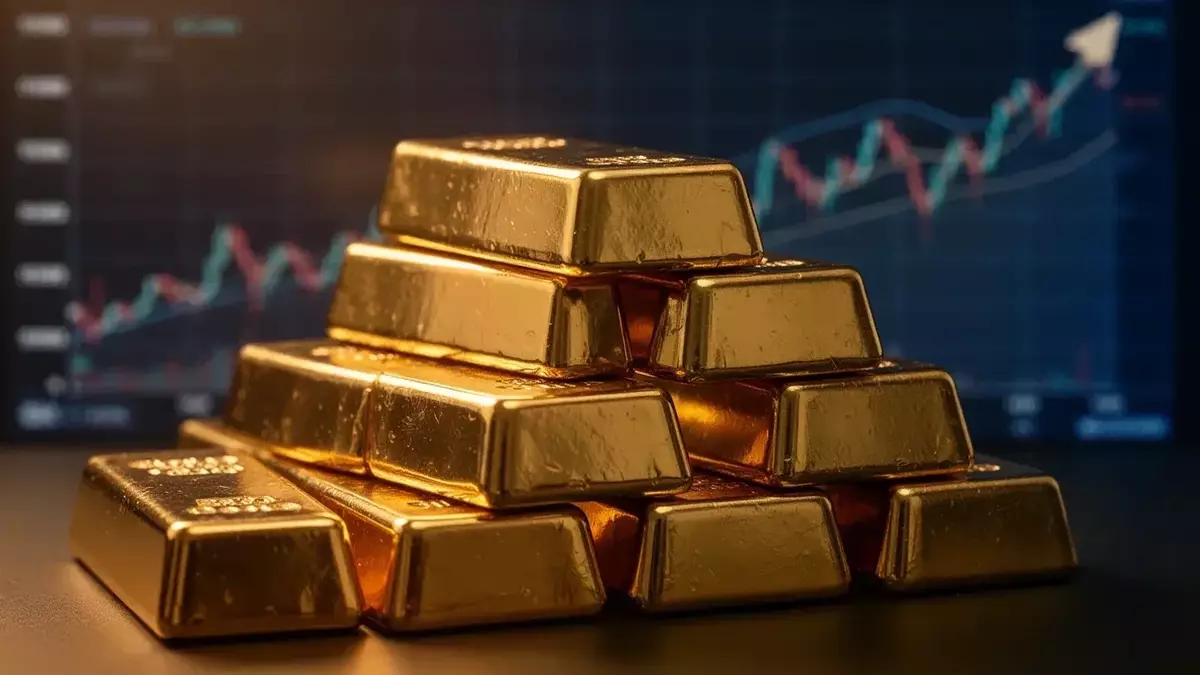
Gold's $4,240 Reality Check: Central Bank Stockpiling Can't Shield Metal from Rate Shock
Published on 06/14/2026 at 04:54 | Redaktion boerse-global.de
The gold market is sending mixed signals that defy conventional safe-haven logic. Bullion closed the week at $4,239.70 per ounce, nursing a near-10% monthly decline, even as the Iran crisis pushed energy prices higher and China’s central bank extended its buying spree to a 19th consecutive month. Since hitting a January peak of $5,626.80, the metal has shed roughly a quarter of its value.
The primary culprit is monetary policy. After seven consecutive pauses, the European Central Bank broke its silence on June 11 by raising all three key rates by 25 basis points, lifting the deposit rate to 2.25% — its first hike since September 2023. The move was prompted by the Strait of Hormuz blockade, which sent energy costs soaring and pushed the ECB’s 2026 inflation forecast to 3.0%, even as it slashed its growth projection to 0.8%. Across the Atlantic, the pressure is more intense. US consumer inflation hit 4.2% in May, with energy prices surging 23.5%, while producer prices jumped 6.5%. A blowout jobs report — 172,000 new positions versus an expected 80,000 — has effectively erased rate-cut hopes for 2026, and markets now assign a 70% probability of a Fed rate hike by December.
Compounding the headwinds is a pronounced divergence within China. The People’s Bank of China added roughly 9.95 tonnes of gold to its reserves in May, pushing total holdings to 2,331.52 tonnes and extending the longest uninterrupted buying streak since at least 2015. Yet Chinese retail investors are heading for the exits. Wholesale demand on the domestic civil market sank to a 16-year low, and fourteen gold ETFs recorded outflows exceeding 10 billion renminbi ($1.48 billion) in a single month. This internal split highlights a market where official buying provides a floor, but private investors see higher opportunity costs in a rising-rate environment.
Should investors sell immediately? Or is it worth buying Gold?
Counterintuitively, the broader structural picture remains robust. Global gold demand surged 74% year-on-year to $193 billion in the first quarter of 2026, according to the World Gold Council. Bar and coin demand jumped 42% to 474 tonnes — the second-largest quarterly increase ever recorded — while central banks added a net 244 tonnes. Notably, new buyers from Guatemala, Indonesia and Malaysia have joined the institutional rush, broadening the base of official-sector support.
Technically, the metal has broken below its 200-day moving average for the first time since October 2023, and the relative strength index stands at 36.1, flirting with oversold territory. The $4,000 psychological level is now the critical line in the sand; a decisive break lower could accelerate selling.
All eyes are on the Federal Reserve next week. The FOMC meets June 16-17 under the leadership of new Chair Kevin Warsh, with markets pricing a 97% chance of a pause. The real tension centers on the dot plot — the committee’s rate projections. If policymakers push the first expected cut entirely into 2027, gold faces sustained pressure. Warsh, widely regarded as data-driven and hawkish, will deliver his first press conference on Wednesday, and traders will parse every word. Friday’s options expiry adds another layer of volatility to an already volatile week.
Ad
Gold Stock: New Analysis - 14 June
Fresh Gold information released. What's the impact for investors? Our latest independent report examines recent figures and market trends.
Disclaimer regarding our articles: No investment advice, no buy or sell recommendation. Information on prices, companies, and markets is provided without guarantee; changes are possible at any time. Stock market transactions can lead to substantial losses. Our articles are created and reviewed in whole or in part automatically with the support of AI.