Gold’s $4,000 Fault Line: Central Bank Appetite Meets Dollar-Driven Fatigue
Veröffentlicht: 19.07.2026 um 09:31 Uhr, Redaktion boerse-global.de
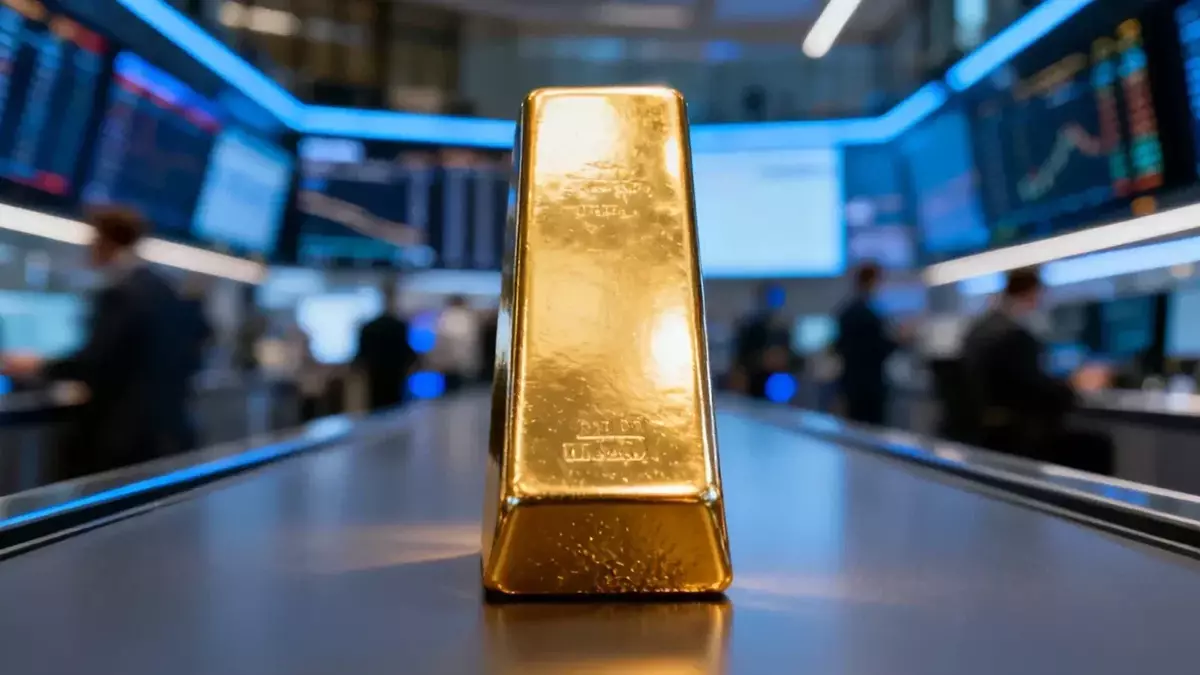
Gold closed last week at $4,021.30 per ounce, up 1.03 percent on Friday but nursing a weekly loss of 2.58 percent — its second consecutive down week. The psychologically charged $4,000 level has become the defining technical battleground for the precious metal, caught between powerful institutional buying and a resurgent US dollar that is siphoning safe-haven flows away from bullion.
The divergence between short-term price action and structural demand is stark. While retail investors have been shedding positions, central banks are piling in at a record pace. China’s official reserves grew by 9.95 tonnes in May and another 14.93 tonnes in June — the 20th straight month of increases. Goldman Sachs estimates that Beijing actually bought around 48 tonnes through the London over-the-counter market in May alone, the highest monthly volume in over a year and far above the 10 tonnes officially reported. Some analysts now suspect China’s true gold holdings may exceed 5,500 tonnes, more than double the figure officially disclosed. The World Gold Council’s latest central bank survey reinforces the trend: 73 percent of respondents expect the dollar’s share of global reserves to shrink over the next five years, while 95 percent anticipate further gold accumulation. China’s monthly purchases are estimated to have tripled between March and June.
On the technical front, gold’s near-term picture is fragile. The metal currently trades 6.57 percent below its 50-day moving average of $4,304.16, and its relative strength index of 40.6 points to weak momentum without yet reaching oversold territory. A breach below $4,000 could trigger a slide toward the $3,900 to $3,950 zone, according to market observers. Conversely, holding that support would open the door to a bounce toward $4,100 — the next notable resistance level. The distance from the record high of $5,626.80, set on January 29, 2026, stands at roughly 28 percent, while the gap to the 52-week low from late October 2025 is a mere 3 percent.
Should investors sell immediately? Or is it worth buying Gold?
Longer-term views remain more constructive. Barron’s has argued that the 30 percent pullback from the January peak represents a healthy correction within an intact uptrend, citing a doji candlestick pattern and a bullish RSI divergence as potential bottoming signals. A third-quarter target of $4,500 has been floated, contingent on the current weakness proving transitory. A separate research note on North Peak, an exploration company, points to a new Nevada cycle and targets gold at $5,200 per ounce — far above current levels.
The macro backdrop, however, remains a formidable headwind. The US dollar continues to strengthen as the preferred safe-haven currency, supported by a resilient labor market — initial jobless claims have fallen — and better-than-feared retail sales data. The geopolitical premium that usually boosts gold during crises, such as the heightened tensions around Iran, is currently being overshadowed by dollar demand for liquidity. The Federal Reserve’s cautious stance on rate cuts keeps the opportunity cost of holding non-yielding bullion elevated. The International Monetary Fund expects US inflation to reach its 2 percent target only in early 2027, a scenario that would delay any easing cycle. Rate expectations are divided: Barclays sees two 25-basis-point cuts in March and June, while Moody’s projects three reductions in the first half of the year on a softening labor market. The Fed’s own dot plot signals just one cut for 2026.
Looking ahead, the direction of gold may be decided by a series of data points and policy events this week. Britain’s consumer price index on July 22, the European Central Bank’s rate decision on July 23, and global purchasing managers’ indexes on July 24 will all influence currency and yield dynamics. Rising oil prices, driven by Middle East tensions, add another layer of complexity — they strengthen the dollar case while also feeding inflation concerns. For now, gold’s fate hinges on whether central bank buying can continue to absorb selling pressure from other quarters and whether the $4,000 level holds as a line in the sand. If it does, a stabilization phase with a recovery toward the mid-$4,000s is plausible. If it gives way, the correction zone near $3,900 will become the next focus in short order.
Ad
Gold Stock: New Analysis - 19 July
Fresh Gold information released. What's the impact for investors? Our latest independent report examines recent figures and market trends.
Disclaimer zu unseren Artikeln: Keine Anlageberatung, keine Kauf oder Verkaufsempfehlung. Angaben zu Kursen, Unternehmen und Märkten ohne Gewähr; Änderungen jederzeit möglich. Börsengeschäfte können zu hohen Verlusten führen. Unsere Beiträge werden ganz oder teilweise automatisiert mit Unterstützung von AI erstellt und geprüft.