BYD Puts Money on the Line for God's Eye as It Readies a Bespoke European PHEV Supermini
Published on 06/04/2026 at 07:42 | Redaktion boerse-global.de
China’s largest automaker is taking a two-pronged approach to shake off a prolonged domestic slump: it is underwriting the financial risk of its own autonomous driving technology while simultaneously launching its first car designed from scratch for European buyers. The moves aim to rebuild consumer confidence at home and crack a fiercely competitive market abroad.
BYD has announced it will cover repair costs, third-party property damage and personal injury claims for accidents in China involving its “God’s Eye” driver-assistance system — provided the system was used according to the rules. The one-year liability policy, which runs from vehicle delivery, applies to both new buyers and existing customers who upgrade to God’s Eye 5.0 via an over-the-air update. Although God’s Eye remains a Level?2 system, chief executive Wang Chuanfu nevertheless framed the commitment in terms of Level?3 and Level?4 liability standards. The message is blunt: the company is so confident in its technology that it is willing to absorb the cost if something goes wrong.
That technological confidence is backed by hardware. BYD has developed the Xuanji A3, which it calls China’s first homegrown 4?nanometre chip for intelligent driving. Designed to handle Level?3 and Level?4 functions, the chip will initially appear in higher?end brands such as Yangwang, Denza and Fang Cheng Bao. Customers who want the full “God’s Eye B” system with LiDAR will pay around 12,000 yuan (roughly $1,770). Separately, on 4 June 2026, the company confirmed a humanoid?robot programme that will leverage its experience in vehicle AI and sensor data. Commercial details remain scarce, but BYD’s extensive dealership network could eventually double as a service channel for the robots.
While the liability and chip news targets the home market, Europe is where the immediate product push is concentrated. BYD’s Dolphin G DM?i — a plug?in hybrid supermini purpose?built for overseas customers — will go on sale in June, with deliveries beginning in autumn 2026. It is the first BYD model conceived entirely for European tastes, not simply a Chinese-market car with minor adaptations. The cabin is minimalist, dominated by a floating infotainment display plus a smaller driver screen, and the three?spoke steering wheel uses physical buttons to cater to local preferences.
The car’s trump card is powertrain. The DM?i hybrid system offers a combined range of over 1,000 kilometres on a full tank and a fully charged battery. Two LFP battery options — 7.8 kWh and 18 kWh — deliver an all?electric range of 50 to 80 kilometres, enough for the typical European commute. That makes the Dolphin G DM?i the only supermini in the region with a genuine plug?in hybrid setup, a segment currently dominated by the VW Polo, Renault Clio and Toyota Yaris.
Pricing could be the real shockwave. Autocar has reported a British price of around £20,000 — about £10,000 less than the next?cheapest compact PHEV on the market. BYD has not officially confirmed that figure, but formal pricing is expected in June. If the number holds, the Dolphin G DM?i will undercut every rival in its class by a wide margin.
As BYD pushes the boundaries of vehicle technology, ensuring workplace safety around new manufacturing processes and materials is just as critical. A free toolkit provides 41 ready-to-use templates and checklists for risk management, fire safety, manual handling, and more — helping you stay compliant with UK regulations. Download the free Risk Assessment Toolkit
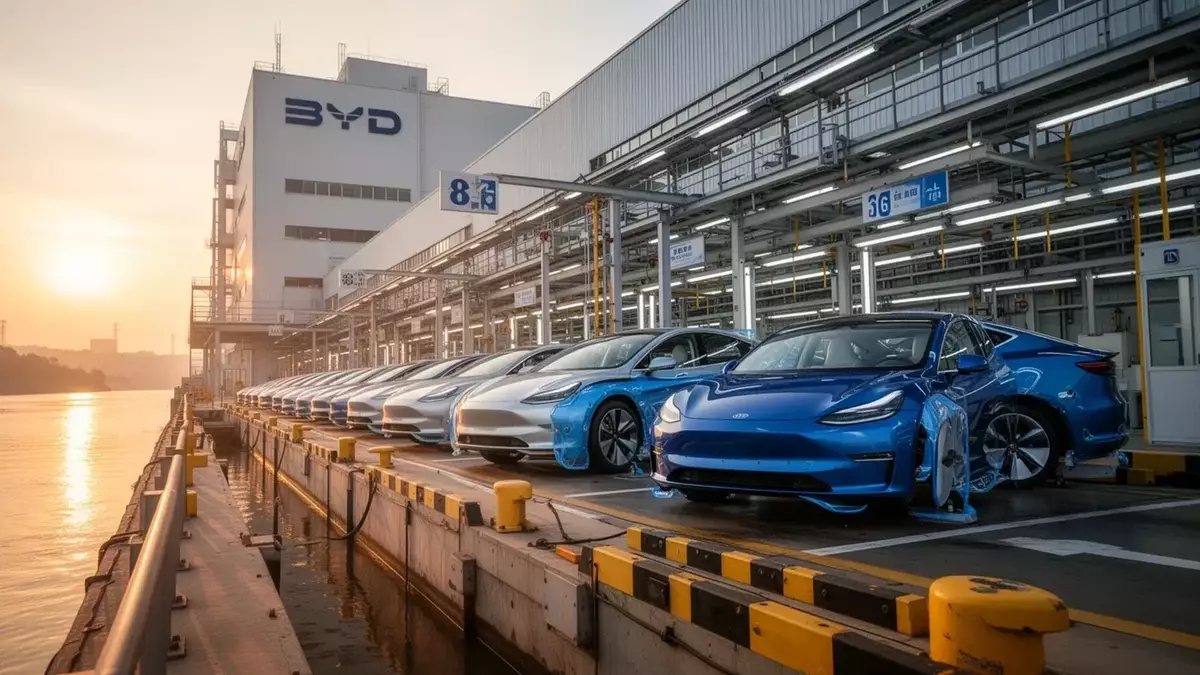
The European offensive is not happening in a vacuum. BYD’s domestic sales fell 24% in May — the 13th consecutive monthly decline — but exports are compensating handsomely. The company shipped roughly 160,000 vehicles abroad in May, a jump of 80.7% year?on?year, marking the first month of positive annual export growth since mid?2025. Total May sales reached 383,453 vehicles, with exports accounting for 42% of that volume. BYD has raised its 2026 overseas target to 1.5 million vehicles, and production at its Hungarian plant in Szeged could eventually shield the Dolphin G DM?i from EU tariffs on Chinese?built EVs.
The stock, however, has yet to catch the export tailwind. BYD’s shares closed at €10.16, down 77.95% from their 52?week high of €46.39. The year?to?date decline stands at around 7%. Analysts remain broadly bullish: 26 out of 27 rate the stock a buy, arguing that export growth is the strongest catalyst while margin pressure at home is the biggest risk. Citi recently placed BYD on a 30?day positive catalyst list, forecasting second?quarter net profit of between 10.3 billion and 12.4 billion renminbi, fuelled by stronger weekly orders and a better earnings mix from exports.
The next few months will test both prongs of the strategy. The Dolphin G DM?i’s reception in Europe will show whether a bespoke hybrid can steal share from entrenched ICE models, while the God’s Eye liability pledge will reveal whether Chinese consumers are willing to trust a Level?2 system with a Level?4 warranty. Meanwhile, shareholders will vote on the dividend plan at the annual meeting on 9 June, with the ex?dividend date set for 11 June. If BYD can prove its export story is sustainable and its autonomy bet is manageable, the stock’s current discount may begin to narrow.
Disclaimer regarding our articles: No investment advice, no buy or sell recommendation. Information on prices, companies, and markets is provided without guarantee; changes are possible at any time. Stock market transactions can lead to substantial losses. Our articles are created and reviewed in whole or in part automatically with the support of AI.