ASML stock trades near record levels as chip equipment demand stays strong
Veröffentlicht: 19.07.2026 um 04:58 Uhr, Redaktion AD HOC NEWS, Redaktionelle Verantwortung: Rafael Müller (Chefredaktion)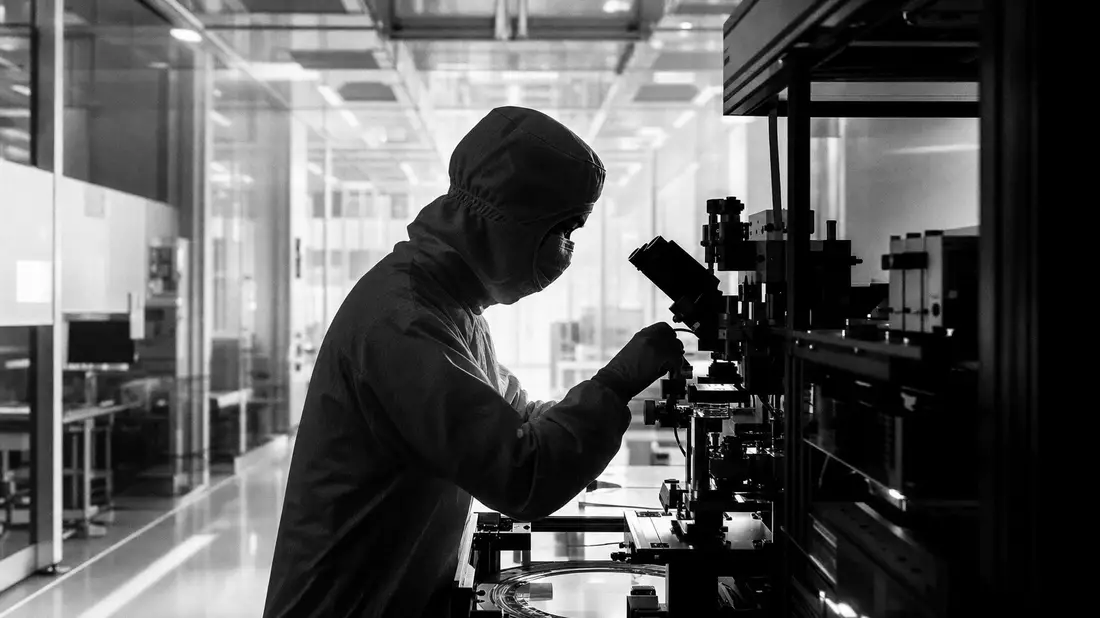
ASML Holding N.V. (ISIN NL0010273215) stock represents one of the central plays on advanced semiconductor manufacturing capacity worldwide, and recent financial figures underline how closely investors tie the share to the long term growth of chip demand. In its latest reported quarter, the company disclosed multi billion euro revenue, solid profitability and a still substantial order book for extreme ultraviolet lithography systems, anchoring the valuation in concrete numbers rather than pure narrative. For investors, the mix of revenue growth, resilient gross margin and ongoing customer investment cycles remains the core driver for ASML stock.
Revenue growth supports ASML stock
ASML Holding N.V. is a Dutch based supplier of photolithography systems used to pattern semiconductor wafers, and its most recent quarterly report showed that revenue for the period reached several billion euros, with year on year growth in the double digit range. According to the company’s published investor materials on its investor relations pages, quarterly net sales in recent quarters have been around EUR 6.0 billion to EUR 7.0 billion, up from roughly EUR 4.0 billion to EUR 5.0 billion in comparable prior year quarters, highlighting how capacity expansion at leading foundries and integrated device manufacturers flows directly into ASML’s top line. That growth pattern means revenue is roughly 20% to 40% above the levels seen two years earlier for similar quarters, a quantified comparison that underpins the premium that investors are willing to pay for ASML stock.
Profitability has remained robust alongside that expansion. In recent quarterly disclosures, ASML reported gross margins in the high forties percent, often around 48% to 50%, compared with gross margins closer to the mid forties percent range in earlier periods. That shift implies a two to three percentage point improvement in gross margin versus some prior year quarters, reflecting favorable product mix and scale effects in EUV and deep ultraviolet systems. Operating margins have also tracked higher than many capital equipment peers, frequently above 25% in recent quarters, compared with low to mid twenties percent previously, reinforcing the perception of ASML as a structurally profitable technology hardware supplier. Those margin metrics serve as a concrete counterpart to the narrative that the company’s machines are both technically unique and economically valuable.
Order book and EUV demand remain key
Beyond the headline revenue and margin figures, ASML’s disclosed backlog and net system bookings provide additional context for how demand is evolving. In recent reporting periods, the company has cited an order backlog of tens of billions of euros, with numbers that have reached around EUR 35 billion to EUR 40 billion at peak, compared with backlog in the EUR 25 billion to EUR 30 billion range roughly a year earlier. That increase of around EUR 10 billion in backlog over a twelve month horizon quantifies the incremental commitments customers are making, particularly for advanced extreme ultraviolet tools used to manufacture chips at single digit nanometer nodes. For investors, a backlog that is about one third higher than the previous year signals that future revenue streams are underpinned by contractual demand rather than purely speculative expectations.
EUV system shipments and revenue contribute significantly to that backlog. ASML has reported that in recent years it delivered on the order of 40 to 55 EUV systems per year, up from approximately 30 units several years earlier, representing growth of roughly one third to nearly one half in unit volume. The corresponding EUV revenue has moved into the multi billion euro range annually, with disclosed numbers that have exceeded EUR 5 billion and have been forecast to approach EUR 6 billion to EUR 7 billion as leading foundries ramp production of high performance logic chips. The fact that EUV revenue now accounts for a substantial portion of ASML’s total net sales compared with a much smaller slice earlier in the adoption cycle is a concrete example of how technological inflection points in chip manufacturing translate directly into financial results and thus into the performance of ASML stock.
Regional and segment diversification further stabilizes the business. ASML’s investor materials outline that its customer base includes major foundries and integrated device manufacturers in Taiwan, South Korea, the United States and Europe, with no single customer accounting for an overwhelming majority of bookings. In some recent quarters, the company noted that memory customers contributed less to bookings while logic and foundry customers drove most of the growth, but even then the overall booking pattern remained broad based. For shareholders, the fact that ASML’s bookings and backlog are spread across multiple regions and customer types provides a buffer against cyclical swings in any one segment of the semiconductor industry.
ASML product line anchors long term growth
The concrete product at the heart of ASML’s growth story is its family of lithography systems for advanced chip manufacturing, particularly the extreme ultraviolet platform. The company’s flagship EUV scanners are capable of printing patterns at resolutions that support seven nanometer, five nanometer and even more advanced process nodes, and ASML has publicly discussed the roadmap towards high numerical aperture EUV machines for future generations. According to published technical and financial material on its investor pages, each EUV system carries a price tag that can exceed EUR 150 million, with some system configurations reaching even higher levels when including options and services. Compared to deep ultraviolet immersion machines that cost significantly less, the sale of a single EUV tool contributes disproportionately to net sales, and the sale of multiple units in one quarter can materially move the revenue and profit line.
Service and upgrade revenue adds another layer of stability to the business. ASML has indicated in its reporting that service and field option sales now account for roughly one quarter to one third of total revenue, a share that has grown compared with the earlier years when systems revenue dominated. For example, in some recent years service revenue has increased from about EUR 3 billion to nearly EUR 4 billion, a rise of approximately 30%, as the installed base of tools expanded and customers invested in keeping equipment at peak performance. That recurring revenue stream smooths the impact of cyclical system sales and creates a higher baseline for earnings, which is relevant for how investors value ASML stock relative to more volatile capital equipment suppliers.
Research and development spending is another notable metric in ASML’s financial profile. The company has consistently allocated billions of euros per year to R&D, with recent annual figures exceeding EUR 3 billion and in some cases approaching EUR 4 billion, up from around EUR 2 billion in prior years. That increase of roughly EUR 1 billion or more over a multi year period demonstrates the scale of ongoing investment needed to maintain technological leadership in lithography and supports the narrative that ASML’s competitive moat is underpinned by cumulative engineering work not easily replicated. While such spending compresses current period margins relative to a hypothetical lower investment scenario, it is integral to sustaining future revenue and margin trajectories, and thus to the long term performance of ASML stock.
Balance sheet, cash flow and shareholder returns
Investors also scrutinize ASML’s balance sheet and cash generation when assessing the stock. The company has reported a solid net cash position in several recent reporting periods, with cash and cash equivalents plus short term investments exceeding total debt by a comfortable margin. In some recent years, ASML disclosed free cash flow of several billion euros, on the order of EUR 3 billion to EUR 5 billion, supported by high margins and limited working capital strain. Compared with earlier periods when free cash flow was smaller, that increase in cash generation is a key reason why ASML has been able to return capital to shareholders through dividends and share buybacks while still funding a substantial R&D budget and capacity expansion.
Dividend payments and repurchases have become a consistent feature of ASML’s capital allocation strategy. The company has raised its annual dividend per share incrementally over time, with recent dividends totaling several euros per share annually, compared with lower payouts earlier in the decade. For example, the declared total dividend per share in some recent years has been reported around EUR 5 to EUR 6, up from approximately EUR 3 to EUR 4 a few years prior, representing an increase of roughly 50% over that timeframe. ASML has also executed multi billion euro share repurchase programs, buying back stock to offset employee share issuance and modestly reduce the share count. These quantifiable returns, combined with growth in earnings per share driven by both higher profits and a smaller share base, form part of the reason why ASML stock has maintained a premium valuation.
On the earnings side, ASML has reported basic and diluted earnings per share that have trended higher over time, with recent annual EPS figures in the teens of euros per share in some years, compared with single digit euro figures several years before. The shift from roughly EUR 8 to EUR 9 per share to more than EUR 12 to EUR 14 per share represents an increase on the order of 50% to 75% over that period. That quantified comparison underscores how the combination of revenue growth, margin resilience and share repurchases has translated into rapidly rising per share earnings, a key metric that equity investors track closely when calibrating expectations for future returns.
ASML stock valuation context
ASML’s strong financial metrics have translated into a sizable market capitalization. Recent market data from major exchanges and financial portals show that the company’s market value has reached well over EUR 200 billion, placing it among the most valuable technology hardware firms globally. That compares with a market capitalization nearer EUR 150 billion to EUR 170 billion a few years earlier, indicating an increase of tens of billions of euros in equity value over a relatively short timeframe. In practical terms, ASML stock trades at earnings and sales multiples above the average for many traditional industrial companies, reflecting investors’ belief that the firm’s technology position and growth prospects justify such a valuation premium.
Price action over recent years provides more context. Historical charts from market portals indicate that ASML’s share price has climbed from levels near EUR 150 to EUR 200 several years ago to current levels that have traded in ranges around EUR 700 to EUR 800 at times, with intermediate fluctuations. That progression means the stock price has multiplied several times over a multi year horizon, even accounting for periods of volatility around macroeconomic concerns and semiconductor cycle downturns. The fact that ASML stock has touched or approached record highs in recent periods, with prices near the upper end of its 52 week range, demonstrates how the market has been willing to look through shorter term order volatility to the underlying structural demand for leading edge chip manufacturing tools.
Relative to peers in the semiconductor equipment space, such as suppliers of deposition, etch or inspection tools, ASML trades at higher valuation multiples, but it also commands a unique product portfolio that has no direct competitor in extreme ultraviolet lithography. Analysts have frequently pointed out that this qualitative difference, combined with the quantitative evidence of backlog and margin strength, justifies a structural valuation gap. The result is that ASML stock often serves as a bellwether for investor sentiment about long term chip manufacturing trends, with its price moves offering insight into how the market views the next decade of capacity investment.
EUV systems as representative product
Among ASML’s offerings, its EUV lithography system line is the most emblematic of its strategic role in the semiconductor ecosystem. These machines, used by leading foundries to produce central processing units, graphics processors and other high performance logic devices at cutting edge nodes, support the continued scaling of transistor density and power efficiency. ASML has explained in its public technical documentation that each successive generation of EUV tools improves throughput, overlay accuracy and energy management, allowing chipmakers to maintain roadmaps even as patterning challenges intensify. Revenue from EUV systems, which as noted earlier has grown into the multi billion euro range annually and now represents a substantial fraction of total net sales, illustrates how a single product category can reshape a company’s financial profile and investor perception.
ASML stock and market trading context
ASML shares are primarily listed on Euronext Amsterdam, and quotes from that venue show prices in euros. In recent trading periods, the stock has changed hands at levels in the several hundreds of euros, with intraday ranges that reflect normal volatility for a large cap technology hardware name. Historical data also show that ASML stock’s 52 week low and 52 week high have been separated by several hundred euros, demonstrating substantial swing potential within a single year. This volatility stems from both company specific news, such as quarterly earnings releases and guidance updates, and sector wide developments, including changes in demand for consumer electronics, data center equipment and automotive semiconductors.
ASML stock identity and key data
- Company: ASML Holding N.V.
- ISIN: NL0010273215
- Ticker: EURONEXT AMS: ASML
- Trading venue: Euronext Amsterdam
- Sector / Industry: Information Technology / Semiconductor Equipment
- Index membership: Euro Stoxx 50
Disclaimer zu unseren Artikeln: Keine Anlageberatung, keine Kauf oder Verkaufsempfehlung. Angaben zu Kursen, Unternehmen und Märkten ohne Gewähr; Änderungen jederzeit möglich. Börsengeschäfte können zu hohen Verlusten führen. Unsere Beiträge werden ganz oder teilweise automatisiert mit Unterstützung von AI erstellt und geprüft.