ASML’s €79M Weekly Buyback Puts a Fresh Spin on a Record-Breaking — and Wobbling — Rally
10.06.2026 - 16:05:26 | boerse-global.de
ASML’s stock touched a fresh all-time high of €1,580.60 on June 9, only to slip 2.6% the following day to €1,497. The retreat came as the Dutch lithography giant disclosed another routine wave of share repurchases: 55,118 shares bought between June 1 and 5 for a total of €79.4 million, at an average price of €1,440 each. The buyback, part of a €12 billion program running through 2028, has so far consumed roughly €1.1 billion in the first quarter of 2026 alone.
That quarterly performance was stellar — €8.8 billion in revenue, a 53% gross margin, and net profit of €2.8 billion — and the company has guided for €8.4 to €9.0 billion in the current quarter and €36 to €40 billion for the full year, with margins of 51% to 53%. But the share price wobble after the record suggests a more complex story beneath the surface. Over the past 12 months the stock has more than doubled, gaining 123%, and year-to-date it is up more than 50% — some calculations put the advance at 55% before Wednesday’s pullback.
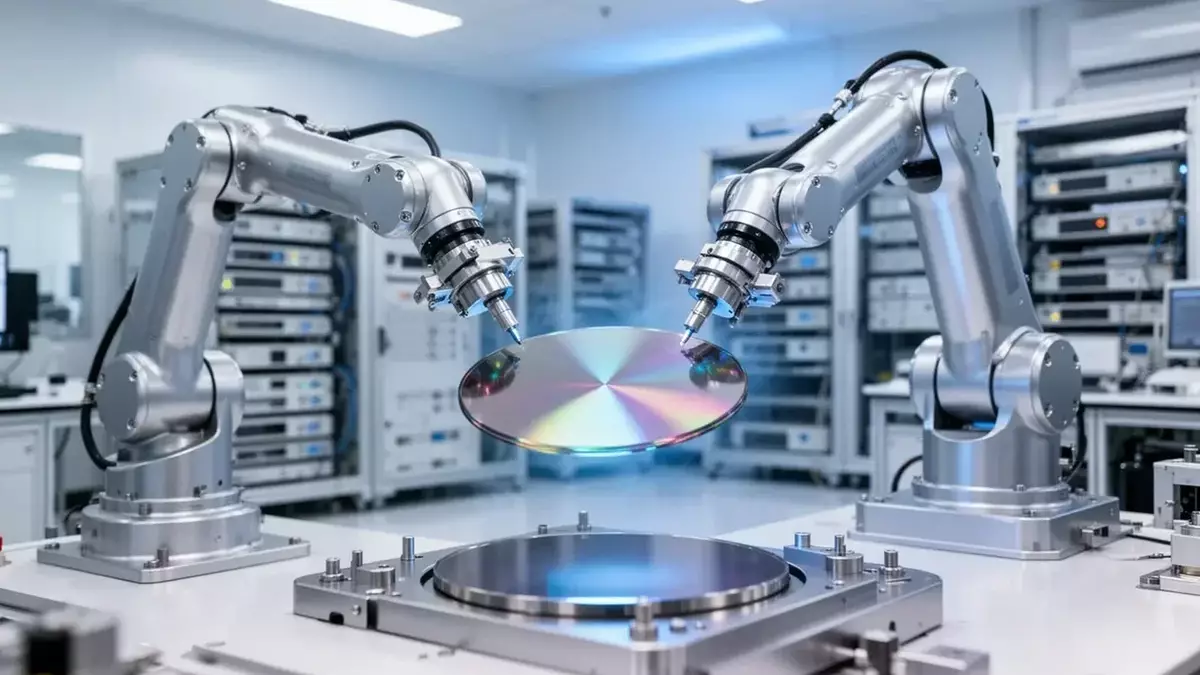
The immediate catalyst for the surge is the approaching commercial launch of ASML’s TWINSCAN EXE:5000 series, its next-generation High-NA EUV machines that cost roughly €400 million each. These systems can pattern features 66% smaller than their predecessors, enabling the sub-2-nanometer chips required for the next wave of AI accelerators. CEO Christophe Fouquet has confirmed that the first logic and memory products built on these tools are set to hit the market in the coming months. While TSMC has expressed caution over the short-term cost justification, Intel and SK Hynix have placed big bets on the technology.
Should investors sell immediately? Or is it worth buying Asml?
At the same time, ASML’s growing dependence on AI-driven demand is colliding with an increasingly assertive regulatory environment. In the United States, the proposed MATCH Act (Multilateral Alignment of Technology Controls on Hardware) aims to close remaining loopholes that allow shipments of deep-ultraviolet (DUV) lithography systems to China. The impact is already visible: China accounted for just 19% of ASML’s system sales in the first quarter of 2026, down sharply from previous levels, while South Korea jumped to 45% as the top market. Fouquet has warned publicly that excessive restrictions could push customers to develop their own alternatives, and he has taken rare aim at Europe’s push for “technology sovereignty,” noting that 80% of ASML’s business lies in Asia and relies on a global supply chain that policymakers now want to re-shore.
A further twist comes from the “Terafab” project in Texas, a massive semiconductor initiative involving Elon Musk. The project signals that the end customers of AI compute capacity — hyperscalers and chip designers — are no longer content to wait passively for fabrication capacity. They are actively shaping the lithography roadmap, which puts ASML at the very center of a strategic network that now stretches from governments to Musk-style megaprojects. The company’s market capitalisation has swelled to roughly €564 billion, a level that places it in a category of its own within European industry.
Despite the near-term pullback, technical indicators suggest the bull case remains intact. The relative strength index stands at 66, and the share price trades nearly 19% above its 50-day moving average, a sign that investors continue to prioritise the long-term scarcity of EUV capacity over short-term regulatory noise. Whether that calculus holds will depend heavily on the second half of 2026, when the MATCH Act is expected to move closer to passage — and when the real-world output of those €400 million High-NA machines will begin to prove whether the AI investment cycle has further to run.
Ad
Asml Stock: New Analysis - 10 June
Fresh Asml information released. What's the impact for investors? Our latest independent report examines recent figures and market trends.