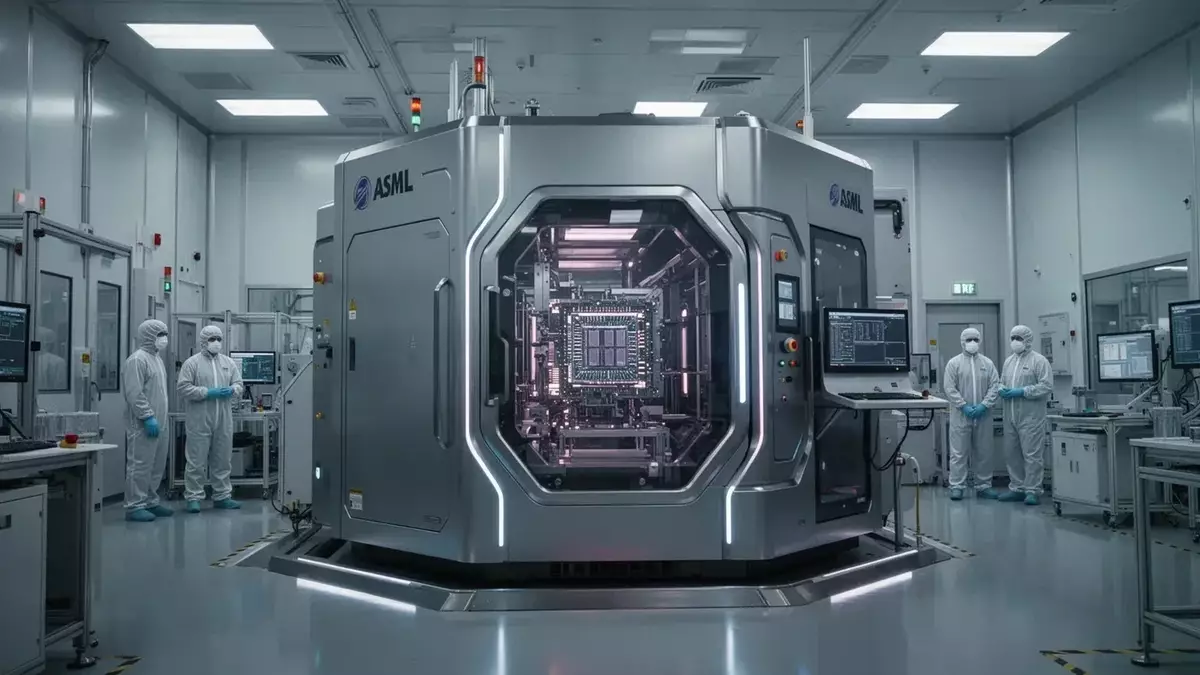
ASML Navigates a Tightrope Between Capacity Crunch and China Curbs as AI Frenzy Fuels Record Demand
18.06.2026 - 07:55:18 | boerse-global.de
ASML finds itself in an unusual bind: the very forces that are pushing its order book to unprecedented heights are also tightening the screws on its ability to deliver. The Dutch lithography giant is simultaneously wrestling with exploding demand from Western chipmakers and a fresh regulatory assault from Washington that threatens to clip its China business. Investors, so far, are betting the AI tailwind will overpower the political headwind.
The stock closed Wednesday at €1,630.60, a whisker below the 52-week high of €1,674.80 set on 15 June. Since the start of the year, shares have surged roughly 65%, a rally that has pushed the relative strength index to 64.6 — not yet overbought, but the margin for error is thinning.
The MATCH Act Targets the China Cash Cow
The most immediate threat to ASML’s near-term outlook comes from the US Congress. The proposed MATCH Act aims to close a remaining loophole in export controls by banning the sale of older DUV lithography systems to China. More damaging still, the bill would also prohibit servicing of machines already installed on the mainland.
China accounted for a third of ASML’s total revenue last year. In the first quarter of 2026, that share had already slipped to 19%, in line with management’s expectation of roughly one-fifth for the full year. If the MATCH Act becomes law, those numbers will shrink further. ASML had already factored in a decline, but the legislation would effectively sever a stream of recurring service income that has long provided a stable base.
Should investors sell immediately? Or is it worth buying Asml?
Capacity Limits Bite as Musk’s Terafab Joins the Queue
Even as the China door narrows, another window is opening wide — but ASML cannot open it fast enough. CEO Christophe Fouquet warned at the Vivatech conference in Paris that the company is “supply-side constrained” given the scale of upcoming mega-projects. He confirmed direct talks with Elon Musk about supplying lithography equipment for the $55 billion Terafab in Texas, a facility designed to produce chips for Tesla, xAI, SpaceX and the Optimus robotics programme.
The problem is that ASML is the world’s sole manufacturer of EUV lithography systems. TSMC, Samsung and Intel are already lined up with orders at record levels. There is simply no spare capacity for another project of this magnitude in the foreseeable future. The delivery bottlenecks are not just a message for Musk; they are a warning to the entire semiconductor industry.
AI Boom Fills the Order Book
The flipside of the capacity crunch is pricing power and product mix. ASML upgraded its revenue guidance for 2026, now expecting growth of 16% to around €38 billion, up from an earlier target of roughly 12%. The driver is a shift away from lower-margin DUV sales to China toward high-margin EUV systems destined for Taiwan, South Korea and the US. Those customers are buying the machines as fast as ASML can build them, racing to expand output of the most advanced logic and NAND chips needed for what Citi calls “agentic AI.”
Citi analyst Atif Malik recently lifted his estimates for the global wafer fab equipment market: $145 billion in 2026, $200 billion in 2027 and $250 billion in 2028. ASML’s own revenue target of €36-40 billion for 2026 remains unchanged. In the first quarter, it posted net income of €2.8 billion on sales of €8.8 billion.
Technology Roadmap Pushes Boundaries — and Prices
ASML is pushing the lithography envelope on two fronts. Its new High-NA EUV system, the EXE:5200B, achieves 175 wafers per hour and started shipping in the fourth quarter of 2025. The company aims to produce a cumulative 500,000 High-NA wafers by the end of this year. Beyond that, development is already under way on Hyper-NA lithography, with a numerical aperture above 0.75 targeting the future A7 semiconductor node. Volume production is not expected before 2033. Each new generation is more complex and more expensive, which will only deepen the supply constraints over time.
Asml at a turning point? This analysis reveals what investors need to know now.
Buybacks and Analyst Splits
While the stock froths, ASML is putting its money where its mouth is. The company is executing a multi-billion-euro buyback programme, spending nearly €16 million per day on its own shares during the second week of June alone. The signal is one of confidence, but the analyst community is divided. Goldman Sachs reiterated a buy rating; Jefferies advises holding. Morningstar warns that the current valuation already prices in the long-term AI boom, leaving little room for disappointment.
The Balancing Act for Investors
ASML’s shares are riding a wave of euphoria that has so far ignored political risks. But two vulnerabilities lurk beneath the surface. First: any delay in assembling an individual EUV machine — a process that takes months — directly impacts chip-fab timelines globally. Second: the China service ban, if enacted, could prove more painful than the company’s upgraded guidance suggests. For now, the EUV monopoly is absorbing the blows. Whether it can continue to do so as the US election cycle intensifies is the question every holder of the stock must answer.
Ad
Asml Stock: New Analysis - 18 June
Fresh Asml information released. What's the impact for investors? Our latest independent report examines recent figures and market trends.