Antimony Resources Under the Microscope: Record Antimony Prices Meet the Bald Hill Development Challenge
11.06.2026 - 18:53:59 | boerse-global.de
The stars could hardly be better aligned for antimony, yet Antimony Resources finds itself at a moment of high-stakes accountability. With spot prices for the critical mineral hitting an all-time high of around $59,750 per tonne on the back of Chinese export curbs, the junior miner is set to face investors in a Q&A session this June — a forum that will test whether its Bald Hill project can finally move beyond exploration headlines into a credible development story.
Chief executive Jim Atkinson will take questions directly from shareholders as the stock trades at €0.42, up 4.5% on the day but still nursing a 30-day decline of 18%. The share price sits 60% below its 52-week high of €1.05 touched in March, and while the equity has more than tripled over the past year, the early momentum has clearly stalled. Technical indicators underscore the vulnerability: the stock is trading below both its 50-day moving average of €0.63 and its 100-day average of €0.61, while the relative strength index at 37.5 suggests oversold conditions that lack fundamental support.
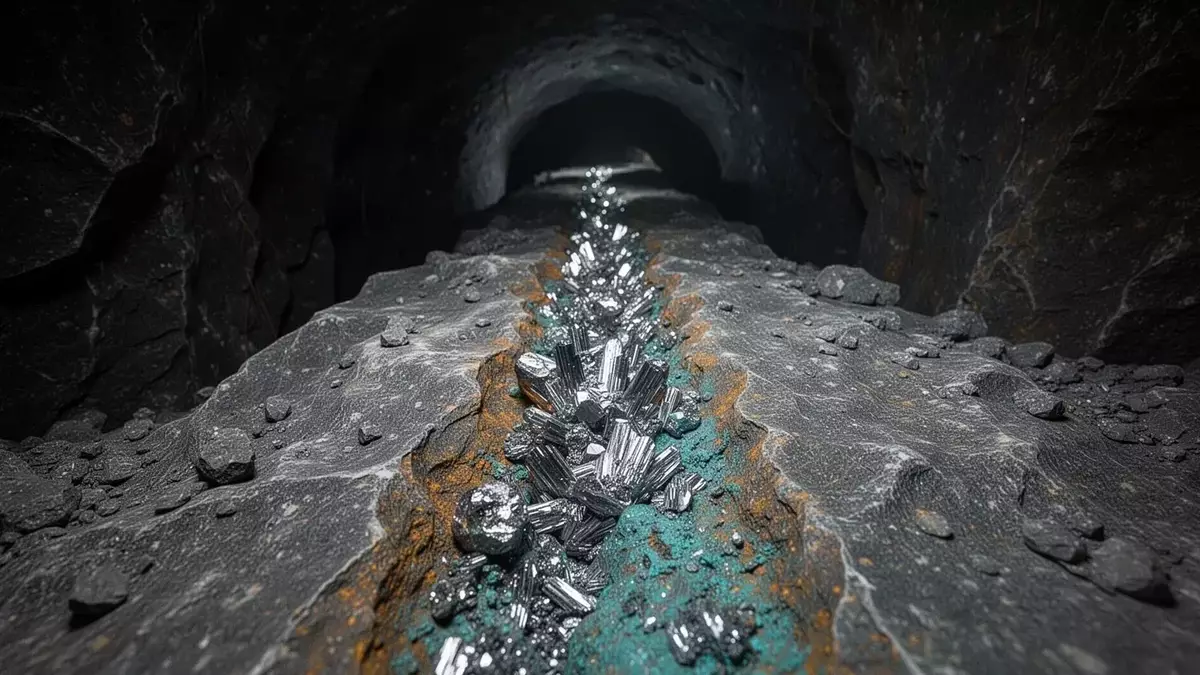
High-grade results from Bald Hill’s South Zone in New Brunswick have kept the project firmly in the spotlight. Rock-chip sampling over more than 200 metres of trenches delivered an average antimony grade of 19.5%, with individual assays hitting as high as 44.2%. Drilling has confirmed the mineralisation extends at depth: hole BH-25-34 intersected 4.38% antimony over 7.05 metres, including a high-grade interval of 9.76% over 3.15 metres. The company plans follow-up work including airborne geophysics to fully delineate the zone.
Should investors sell immediately? Or is it worth buying Antimony Resources?
Yet investors are looking beyond the assays. The key question for Atkinson is how these promising data points translate into a defined resource and a clear permitting timeline. The current NI 43-101-compliant resource stands at 2.7 million tonnes with an estimated grade of 3% to 4% antimony — a base that the company hopes to expand by connecting the main zone with the newly discovered South Zone. A 10,000-metre definition drilling programme at the Main Zone is slated for the first half of 2026, designed to achieve the density needed for an initial resource estimate. Concurrent work on resource modelling, regulatory approvals and environmental assessments is fully funded.
Antimony’s status as a critical mineral in the United States, the European Union and Australia provides a favourable macro backdrop. The USGS includes it on its 2025 critical minerals list, and its role in lead-acid batteries, flame retardants, defence electronics and renewable-energy technologies ensures strategic demand. Antimony Resources has pointed to the business model of Lynas Rare Earths as an aspirational template, targeting long-term offtake agreements to underpin project financing.
The mismatch between the strategic tailwind and the stock’s recent technical weakness suggests the market is demanding more than geology. With a market capitalisation of roughly C$60 million, the company remains a small player in a sector that rewards execution. The June Q&A will reveal whether Atkinson can knit together the drilling timetable, resource estimate and permitting work into a coherent delivery narrative. Without that, the tentative recovery of the past few sessions may prove short-lived.
Ad
Antimony Resources Stock: New Analysis - 11 June
Fresh Antimony Resources information released. What's the impact for investors? Our latest independent report examines recent figures and market trends.