Shell stock eases as oil prices slide but valuation stays below peers
Published on 08/26/2026 at 16:19 | Editorial responsibility: Rafael Müller, Editor-in-Chief AD HOC NEWS
Shell plc (ISIN NL0000009827) stock traded lower on August 26, 2026 as weaker oil prices weighed on the wider energy sector, with the London-listed shares easing by a little more than 1 percent on the day according to real-time market data dated August 26, 2026. The move comes as investors reassess short-term demand for crude and refined products, while longer-term valuation metrics continue to suggest the stock trades at a discount to many global oil and gas peers.
Shell shares track oil price softness
Energy names were under pressure on August 26, 2026, with market data showing Shell falling around 1.4 percent during the session as benchmark oil prices declined for a third consecutive day. This intraday slide reflects concerns that shipping flows through key routes could normalize sooner than expected, easing supply tightness that had previously supported crude prices and sector margins.
Quote data for Shell's London listing indicate that the stock recently changed hands close to 3,341.5 pence, down 1.33 percent on the day as of August 26, 2026. That level leaves the shares below recent intraday marks near 3,386.5 pence seen on August 25, 2026, highlighting how quickly sentiment can shift with commodity price moves. For investors, the single-session decline is modest relative to the stock's longer-term performance, but it underscores the sensitivity of integrated oil majors to short-term swings in the underlying commodity.
Further market context from continental trading venues shows Shell quoted at 39.48 EUR as of the close on August 25, 2026, a price that was down 0.37 percent over the prior five trading days but still up 25.87 percent since the start of the year. That combination of a slight recent pullback with a strong year-to-date gain illustrates how the shares have already rallied significantly in 2026 even as they experience short-term consolidation.
Valuation and earnings backdrop
While day-to-day price moves are driven largely by oil markets, recent analytical commentary points to Shell's equity valuation as another key part of the story in late August 2026. One detailed overview of the stock notes that Shell currently trades on a price-to-earnings ratio of 9.9 times, compared with an oil and gas industry average of 13.3 times and a broader peer group at 14.7 times. That means Shell's earnings multiple sits 3.4 points below the industry average and 4.8 points under the wider peer group, reinforcing the narrative that the shares remain comparatively inexpensive on a headline earnings basis.
This valuation gap matters when considered alongside the company's most recent earnings trends. Sector analysis published on August 26, 2026 indicates that large European oil majors such as Shell and another integrated peer both managed to double their profits compared with 2025 in their latest reporting season, even though second-quarter oil and gas production volumes fell in a band of 100,000 to 300,000 barrels per day versus prior periods. The combination of higher profitability with lower production reflects the impact of improved refining margins, trading gains, and disciplined capital spending, but it also highlights the operational challenges posed by outages and maintenance.
Because those profit figures relate to the first half of 2026 and the second quarter of 2026, they fall inside the accepted freshness window for current fundamentals relative to August 26, 2026. The data suggest that Shell's earnings momentum is strong, even after adjusting for lower output, and that cash generation from its core businesses has allowed the group to maintain shareholder distributions such as dividends and buybacks while continuing to invest in future projects.
Investors weighing Shell's valuation against these earnings trends can see a clear quantified comparison: a company that has doubled profits versus the 2025 baseline yet still trades at just 9.9 times earnings, versus 13.3 times for the sector and 14.7 times for broader peers. The numerical spread implies that, on current earnings, the market assigns a discount to Shell's shares relative to comparable oil and gas companies, despite the strong improvement in profitability.
Sector dynamics and project pipeline
The wider oil and gas sector context is also relevant for Shell in late August 2026. Recent coverage of global majors notes that several large integrated companies, including Shell, reported second-quarter production losses in the range of 100,000 to 300,000 barrels per day, while a major US-based peer managed to grow output in the same period. For Shell, such production volatility can stem from asset maintenance, regulatory changes, or project timing in key regions.
At the same time, new project activity across the Americas is described as a way for the majors to plug a potential production gap. Shell's participation in these regional developments plays into its medium-term volume outlook, with the company leveraging existing infrastructure and partnerships to ramp up output when market conditions warrant. Investors watching 2026 and 2027 production guidance will be keen to see whether the company can offset recent operational disruptions with new barrels coming online.
Beyond traditional oil and gas, Shell continues to adjust its portfolio toward lower-carbon energies and transition-related activities, though hydrocarbons still dominate current earnings. The valuation metrics discussed earlier implicitly capture the market's view on both legacy operations and transition investments, as the price-to-earnings ratio reflects aggregate expectations for future cash flows.
Representative product: integrated fuels and lubricants
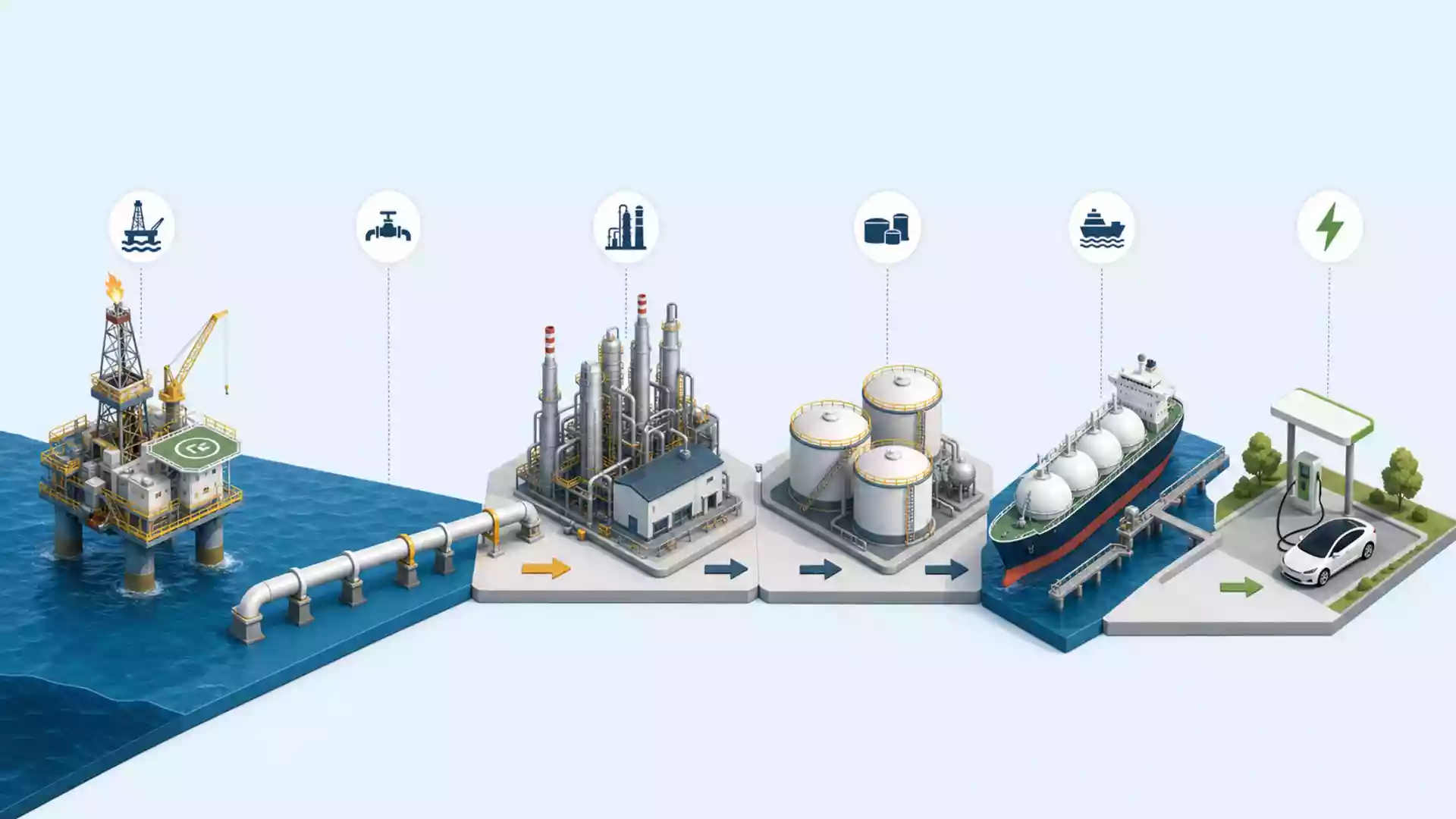
A representative part of Shell plc's business model is its integrated fuels and lubricants offering, which combines upstream oil production, refining capacity, and downstream marketing into a seamless supply chain. Through its refining network, the company processes crude oil into fuels such as gasoline, diesel, and jet fuel, as well as specialty products like petrochemical feedstocks and industrial lubricants.
These refined products are then distributed to customers via Shell-branded service stations, wholesale channels, and commercial contracts. The integration across upstream, refining, and retail helps the company capture margin at multiple points, smoothing profitability over the commodity cycle. When crude prices fall, downstream margins and retail volumes can partially offset the hit to upstream earnings; when prices rise, upstream profits expand even as refining spreads potentially compress.
In practice, this integrated product offering means that Shell's earnings are driven not only by headline oil prices but also by refining utilization rates, retail fuel demand, and the mix of products sold. Investors evaluating Shell stock therefore pay close attention to refining throughput figures, marketing volumes, and segment contributions to earnings in each quarterly report, alongside the core upstream metrics.
Stock level and investor takeaway
From a pure price perspective, the most recent available market data place Shell's London-listed shares close to 3,341.5 pence as of August 26, 2026, with quote snapshots from August 25, 2026 showing trading lines around 3,386.5 pence and continental exchanges reflecting a level of 39.48 EUR at the same time. These figures show that, despite a single-session decline of roughly 1 to 1.4 percent, the stock remains within a relatively tight band compared with the prior day's trade and continues to sit significantly higher than its level at the start of 2026.
For investors, the key takeaway is that Shell stock in late August 2026 combines short-term sensitivity to oil price moves with a longer-term profile of improved earnings and a discounted valuation versus peers. That mix of cyclical exposure and valuation gap shapes how portfolio managers may position the shares within broader energy and value strategies, particularly as the company navigates production volatility and the ongoing energy transition.
Read more
Further structured information on Shell's corporate structure and group entities is available through detailed listings that show the company's subsidiaries and relationships, including real-time trading data for its equity on European venues. Such resources can help investors understand how different segments and legal entities contribute to overall group performance.
Fact box
Company: Shell plc
ISIN: NL0000009827
Ticker: SHEL
Exchange: London Stock Exchange
Price (as of August 26, 2026, latest intraday data): 3,341.5 pence
Market cap: not specified in the latest snippet
Sector / Industry: Energy - Oil and Gas
Index membership: FTSE 100