

Nokia stock holds gains as AI demand lifts Q2 results and guidance
Published on 08/22/2026 at 13:59 | Editorial responsibility: Rafael Müller, Editor-in-Chief AD HOC NEWS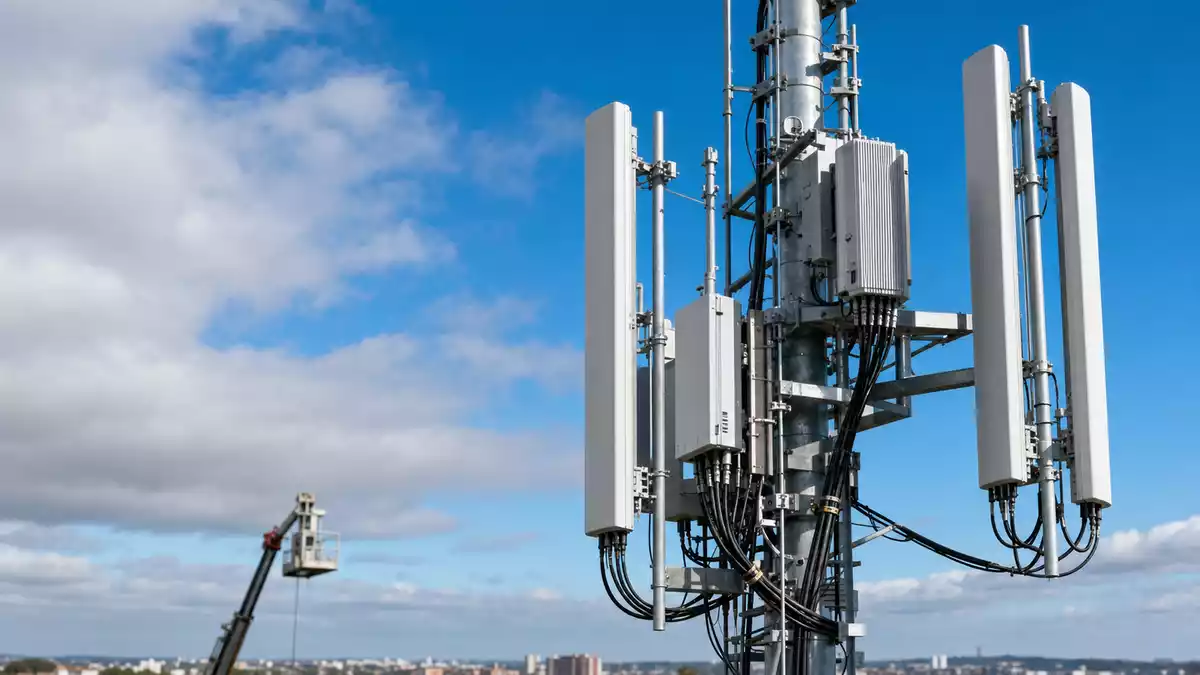
Nokia (ISIN FI0009000681) stock is benefiting from strong second quarter 2026 demand for AI infrastructure, with the shares trading just above €8.80 on the Helsinki market as of August 21, 2026, while investors digest higher profit guidance and rising institutional interest. Per recent market data, the stock closed at €8.76 on August 20, 2026, leaving it 41 percent below its 52-week high of €14.97 from June 3, 2026, but still 57 percent higher than at the start of the year.
Q2 2026 results show AI-driven growth
Recent coverage of Nokia’s second quarter 2026 results highlights that net sales for the quarter reached €4.82 billion, representing 8 percent year-over-year growth, as AI-related infrastructure orders expanded across cloud and telecom customers. The company reported adjusted earnings per share of $0.08 for the quarter, compared with market expectations closer to $0.07, underscoring a modest earnings beat and improved profitability on expanding AI workloads. This combination of mid-single-digit top-line growth and a one-cent EPS surprise in Q2 2026 reflects solid operating leverage as Nokia ramps its AI-centric networking solutions across key geographies.
Alongside the Q2 figures, guidance for full-year 2026 comparable operating profit has been set in a range of €2.1 billion to €2.6 billion, signaling management’s confidence that the earnings trajectory is improving as the AI infrastructure pipeline converts into revenue. In the same guidance update, planned capital expenditure for 2026 was trimmed to a band of €800 million to €900 million, pointing to tighter cost discipline and an emphasis on capital-light growth initiatives within cloud, software, and advanced radio access networks. For investors, the spread between the profit guidance midpoint and the lower capex range suggests a structurally higher free cash flow potential once restructuring charges roll off.
Shares consolidate after a strong year-to-date run
Market data from the Helsinki listing indicates that Nokia shares closed at €8.76 on August 20, 2026, down 6.4 percent on the week, but still substantially ahead of their level at the beginning of the year. The same data set shows the stock 41 percent below its 52-week high of €14.97 recorded on June 3, 2026, and 57 percent higher than at the start of 2026, illustrating a period of consolidation after a powerful rally. A relative strength index reading of 46.5 around August 21, 2026, points to neutral momentum rather than overbought or oversold extremes, suggesting the market is reassessing valuation rather than shifting into panic selling.
Additional quote data from another portal confirms that Nokia’s Finland-listed shares traded at €8.838 as of August 21, 2026, up 0.66 percent from the prior close, with an intraday range between €8.776 and €8.976 on volume of 3.18 million shares. This price level keeps the stock close to the €8.80 region referenced in broader market commentary, and highlights how the shares are now trading in the middle of their recent range, well above a historical low near €3.61 reached in August 2025 but still significantly below the 52-week peak. For traders tracking short-term moves, the modest 0.66 percent daily advance set against a 6 percent weekly decline implies a tentative attempt to stabilize after profit-taking.
Analyst and institutional positioning
On the New York Stock Exchange, Nokia’s sponsored American depositary shares recently opened trading at $10.21 on August 21, 2026, according to a market-data driven filing focused on institutional holdings. In that context, the same snapshot reports an average analyst rating in the “Moderate Buy” band, with a consensus target price of $12.57 for the ADR, implying upside of roughly $2.36 or close to 23 percent versus the $10.21 opening quote. That spread between current ADR pricing and the $12.57 consensus target underscores that, despite the strong year-to-date run, analysts still see room for further appreciation if Nokia executes on its AI infrastructure roadmap and restructuring plans.
Investor activity in the options market has also intensified. A dedicated options overview for Nokia’s US-listed shares shows that on August 21, 2026, total options volume reached 137,600 contracts, with call options representing 65.66 percent of the day’s trades and puts accounting for 34.34 percent. Open interest across Nokia options stood at 4.0158 million contracts, 105.51 percent of the recent 30-trading-day average, signaling elevated speculative and hedging activity around the ADR. A single put option block of 10,000 contracts executed when the underlying ADR traded at $10.17, tied to a strike price of $9.00 and an expiration date of September 18, 2026, hinting that at least one large participant is positioning for potential short-term downside or volatility while still recognizing that the underlying trend has been positive.
Valuation, guidance and AI infrastructure exposure
From a valuation perspective, a broader article on Nokia’s role in forthcoming 6G trials and AI-driven radio access networks notes that the ADR recently traded at $10.32, equating to roughly 24 times forward earnings. In the same context, the analyst target price is cited at $15.02, which stands $4.70 above the $10.32 reference level, or an upside gap of 45.5 percent if the company delivers on its AI-related growth and cost discipline. Full-year 2026 guidance for comparable operating profit, set between €2.1 billion and €2.6 billion, is described as tracking above the midpoint so far, reflecting management expectations that the second half of 2026 will maintain or improve on the Q2 2026 profitability profile.
The same guidance discussion highlights that free cash flow turned negative at €732 million in the latest quarter because of restructuring charges tied to factory closures and efficiency programs. While negative free cash flow is a cautionary point for some investors, the explanation that it stems largely from one-off restructuring rather than ongoing operational weakness helps contextualize the risk. In addition, the guidance for lower capital expenditure over the rest of 2026 supports the thesis that Nokia can return to positive free cash flow once the bulk of restructuring is complete, creating a more streamlined cost base to support AI and cloud infrastructure projects.
A separate market forecast tool, which extrapolates price action into short-term projections as of August 22, 2026, places Nokia’s ADR at a predicted level of $10.18 for that date, with an estimated average price of $10.10 over the month of August 2026 and a maximum forecast of $10.54. The same forecast indicates an expected August 2026 percentage change of 3.86 percent, suggesting a modestly positive bias. While such model-based projections are inherently uncertain, they align with the notion of gradual appreciation rather than dramatic swings, consistent with the moderation in the relative strength index and the current consolidation phase seen in the Helsinki listing.
Strategic restructuring and China exit
Beyond quarterly numbers, Nokia is in the midst of a strategic restructuring that includes exiting manufacturing operations on the Chinese mainland by the end of 2026. Recent reporting indicates that this decision affects a significant portion of the 7,200 employees Nokia counted across China, Hong Kong, and Taiwan at the close of 2025. The move is framed as part of a balancing act in which the company reduces exposure to lower-margin, geopolitically sensitive manufacturing in China while reallocating capital and engineering talent toward AI-enabled network functions, cloud-native software, and advanced radio access technologies in other regions.
To investors, the planned closure of remaining Chinese factories by late 2026 has two main implications. First, it supports management’s narrative of focusing on higher value-added segments like AI-ready radio access networks and cloud infrastructure, which can command better margins and more predictable long-term contracts. Second, it reinforces the rationale for the current restructuring charges that weighed on free cash flow, which investors must weigh against the potential future savings and improved strategic positioning. As long as restructuring spending remains within the announced bands and progress on AI infrastructure wins continues, the market may view the China exit as a necessary step toward a more resilient earnings profile.
AI-RAN partnerships and 6G trials
In the AI and wireless domain, recent analysis of upcoming 6G trials underscores Nokia’s partnership with a major US-based technology firm that has taken a $1 billion equity stake in Nokia. This stake anchors an AI-based radio access network platform that a large US telecom operator is field-testing, with ambitions to achieve spectral efficiency gains exceeding 100 percent by 2028. The partnership positions Nokia at the center of a broader ecosystem that combines GPU-accelerated computing with advanced radio access hardware and software, enabling networks to dynamically optimize traffic and energy usage in ways that traditional baseband architectures cannot.
The AI-RAN platform in question is expected to underpin early-stage 6G trials over the coming years, with Nokia supplying key base station components, software-defined networking features, and integration expertise. For shareholders, the significance lies in Nokia’s potential to capture a meaningful share of future capital expenditure cycles in mobile networks, especially if AI-driven optimization proves to deliver the promised efficiency gains. The combination of a strategic equity holder, a flagship US operator, and a focus on 6G-ready architectures enhances Nokia’s credibility as a long-term infrastructure partner rather than a commoditized hardware vendor.
Nokia’s network and cloud portfolio
Nokia’s core business revolves around providing network infrastructure, cloud services, and software solutions that enable telecom operators and enterprises to build and manage high-performance communications systems. Its product set spans mobile networks, fixed networks, IP routing, optical transport, and network automation, with a growing emphasis on integrating AI and machine learning into network management and security. Within this portfolio, the company’s AI-optimized radio access solutions and cloud-native core networks are emerging as key differentiators, as customers seek platforms that can flexibly scale and adapt to increasingly complex traffic patterns and service demands.
One representative offering that illustrates this direction is Nokia’s AirScale radio access portfolio, which provides modular base station hardware and software designed for 5G and future 6G upgrades. AirScale combines multi-band radio units, massive MIMO technology, and cloud-connected baseband processing to support high-capacity, low-latency mobile services. By layering AI-driven optimization on top of AirScale’s hardware, Nokia aims to help operators minimize energy consumption, reduce maintenance costs, and improve user experience, particularly in dense urban environments and emerging industrial networks. As AI-RAN and 6G trials progress, AirScale and related products are likely to serve as the physical and software foundation for many of Nokia’s flagship deployments.
Closing view on Nokia stock
For Nokia’s Helsinki-listed shares, the recent close at €8.838 on August 21, 2026, with a 0.66 percent daily gain, frames the current trading level in the context of a broader 57 percent year-to-date rise and a 41 percent gap to the €14.97 52-week high. On the ADR side, the $10.21 opening quote on August 21, 2026, compared with the $12.57 consensus target, reflects moderate implied upside if Nokia continues to turn AI infrastructure demand into higher net sales and delivers on its €2.1 billion to €2.6 billion profit guidance. While restructuring charges and a temporary swing to negative free cash flow present risks, the combination of strategic portfolio shifts, partnerships in AI-RAN and 6G, and disciplined capital expenditure suggests that Nokia stock remains a vehicle for investors looking for exposure to next-generation network infrastructure rather than legacy hardware.
Read more
Investor Relations
Fact box
Company: Nokia Corp.
ISIN: FI0009000681
Ticker: NOK
Exchange: Helsinki, New York Stock Exchange (ADR)
Price (as of August 21, 2026, close Helsinki): €8.838
Market cap: Data based on current pricing from market portals
Sector / Industry: Communication equipment, network infrastructure
Index membership: Key Finnish and European equity indices


