
Lam Research stock steadies after China trade-driven drop as valuation concerns grow
Published on 08/29/2026 at 14:08 | Editorial responsibility: Rafael Müller, Editor-in-Chief AD HOC NEWS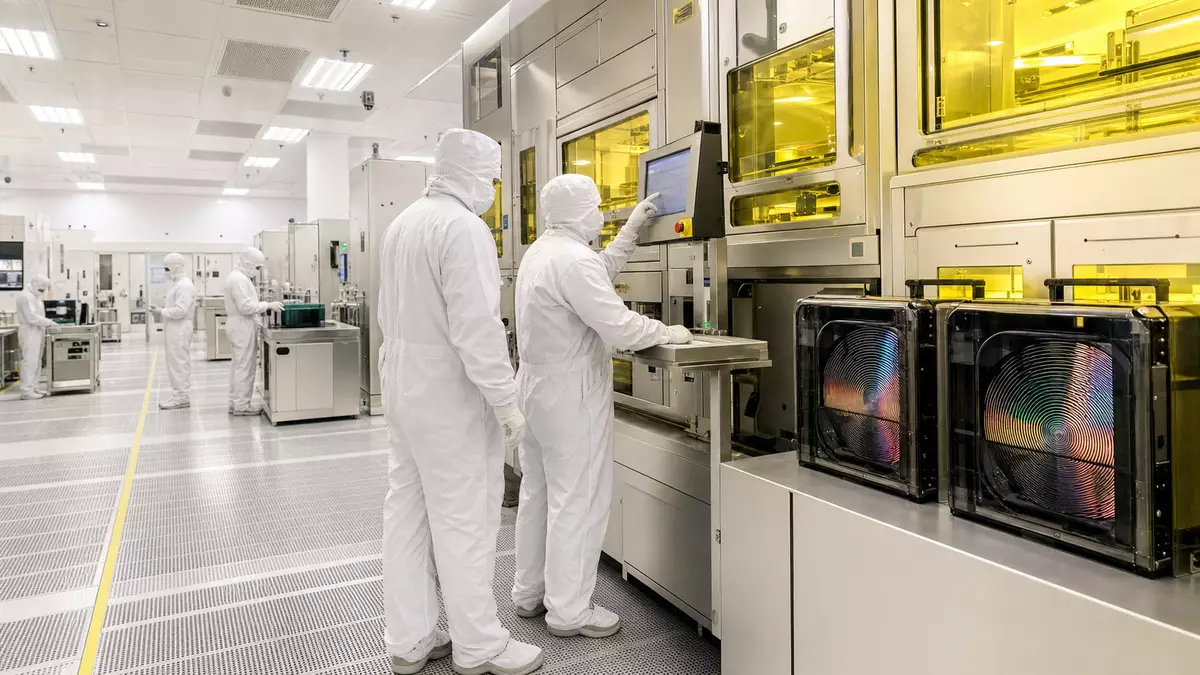
Lam Research Corp. (ISIN US5128071082) stock is stabilizing in the low $300 range as of August 28, 2026 after a sharp pullback linked to renewed China trade tensions, with the shares last quoted at $301.90 USD and flagged as heavily overvalued versus intrinsic value estimates per a detailed valuation snapshot. The valuation overview highlights how sensitive the stock has become to macro headlines when trading well above modeled fair value.
China trade risk drives a sharp one-day decline
Per the latest market commentary dated August 28, 2026, Lam Research shares fell 5.2% during that session, bringing the closing price down to $301.90 USD and erasing a portion of the strong gains seen earlier in the week. The same valuation-driven market snapshot links the move to renewed concerns over China trade and export controls, underscoring how policy uncertainty is translating directly into volatility for semiconductor equipment names.
The one-day drop stands out because it followed a period of resilient trading in which Lam Research closed at $314.66 USD earlier in the week with a market capitalization cited at $393.74 billion, indicating investors had been willing to pay a premium for exposure to the company’s wafer fabrication equipment franchise. A corporate news overview points out that the 5.2% decline on August 28, 2026 took the shares down from that previous close of $314.66, highlighting the magnitude of the adjustment in a single session.
Valuation signals show shares far above intrinsic value metrics
The valuation-focused report dated August 28, 2026 calculates a modeled fair value estimate for Lam Research at $149.95 USD, compared with the then-current price of $301.90, implying the stock is trading 101.3% above that intrinsic value benchmark. This comparison effectively says investors are paying more than double the underlying GF Value estimate for Lam Research, a gap that raises questions about how much future growth and margin resilience is already embedded in the share price.
For investors, the number is concrete: a current price of $301.90 versus a GF Value estimate of $149.95, both explicitly dated to August 28, 2026, yields that 101.3% overvaluation reading. While valuation models always involve assumptions, the signal here is clear that Lam Research stock is being priced at a substantial premium to modeled fundamentals and cash-flow expectations, which helps explain why any macro shock such as China trade headlines can trigger outsized percentage moves.
The same valuation snapshot flags Lam Research as significantly overvalued at that price level, noting the stock has moved well beyond the GF Value estimate even after the 5.2% decline. That means the pullback, while notable in percentage terms, still leaves the shares elevated versus a range of intrinsic value frameworks and suggests that volatility may persist as the market tests how much premium the company’s exposure to advanced semiconductor manufacturing truly deserves.
Recent trading range and market data reinforce volatility
Market data for late August 2026 show that Lam Research has been trading firmly in the low to mid-$300s with meaningful volume, highlighting both strong investor interest and a willingness to adjust positions quickly. For example, on August 28, 2026 the closing price was $301.90 USD with reported volume of 8,057,935 shares, while on August 27, 2026 the stock closed higher at $318.58 USD on volume of 6,561,235 shares, capturing a positive 1.82% move before the subsequent decline. A recent quotes overview details this series of closes and volume figures.
Extending the view across the week, Lam Research closed at $312.88 USD on August 26, 2026 with a slight 0.57% decline, at $314.66 USD on August 25, 2026 with a 1.45% gain, and at $310.17 USD on August 24, 2026 with a 1.22% decline, illustrating a pattern of short-term swings within a relatively tight $310-$320 band. The same quote history shows how the August 28, 2026 drop to $301.90 USD represented a more pronounced downside move compared with these earlier sessions, pushing the stock slightly below the recent range but not yet triggering a deeper technical breakdown.
Intraday data suggest that Lam Research’s share price range on the most recent session spanned from $307.86 USD to $318.61 USD, with an opening print at $316.20 USD, highlighting the intraday volatility before the closing figures captured in the daily quote tables. A historical data view underscores how the stock has seen wide intraday swings in tandem with sector news and macro developments, which is typical for a high-beta semiconductor equipment name but still meaningful for investors managing risk.
Dividend increase underlines confidence but adds to valuation debate
Beyond the short-term price moves, Lam Research’s board has signaled confidence in the company’s cash generation by approving a dividend increase. Per the latest press release dated August 29, 2026, the board authorized a $0.30, or 15%, increase in the quarterly dividend, lifting the payout from $2.00 to $2.30 per share of common stock. The company’s press release presents the step as part of its ongoing capital-return program, rewarding shareholders while balancing investment in future growth.
This dividend hike, applied on a per-share basis, means Lam Research’s annualized dividend commitment rises from $8.00 USD to $9.20 USD, assuming four quarterly payments, which constitutes a tangible incremental cash return for investors at current share levels. When compared against the $301.90 USD share price as of August 28, 2026, the new dividend implies a forward yield in the low-single-digit percentage range, underlining how most of the stock’s valuation case still rests on expectations for long-term earnings and free-cash-flow growth rather than on income alone.
From a valuation perspective, the higher dividend can be seen as both support for the stock and a factor that raises the stakes if macro conditions or industry demand weaken. Investors now have an incrementally larger cash payout, but that payout is still small relative to the absolute price level when the shares trade more than 100% above the GF Value intrinsic estimate, maintaining the debate about whether the premium is justified by Lam Research’s market position in advanced etch and deposition tools for leading-edge fabs.
Governance and long-term positioning support the story
Corporate governance developments also play into the long-term narrative around Lam Research. A recent item dated August 28, 2026 notes a planned board governance transition, confirming that the company continues to refresh its oversight structures and align board composition with its strategic priorities in semiconductor equipment, services, and global expansion. The governance update highlights that analyst sentiment around Lam Research remains constructive, with the most recent rating cited as a Buy and a corresponding price target of $450.00 USD.
This $450.00 USD target, set against the $301.90 USD price as of August 28, 2026, implies upside of more than $148.10 USD per share from that closing level, indicating that at least part of the market believes Lam Research’s earnings and free cash flow trajectory can justify the current premium and potentially more. At the same time, juxtaposing that target with the $149.95 USD GF Value intrinsic estimate reveals a wide spread in valuation frameworks: one model identifies significant overvaluation, while a forward-looking rating model sees room for further appreciation, which explains why the stock can be both sensitive to news and still supported by long-term growth narratives.
Investors weighing these signals must consider Lam Research’s position in the supply chain for advanced semiconductor manufacturing, where its etch and deposition solutions are critical for high-volume production of leading-edge nodes in logic and memory. As chipmakers increase capital spending on newer process technologies, Lam Research stands to benefit, but export controls, especially those involving China, can delay or re-route orders, affecting near-term revenue visibility and contributing to the kind of rapid percentage shifts seen in late August 2026.
Operations and R&D expansion underpin long-run growth
Operationally, Lam Research has been investing heavily in its research and development footprint to stay ahead in process technology. A recent report dated August 29, 2026 describes Lam Research breaking ground on a new R&D facility in Oregon with a projected investment of $3 billion, signaling a major long-term commitment to innovation and collaboration with key customers and ecosystem partners in the United States. The coverage of this project indicates that the lab will focus on next-generation plasma etch, deposition, and related process solutions that enable more complex device architectures.
The scale of the $3 billion Oregon project is material when seen against Lam Research’s broader capital allocation strategy. With the board simultaneously raising the quarterly dividend to $2.30 USD per share, the company is reinforcing a dual track of returning capital to shareholders and deploying significant resources into R&D infrastructure that should support future revenue, margin, and cash flow growth. The Oregon lab investment signals that Lam Research aims to remain a central partner for customers pushing toward more advanced nodes, 3D structures, and heterogeneous integration, all of which require sophisticated equipment and process expertise.
For long-term investors, such a sizable R&D commitment provides context for why Lam Research might trade at a premium to certain intrinsic value frameworks: the market is pricing in future capabilities and the ability to sustain high-margin tool and service sales to foundry, logic, and memory customers. However, the investment also raises execution and cycle-risk considerations, particularly if global semiconductor demand faces cyclical pauses or if export policies restrict the company’s ability to deploy its newest tools across all regions, which could constrain the payback profile of the Oregon project.
Sector context and sensitivity to macro headlines
The late August 2026 slide in Lam Research shares is consistent with broader sector behavior in which semiconductor equipment names often respond quickly to macro and trade signals. A contemporaneous note on sector dynamics mentions that Lam Research was down 3.5% in recent trading, reflecting how investors reprice expectations when China trade risks appear to outweigh positive factors such as dividend hikes or R&D announcements. This sector commentary emphasizes that policy developments can be a stronger short-term driver than incremental improvements in shareholder returns.
Such sensitivity is particularly relevant when a stock is signaled as heavily overvalued by at least one intrinsic value model; in Lam Research’s case, the 101.3% overvaluation reading relative to the $149.95 USD GF Value estimate suggests that the shares are priced for very optimistic scenarios. As a result, any perceived negative shift in trade policy, export licensing, or demand outlook can trigger rapid moves, as seen in the 5.2% decline on August 28, 2026. For investors, this means Lam Research behaves as a high-beta instrument within the semiconductor complex, rewarding those who correctly anticipate cycle turns but punishing positions that are caught on the wrong side of new headlines.
Despite the volatility, Lam Research continues to benefit from structural drivers such as rising chip complexity, increased layer counts, and the transition toward more advanced manufacturing for both logic and memory, which require more process steps and, therefore, more equipment.The company’s tools are deeply embedded in critical process modules, and its services and spares business provide recurring revenue that can cushion cyclical declines in new tool orders. This structural backdrop partly explains why analyst sentiment can remain supportive with Buy ratings and a $450.00 USD target, even as valuation models flag significant overvaluation and macro news triggers short-term selloffs.
Key product: advanced etch systems for leading-edge nodes
A representative product category that illustrates Lam Research’s strategic positioning is its advanced plasma etch systems designed for leading-edge logic and memory nodes. These tools are used by major semiconductor manufacturers to pattern ever-smaller features with high precision and repeatability, supporting processes such as high-aspect-ratio etching for 3D NAND and complex multi-patterning for logic devices. In practice, a typical Lam Research etch system integrates sophisticated hardware for plasma generation and wafer handling with advanced software control, enabling customers to achieve tighter critical dimension control and better uniformity across wafers.
Customers deploying these etch systems often do so as part of a larger suite of Lam Research solutions, including deposition and clean tools, which together help them realize process flows for next-generation devices. Because the performance of these tools directly influences yield, device reliability, and throughput, chipmakers are willing to invest heavily in them, particularly when transitioning to new nodes with more challenging geometries. Lam Research’s ability to co-develop process solutions with customers is a core differentiator that supports its pricing power and long-term equipment replacement cycles, reinforcing the revenue base underpinning its valuation.
Stock context and investor takeaway
Lam Research stock is listed on Nasdaq under the ticker LRCX and as of the most recent detailed valuation and corporate news snapshots around August 28, 2026 is trading in the low $300 range, with a closing price of $301.90 USD following a 5.2% decline that day and previous closes as high as $318.58 USD earlier in the same week. While intraday ranges have extended between roughly $307.86 USD and $318.61 USD in recent sessions and the company’s market capitalization was cited at $393.74 billion when shares closed at $314.66 USD, the overarching narrative is that Lam Research is both benefiting from strong structural demand for semiconductor equipment and facing elevated sensitivity to macro and trade policy headlines.
For investors, the key near-term tension lies between the bullish signals of a dividend increase to $2.30 USD per share and supportive Buy ratings with a $450.00 USD price target on one side, and the bearish signal of a GF Value intrinsic estimate at $149.95 USD with a 101.3% overvaluation reading at the current $301.90 USD price on the other. Navigating that tension requires a careful evaluation of Lam Research’s long-term earnings, cash-flow growth prospects, and the potential impact of ongoing export control debates, especially related to China, on its order book and ability to fully monetize its $3 billion Oregon R&D lab investment over time.
Read more
Lam Research equipment in advanced manufacturing
Lam Research’s equipment portfolio spans critical process steps in wafer fabrication, with its etch, deposition, and clean tools playing central roles in both front-end and back-end manufacturing flows. In advanced logic, its systems support gate stack formation, spacer definition, and contact etching, while in memory they are integral to building 3D structures that require high-aspect-ratio etching and precise control over film properties. The integration of these tools into fab workflows underscores why Lam Research can command premium pricing and maintain strong relationships with leading chipmakers.
Shares anchored on Nasdaq listing
Lam Research shares, listed on Nasdaq under ticker LRCX, continue to trade in USD with the latest evident closing price at $301.90 USD as of August 28, 2026, against a backdrop of high trading volumes and pronounced sensitivity to sector and macro developments.
Fact box
Company: Lam Research Corp.
ISIN: US5128071082
Ticker: LRCX
Exchange: Nasdaq
Market cap: $393.74 billion (as of August 25, 2026)
Sector / Industry: Information Technology / Semiconductor equipment
Index membership: S&P 500


